

Managing Operational Disruptions
- View
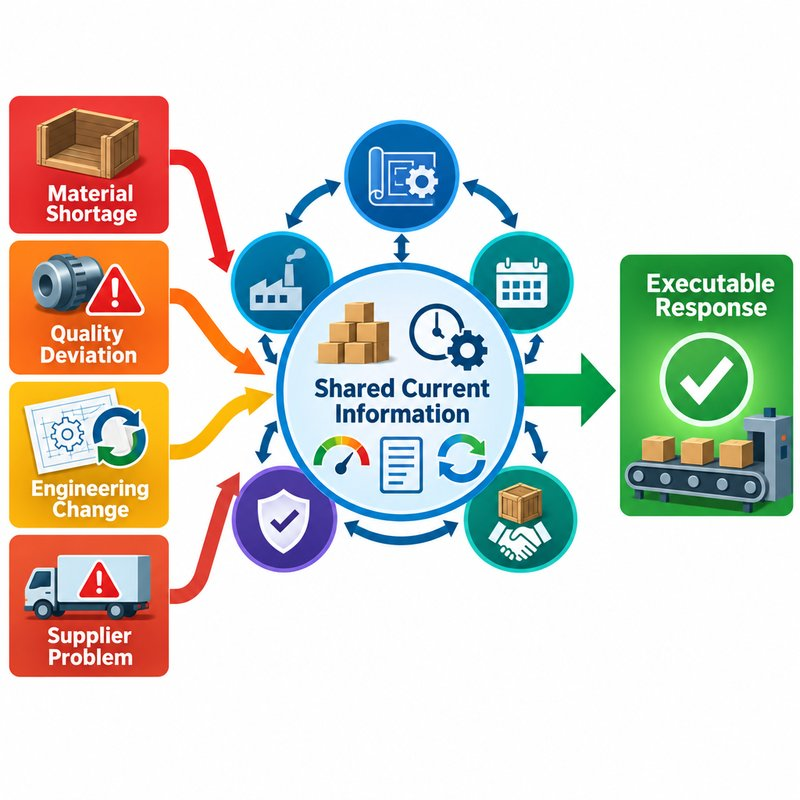
An integrated information view, as covered in Lesson 6.2, becomes most valuable when normal operations break down. A material shortage, quality deviation, engineering change, or supplier problem can affect several parts of the production flow at once. The response therefore cannot remain within one function. Engineering, planning, procurement, quality, and production need current information, coordinated decisions, and a clear pathway for acting on those decisions. This lesson examines how those elements replace informal improvisation during disruption.
Four Disruptions That Require Coordinated Action
The source identifies four recurring operational disruptions:
- Material shortages
- Quality deviations
- Engineering changes
- Supplier problems
Although each disruption begins differently, all four can interfere with planning, material availability, production capacity, or execution.
Material Shortages
A material shortage means that required material is not available when the production flow needs it. Responding effectively requires more than confirming an inventory figure. The team needs current visibility into:
-
Actual material availability
-
Lead times for critical components
-
The affected orders
-
Available production capacity
-
Related engineering changes
These information elements must be considered together. A shortage may alter the production plan, require procurement action, or change which work production can perform with the available material and capacity.
Quality Deviations
A quality deviation is a departure from the expected quality condition. It creates an operational question as well as a quality question: what can proceed, what must stop, and what needs review?
Quality cannot answer those questions in isolation. Engineering may need to interpret the technical implications, planning may need to assess schedule effects, and production needs a reliable decision before continuing. Procurement may also become involved when the deviation concerns supplied material or components.
The essential principle is that production should not depend on an informal interpretation passed through disconnected messages. The deviation and its status must be visible to the functions responsible for evaluating and acting on it.
Engineering Changes
Engineering changes continuously disturb established production and supply plans. During a disruption, the team needs the current status of the engineering change, not merely evidence that a change exists.
The operational response depends on how that change relates to:
-
Materials already available
-
Critical-component lead times
-
Existing orders
-
Current production capacity
-
Work already underway
This is why engineering-change information must connect with planning, procurement, and production information. If functions work from different change statuses, their decisions can conflict even when each function is acting reasonably from its own records.
Supplier Problems
A supplier problem can affect component lead times and material availability, creating consequences for both planning and production. Procurement provides supplier-related information, but the operational response remains cross-functional.
Planning must understand the effect on schedules and orders. Production must know what work remains executable. Engineering may need to consider the technical relationship between the affected component and the product. Quality becomes relevant when the supplier problem concerns conformity or a deviation.
The disruption therefore moves beyond supplier communication. It becomes a shared operational decision requiring a current view of the affected process.
Bringing Five Functions Into the Same Decision
Reliable disruption management depends on coordination among all five functions named in the source.
| Function | Contribution during a disruption |
|---|---|
| Engineering | Provides the status and implications of engineering changes and supports technical interpretation. |
| Planning | Relates the disruption to orders, schedules, material needs, and capacity. |
| Procurement | Provides information about critical components, lead times, and supplier problems. |
| Quality | Evaluates quality deviations and supports decisions about affected materials or production. |
| Production | Identifies the execution impact and acts on the coordinated decision. |
The purpose is not simply to include more people. It is to connect the information each function holds so that the organization can reach one operationally usable decision.
For example, knowing that a critical component has a longer lead time is not enough. The team must also determine which orders depend on it, whether an engineering change alters that dependency, and how production capacity should be used in the meantime. The disruption becomes manageable only when these connected facts are considered together.
From Informal Improvisation to a Defined Response Pathway
Fragmented information across ERP, PLM, MES, Excel lists, and email creates a serious weakness during disruption. Teams must first reconcile conflicting or incomplete records before they can decide what to do. Manual coordination then adds delay between consecutive process stages, as covered in Lesson 2.1.
A defined response pathway replaces improvised coordination with a reliable route from disruption recognition to cross-functional action. Based on the source, that pathway must support three essential conditions:
Current Operational Information
The response must use the current state of:
-
Material availability
-
Critical-component lead times
-
Capacity utilization
-
Orders
-
Engineering changes
Outdated information can direct one function toward an action that no longer fits the operational situation.
Cross-Functional Interpretation
The same disruption has different implications for different functions. A supplier problem may appear as a lead-time issue to procurement, a scheduling issue to planning, and an execution constraint to production. The response pathway must bring those interpretations together rather than allowing each function to act separately.
A Decision That Can Be Executed
Discussion alone does not resolve a disruption. The resulting decision must give production and the supporting functions a consistent basis for action. Engineering, planning, procurement, quality, and production should not leave the response with different understandings of the disruption’s status.
Reliable information and a defined pathway are therefore complementary. Information provides the facts; the pathway ensures that the appropriate functions use those facts together.
What Effective Disruption Management Achieves
Operational disruption management connects four elements: the disruption itself, current operational information, the five responsible functions, and an executable response. Material shortages, quality deviations, engineering changes, and supplier problems should not trigger isolated decisions or ad hoc exchanges through spreadsheets and email. They should activate a defined cross-functional pathway based on shared information about materials, lead times, capacity, orders, and change status.
Test a Disruption Response
1. Map a Material-Shortage Decision
A critical component is unavailable when production expects it.
Create a response map that identifies:
-
What engineering must clarify
-
What planning must assess
-
What procurement must confirm
-
What quality may need to evaluate
-
What production needs before acting
For each function, connect its contribution to at least one of these information elements: material availability, component lead time, capacity, order status, or engineering-change status.
2. Analyze a Combined Disruption
A supplier reports a problem with a critical component while an engineering change affecting that component is still in progress.
Answer the following:
- Which of the four disruption categories are present?
- Why would procurement information alone be insufficient?
- Which current information must be shared across functions?
- Where could conflicting change-status records lead to inconsistent action?
- What must be clear before production proceeds?
3. Compare Improvisation With a Defined Pathway
Choose one disruption: a material shortage, quality deviation, engineering change, or supplier problem. Build a two-column comparison:
-
Informal improvisation: messages, individual follow-up, disconnected records, and separate functional decisions
-
Defined response pathway: shared current information, participation by the relevant functions, and one executable decision
Conclude by identifying the point at which the defined pathway most directly reduces operational uncertainty.