

Critical Operational Information
- View
What must be known before a production or supply chain team can make a sound decision today? The source identifies a compact but critical set of operational information: current material availability, lead times for critical components, capacity utilization, order status, and the status of engineering changes. These are not isolated data points. Together, they show whether materials, production resources, customer or production requirements, and engineering definitions are aligned. This lesson examines what each information category reveals and why the different operational roles need a shared, current view.
The Five Information Categories Needed Each Day
1. Current Material Availability
Current material availability indicates whether the materials and components required for production are available now. The word current is essential: an earlier record may no longer represent the actual operational situation.
This information matters across roles:
-
A Technical Component Buyer needs it to understand the immediate material position.
-
An Operational Planner needs it when evaluating whether planned work is supportable.
-
A Manufacturing Process Engineer needs it in relation to work moving toward assembly.
-
A Quality & Compliance Engineer needs visibility into the materials connected to operational work.
-
A Supply Chain Manager needs an overall view of availability across the production and supply chain process.
Material availability answers one question, but not every supply question. A component that is unavailable today may be expected later. That makes lead-time information the necessary next layer.
2. Lead Times for Critical Components
A lead time indicates how long it takes for a required component to become available. The source gives particular attention to the lead times of critical components—components whose timing is important to continued production and supply chain execution.
Material availability and critical-component lead time must be considered together:
-
Availability shows the present condition.
-
Lead time shows the timing of future availability.
Knowing only that a component is missing does not show how long the constraint may continue. Conversely, knowing a normal lead time does not establish whether usable material is currently available. Daily decisions therefore require both pieces of information.
For the Technical Component Buyer, critical-component lead times are directly connected to the purchasing perspective. For planners, engineers, quality personnel, and supply chain managers, the same information helps establish whether the wider process can proceed as expected.
3. Production Capacity and Capacity Utilization
Production capacity concerns the production resources available to perform work. Capacity utilization shows how much of that capacity is already occupied.
This category adds a different constraint to the operational picture. Material availability alone does not establish that assembly or production can take place. The team must also know whether the necessary capacity is available or already committed.
Capacity information is particularly relevant to daily coordination because it connects planned work to actual production conditions. An Operational Planner may view it from a planning perspective, while a Manufacturing Process Engineer views it in relation to execution. A Supply Chain Manager needs it as part of the broader end-to-end picture. Although their perspectives differ, they depend on the same current capacity condition.
4. Order Status
Order status indicates where an order currently stands. It provides a reference point for determining which work is pending, progressing, or otherwise requires attention.
Order status gains operational meaning when combined with the other information categories. For example, an order may have a defined status, but the team must still relate that status to:
-
current material availability;
-
lead times for critical components;
-
available or utilized capacity; and
-
relevant engineering changes.
A status viewed by itself cannot show whether every condition supporting the order is aligned. The source therefore points toward a connected operational view rather than a collection of separate updates.
5. Engineering-Change Status
The status of engineering changes shows whether a change is active and where it stands. This differs from merely knowing that an engineering change exists. Daily decision-making depends on knowing its current status.
As covered in Lesson 2.1, engineering changes and replanning can disrupt lead time. The information requirement here is more specific: each role needs current visibility into the change itself so that operational decisions are based on the relevant engineering condition.
Engineering-change status connects engineering information to planning, procurement, and assembly. Without that connection, one part of the organization may act on a different understanding of the product or process than another part.
Reading the Information as One Operational Picture
The five categories should not be treated as independent reports. They describe different dimensions of the same operating condition:
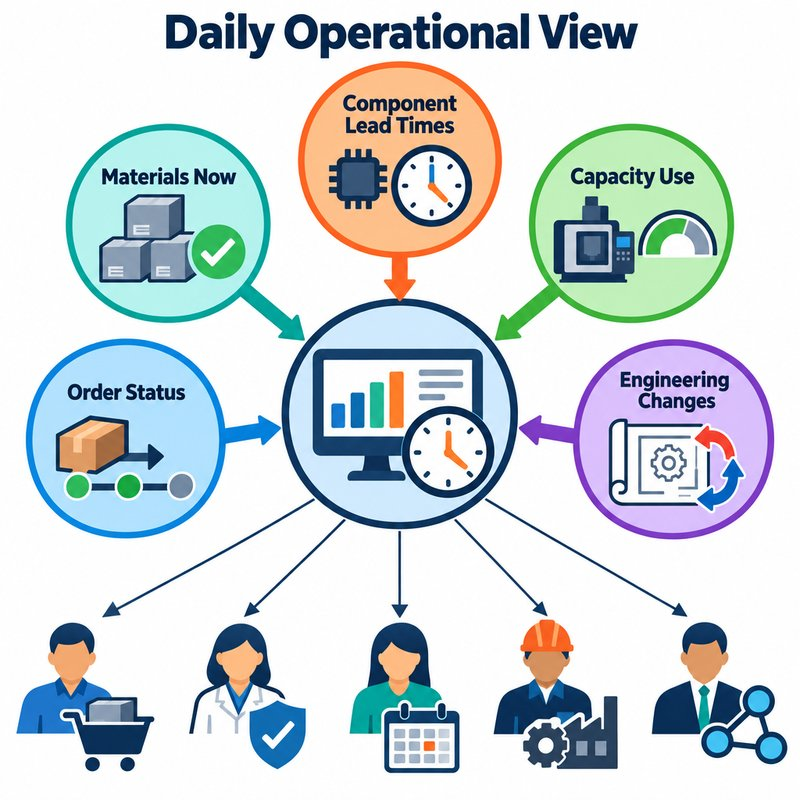
| Information category | What it reveals |
|---|---|
| Current material availability | Whether required material is available now |
| Critical-component lead times | When important components may become available |
| Production capacity or capacity utilization | Whether production resources are available or already occupied |
| Order status | Where the relevant order currently stands |
| Engineering-change status | The current condition of a change affecting the work |
A team may know that material is available but still lack capacity. It may have capacity but be waiting for a critical component. Material and capacity may both appear ready while an engineering change remains unresolved. The order status must therefore be interpreted against all the other operational conditions.
The source also emphasizes the need for this information daily. A static or occasional picture is not enough for decisions made under changing conditions. The required view must reflect the current state of materials, component timing, capacity, orders, and engineering changes.
Shared Information, Different Role Decisions
All five roles named in the source require the same core information, but they approach it from different operational positions.
-
The Technical Component Buyer focuses on the component and supply perspective.
-
The Quality & Compliance Engineer evaluates the information from a quality and compliance position.
-
The Operational Planner relates current conditions to planning.
-
The Manufacturing Process Engineer relates them to production and assembly execution.
-
The Supply Chain Manager considers their combined effect across the supply chain.
This creates an important distinction: shared information does not eliminate role-specific responsibility. Instead, it gives each role a common operational basis for its own decisions. If the roles use different or differently timed views, their decisions may no longer align—even though they concern the same production flow.
The Essential Operational View
Critical operational visibility is built from five connected elements: materials available now, lead times for critical components, capacity conditions, order status, and engineering-change status. Each answers a different question, and none provides a complete view alone. Daily decisions become better aligned when buyers, quality and compliance engineers, planners, process engineers, and supply chain managers work from the same current operational picture.
Build and Test the Daily Information View
1. Complete the Operational Picture
Consider this partial situation:
-
A required critical component is not currently available.
-
Production capacity is available.
-
The order has an active status.
Answer the following:
- Which two critical information categories are still missing?
- Why is available capacity not enough to determine whether work can proceed?
- What additional timing information would the team need about the missing component?
2. Compare Two Role Perspectives
Choose two of the following roles:
-
Technical Component Buyer
-
Quality & Compliance Engineer
-
Operational Planner
-
Manufacturing Process Engineer
-
Supply Chain Manager
For each role, explain how it would use:
- current material availability;
- capacity utilization; and
- engineering-change status.
Then identify why both roles must receive a consistent view even though their responsibilities differ.
3. Diagnose an Incomplete Daily Update
A team receives the following update:
“All required material is currently available, and the order is progressing.”
Analyze the update by answering:
- Which of the five critical information categories are included?
- Which categories are absent?
- What could the team still not determine from this update?
- Rewrite the update as a checklist that requests all five categories without assuming any particular outcome.