

Knowledge Loss and Workforce Transition
- View
The true cost of individual dependency becomes visible when the experienced colleague is no longer available. A process that previously appeared stable may slow or stop because the knowledge needed to continue it was never made accessible to others. This lesson examines two connected workforce-transition risks: process interruption when expertise becomes unavailable and extended onboarding when new employees must reconstruct undocumented knowledge. It then considers how searchable knowledge supports operational continuity without assuming that access to experienced employees will always be possible.
When Employee Availability Becomes a Process Risk
As covered in Lesson 5.1, some manufacturing knowledge remains concentrated among experienced colleagues because they have performed the work for years. The workforce-transition issue begins when the organization depends on the continued availability of those individuals.
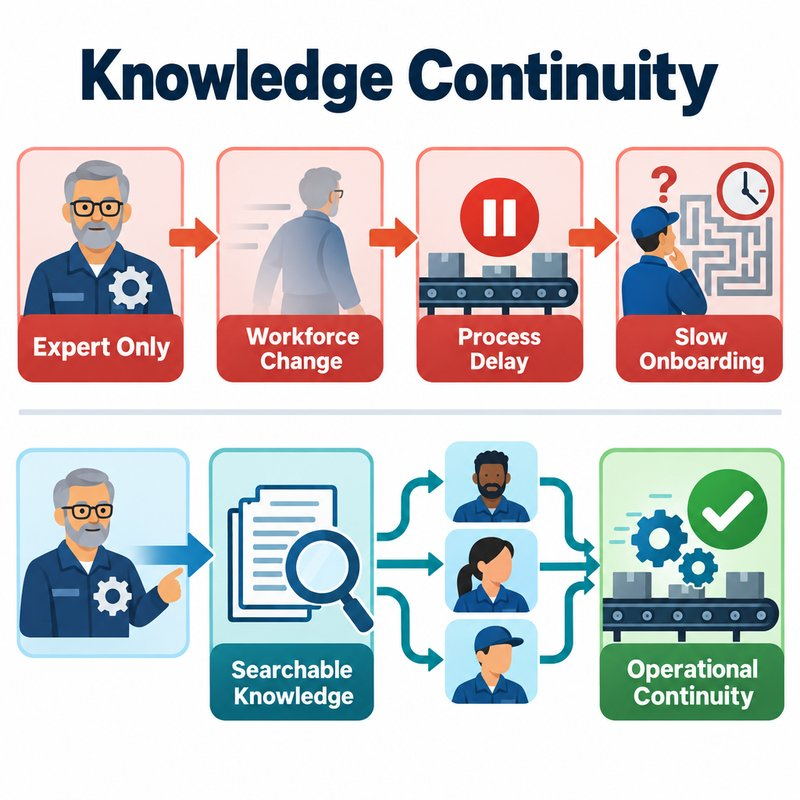
If an experienced employee becomes unavailable, the organization may lose practical access to what that person knows. The knowledge has not necessarily disappeared permanently, but it is no longer available at the point where the process requires it. This creates a direct connection between a staffing change and process performance.
The resulting interruption can be understood as a simple dependency chain:
- A process requires expertise held by an experienced employee.
- That expertise has not been made accessible to other employees.
- The experienced employee becomes unavailable.
- The team cannot confidently perform the knowledge-dependent work.
- The process slows, pauses, or requires additional investigation before it can continue.
The critical issue is therefore not employee absence by itself. Employees will inevitably change roles or become unavailable. The operational weakness is that essential knowledge cannot be reached independently of the person who holds it.
Availability Is Not the Same as Continuity
A process may function reliably for years while the knowledgeable employee remains present. That apparent reliability can conceal a fragile knowledge architecture. Continuity has not been secured if the process works only when a particular colleague can be consulted.
This distinction matters:
-
Employee availability means the expert can currently provide an answer or perform the work.
-
Operational continuity means the process can continue even when that expert is unavailable.
Organizations that rely on the first condition may mistake repeated expert intervention for a stable process. In reality, the employee is acting as the access point to essential knowledge.
Why Undocumented Expertise Extends Onboarding
Workforce transition also affects employees entering a role. When expertise is undocumented, onboarding requires more than learning the visible process. A new employee must also discover knowledge that is held by experienced colleagues rather than made directly accessible.
This extends onboarding because the newcomer cannot independently search for and retrieve what is needed. Learning depends on opportunities to ask the right person, observe how work is performed, and gradually accumulate understanding. If the relevant expert is unavailable, the transfer slows further.
The resulting pattern is circular:
-
Experienced employees hold essential knowledge.
-
New employees depend on those employees to learn the work.
-
Knowledge transfer occurs through individual contact rather than accessible organizational knowledge.
-
The new employees require longer before they can operate independently.
-
The organization continues to depend on the same experienced employees.
This creates pressure on both sides of the transition. New employees take longer to become self-sufficient, while experienced employees remain necessary for routine explanation and support. Their expertise is used repeatedly, but it is not necessarily converted into something that the wider team can retrieve.
Onboarding as a Test of Knowledge Accessibility
A workforce transition reveals whether knowledge belongs functionally to the organization or remains attached to particular individuals. If a new employee can access the knowledge required to understand and continue the process, the transition is less dependent on personal availability. If the employee must repeatedly locate specific experienced colleagues, individual dependency remains.
The length and difficulty of onboarding can therefore indicate a knowledge-access problem. Extended onboarding is not only a training concern; it can show that expertise has not been organized for reuse.
Searchable Knowledge and Operational Continuity
The source points toward searchable knowledge as the connection between expertise and continuity. Searchability means that employees can locate the knowledge required for their work instead of depending entirely on knowing whom to ask.
Searchable knowledge supports continuity in three related situations:
During an Unexpected Absence
When an experienced employee is unavailable, other team members can retrieve relevant knowledge and continue the process rather than waiting for the individual to return.
During a Role Change or Departure
When responsibilities move from one employee to another, accessible knowledge reduces the amount that must be reconstructed through memory or person-to-person explanation.
During Onboarding
A new employee can search for required knowledge as questions arise. Experienced colleagues may still provide guidance, but they are no longer the only route to the information.
Searchability does not eliminate the value of experience. Instead, it changes how the organization benefits from that experience. Knowledge that can be found and reused is less vulnerable to workforce changes than knowledge available only through a particular person.
The central relationship is:
Accessible, searchable knowledge reduces dependence on individual availability and supports continued operation during workforce transitions.
The excerpt does not specify a documentation system, capture procedure, or technical tool. The essential requirement is therefore not a particular platform. It is that important expertise becomes searchable and usable beyond the employee who originally developed it.
Reading the Transition Risk
| Condition | Workforce-transition effect | Operational implication |
|---|---|---|
| Expertise is available only through experienced colleagues | Their absence removes access to needed knowledge | The process may slow or stop |
| Expertise is undocumented | New employees must reconstruct knowledge through others | Onboarding takes longer |
| Knowledge is searchable | Employees can locate what they need without relying on one person | Continuity is less vulnerable to staffing changes |
| Several employees can access required knowledge | Responsibility can transfer more readily | Individual dependency is reduced |
A resilient process is not defined by never losing experienced employees. It is defined by remaining operable when employee availability changes.
Examine Your Workforce-Transition Exposure
1. Analyze an Expert-Unavailability Scenario
Choose a process that currently relies on an experienced employee.
-
Identify the point at which that employee’s knowledge is required.
-
Assume the employee becomes unavailable without warning.
-
Describe what the team could continue without assistance.
-
Identify where the process would slow or stop.
-
State what knowledge would need to be searchable to preserve continuity.
Keep the analysis focused on knowledge access rather than the reason for the employee’s absence.
2. Trace an Onboarding Dependency
Consider a new employee entering a knowledge-dependent role.
Create two columns:
-
Can learn from accessible knowledge
-
Must learn from an experienced colleague
Place each required area of knowledge into one of the columns. Then answer:
- Which items are likely to extend onboarding?
- Which experienced employees become necessary access points?
- What happens if those employees are unavailable during the transition?
- Which knowledge should become searchable first?
3. Compare Presence With Continuity
Evaluate the claim: “The process is stable because our experienced people know how to handle it.”
Write a short response that distinguishes current expert availability from true operational continuity. Include:
-
the individual dependency hidden in the claim;
-
the likely effect of workforce transition;
-
the onboarding consequence; and
-
the role of searchable knowledge in reducing the risk.