

Scarcity, Forecast Changes, and Supplier Response
- View
Scarcity changes the cost of a late message. When a component is readily available, a delayed forecast update may remain manageable. When that component is scarce, the same delay can leave procurement and production reacting after the opportunity to respond has already narrowed. The source describes this condition directly: forecasts are shared, but changes are communicated too late, causing teams to remain behind events. This lesson examines the chain from late forecast changes to supplier-response problems, production disruption, escalation, and emergency orders.
Why a Shared Forecast Is Not Enough
A forecast gives a supplier an expected view of future demand. Sharing it is important, but the original forecast does not remain sufficient when demand changes. The supplier also needs the change to reach it in time to influence its response.
This creates a critical distinction:
-
Forecast sharing communicates an expected requirement.
-
Forecast-change communication communicates that the expected requirement is no longer current.
Lesson 4.1 examined the portals, email, and telephone used in supplier communication. The concern here is not the channels themselves. It is what happens when a revised requirement moves through those channels too late.
If the supplier continues acting on an earlier forecast, internal planning and procurement may believe that the changed requirement is being addressed when it is not. By the time the mismatch becomes visible, the organization is already behind the facts: its decisions are based on a view that no longer reflects current demand.
Scarcity Makes Delay Operationally Significant
A scarce component is a component for which availability is constrained. Under this condition, timing becomes especially important. A forecast change that arrives late affects the ability to make decisions about the constrained supply.
The pattern in the source can be expressed as a sequence:
- A forecast is shared with a supplier.
- The forecast changes.
- The change is communicated too late.
- Decisions concerning scarce components are delayed.
- Procurement and production must react after the situation has already developed.
The important point is that scarcity and communication delay reinforce each other. Scarcity makes component decisions more sensitive to timing, while late communication reduces the time available for an effective supplier response.
The result is not merely an inaccurate forecast record. The delay can threaten production continuity—the ability to keep production operating without interruption caused by missing components.
Disconnected Records Obscure the Current Requirement
Supplier-related information may be distributed across systems, files, and people. This creates a practical problem when a forecast changes: different participants may not be working from the same version of the requirement.
For example, the original forecast may exist in one location while a later change is held in another file or communicated by an individual. The lesson is not simply that information is fragmented; that broader architecture problem was covered in Section 3. Here, the specific issue is how disconnected supplier records interfere with a timely response to scarcity.
To determine whether a scarce-component decision is based on current information, the organization must be able to connect:
-
the forecast originally shared;
-
the latest forecast change;
-
the supplier-facing update;
-
the current material situation; and
-
the effect on procurement and production.
When these elements remain separated, the status of the change becomes difficult to establish. A team may know that the forecast changed without knowing whether the supplier received the revision. Alternatively, the supplier may have received some information, but internal procurement or production personnel may still be using an older record.
The result is a gap between the current requirement and the requirement being acted upon.
From Late Change to Production Disruption
The source links these information delays to concrete operational consequences. If the component situation is not addressed in time, a line outage can occur: production can no longer continue because the required material is unavailable.
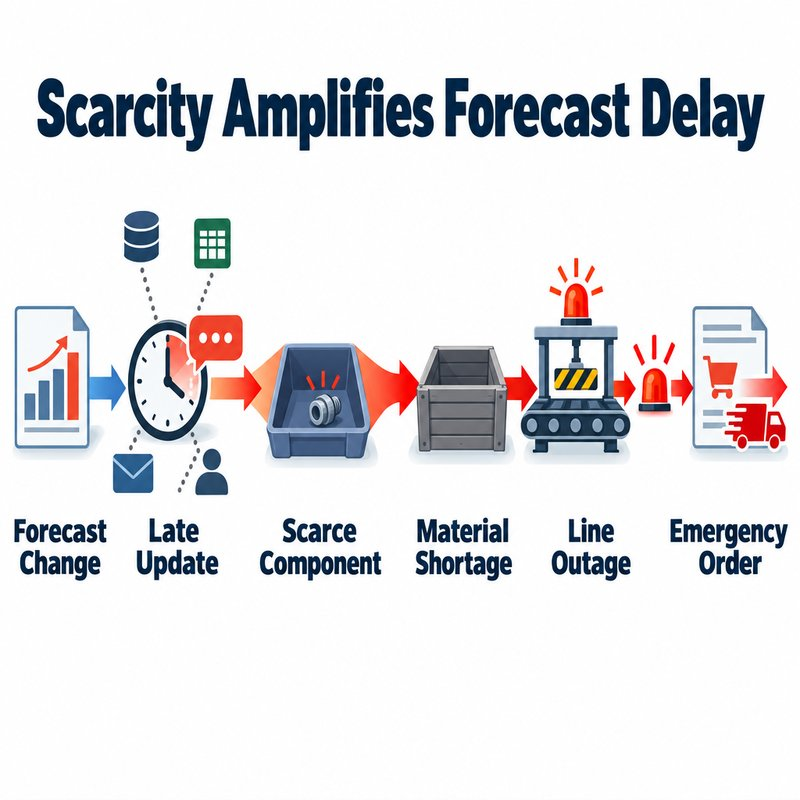
That interruption then produces a further response chain:
Late forecast change
→ delayed scarce-component decision
→ insufficient or unavailable material
→ line outage
→ production escalation
→ emergency supplier order
An escalation from production occurs when the material problem becomes urgent enough to require immediate attention beyond normal coordination. At that stage, the organization is no longer managing the change proactively. It is responding to an active threat or interruption.
An emergency order is similarly reactive. It is generated because the ordinary flow of forecast communication, procurement, and supply response has not protected production continuity. The source therefore presents emergency action not as an isolated purchasing event, but as a downstream consequence of late or disconnected information.
Evaluating Supplier Response Through Timing
A supplier response cannot be judged only by whether communication eventually occurred. The timing of that communication matters.
Consider three distinct states:
| State | What has happened | Operational position |
|---|---|---|
| Forecast shared | The supplier has received the original expected demand | Initial alignment exists |
| Forecast changed but not propagated promptly | The internal requirement has changed, but the supplier may still be acting on the earlier view | Scarce-component decisions are at risk |
| Consequences become visible | Material is insufficient or unavailable, creating production interruption, escalation, or an emergency order | The organization is reacting after the fact |
This progression explains the phrase “behind the facts.” The team is not necessarily missing every piece of information. Instead, the needed information reaches the decision point after it could have supported a timely response.
The operational question is therefore not just:
Was the forecast shared?
It is:
Did the latest change reach the supplier and the relevant internal teams before scarcity affected production?
The Scarcity–Response Pattern
The central relationship is straightforward: a forecast provides value only while it reflects the requirement being acted upon. Once that requirement changes, delayed propagation can make the earlier forecast operationally misleading. Scarce components amplify the effect because procurement, suppliers, and production have less room to absorb delay.
The full pattern is:
| Condition | Immediate effect | Downstream consequence |
|---|---|---|
| Forecast changes arrive late | Supplier and internal decisions may rely on an outdated requirement | Teams fall behind events |
| Records are disconnected across systems, files, and people | The current change and its communication status are difficult to establish | Response is delayed or uncertain |
| Scarce material is not secured in time | Production lacks a required component | Line outage |
| The shortage reaches production | Normal coordination becomes insufficient | Escalations and emergency supplier orders |
Diagnose the Response Gap
1. Trace a Late Forecast Change
Use the following scenario:
A forecast has been shared. Demand then changes, but the revision reaches the supplier late. The affected component is scarce, and production later reports that the material will not be available when needed.
Answer:
- Which event made the original forecast insufficient?
- At what point did the situation become a supplier-response problem?
- Why does component scarcity increase the importance of the delay?
- What operational consequences identified in the source could follow?
2. Identify the Current Requirement
Suppose the following pieces of information exist separately:
-
an original forecast in a system;
-
a revised quantity in a file;
-
an employee who knows that the requirement changed;
-
a supplier record that still reflects the original forecast.
Analyze the situation:
- Which requirement is current?
- Which requirement appears to be guiding the supplier?
- What uncertainty exists for procurement?
- Explain how this separation can threaten production continuity without assuming that any individual record is necessarily incorrect.
3. Work Backward From an Emergency Order
A scarce component is unavailable, production escalates the shortage, and procurement places an emergency supplier order.
Work backward through the chain and identify:
- the immediate production problem;
- the material condition behind it;
- the supplier-decision problem that may have preceded it;
- the forecast-communication failure described in the source; and
- the records across systems, files, or people that would need to be connected to understand what happened.