

Tacit Manufacturing Knowledge
- View
A manufacturing process may appear to be defined by systems and records, yet essential operating knowledge can still reside mainly with experienced engineers. They know which process settings work, how particular suppliers must be handled, and how deviations are addressed in practice. This is tacit manufacturing knowledge: operational know-how held by individuals rather than made broadly accessible to the organization. This lesson examines its main forms and the dependency created when production relies on a small number of experts.
What Experienced Engineers Know but Systems May Not Show
Earlier lessons examined operational information distributed across systems, spreadsheets, email, and individuals. Tacit knowledge is the specifically human part of that fragmented architecture. It consists of practical knowledge that experienced employees use to make the process work but that is not necessarily available in a shared, searchable form.
In the semiconductor-equipment environment described in the source, a Manufacturing Process Engineer reports that critical process knowledge is held by experienced people. Three forms are especially important:
- Process settings known primarily by experienced engineers
- Supplier-specific practices
- Informal approaches to deviations
These forms of knowledge influence work across the flow from engineering and forecasting to planning, procurement, and assembly. They are not simply background expertise. They can determine how work is performed when formal records do not provide a complete answer.
Process Settings
Process settings are the operating choices or parameters required to run a manufacturing process. The important issue here is not the settings themselves, but where knowledge of them resides.
When settings are known mainly by experienced engineers, the organization depends on those engineers to interpret and apply them. Other employees may have access to the formal process, but they may not know the practical settings that experienced personnel use. The process therefore contains an invisible knowledge layer: the documented workflow shows what should happen, while the expert knows how to make it happen in practice.
This creates a difference between:
-
having access to a process description; and
-
possessing the experience needed to operate the process effectively.
Tacit knowledge becomes operationally significant whenever the second is required but the first is all that is widely available.
Supplier-Specific Practices
Some knowledge concerns how work is coordinated with a particular supplier. These supplier-specific practices are not general rules that can automatically be applied to every external partner. They are ways of working associated with an individual supplier.
This may leave important knowledge concentrated in the employees who have direct experience with that relationship. The organization can therefore know which supplier is involved without necessarily sharing the practical knowledge needed to work with that supplier.
This is distinct from the communication-channel problems covered in Lessons 4.1 and 4.2. The issue here is not whether information moves through a portal, email, or telephone. It is whether the organization has retained the human know-how needed to interpret and manage the supplier relationship.
Informal Approaches to Deviations
A deviation is a situation in which actual conditions do not follow the expected process or requirement. Experienced employees may know how similar deviations have been handled, even when that response has not been captured as a formal organizational approach.
These informal approaches allow work to continue, but they also place decision-making knowledge inside individual experience. Two employees may have access to the same formal information while only one knows the established practical response.
Informal handling is therefore not the same as shared organizational knowledge. If an approach remains in one person’s memory, colleagues cannot reliably retrieve, evaluate, or reuse it.
From Expertise to Individual Dependency
Experience is valuable, but the source identifies a vulnerability when the process depends on a particular person. If that person is absent or leaves, the process can stall. This reveals that the organization has not fully converted individual expertise into accessible organizational knowledge.
The dependency can be represented as a simple chain:
Knowledge held by one expert → colleagues must consult that expert → work depends on the expert’s availability
This dependency may remain hidden during normal operations. As long as the experienced engineer is available, questions are answered and exceptions are handled. The process appears to function. The underlying weakness becomes visible only when others must proceed without that person.
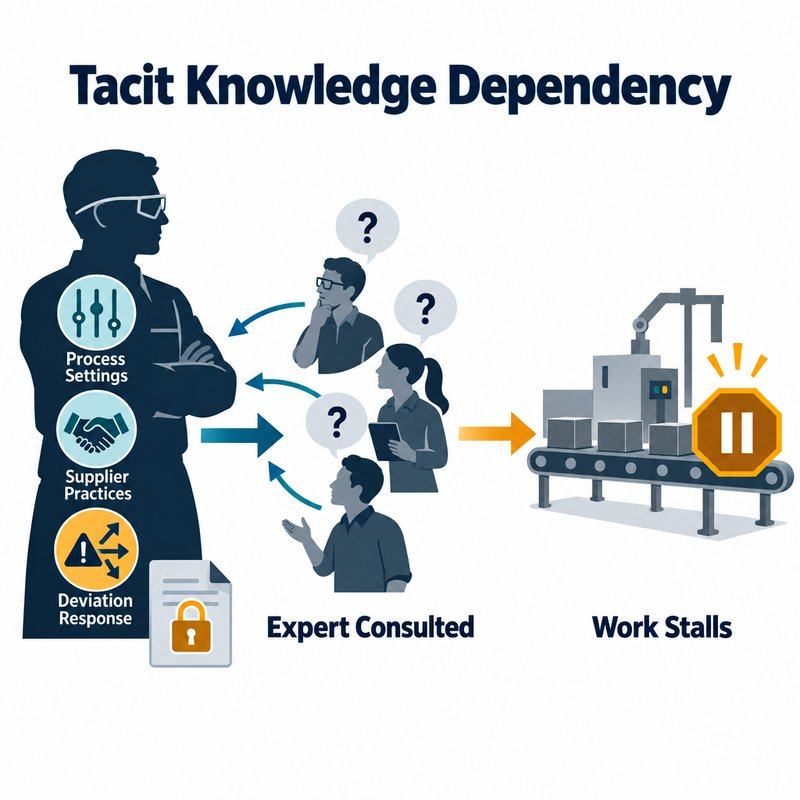
Not all employee expertise creates the same level of dependence. The risk is greatest when the knowledge is:
-
necessary for carrying out the process;
-
known mainly by one or a few experienced employees;
-
unavailable in shared or searchable form; and
-
required when a setting, supplier practice, or deviation must be interpreted.
The central distinction is therefore between individual knowledge and organizationally accessible knowledge. Individual knowledge belongs to the person who has learned it. Organizationally accessible knowledge can be found and used by the wider production and supply chain team.
The consequences of employee unavailability and the extended onboarding of new personnel are addressed directly in Lesson 5.2. For this lesson, the essential point is the architecture of the dependency: operational capability rests on knowledge that the organization cannot readily access without its holder.
Recognizing the Tacit Knowledge Pattern
| Form of tacit knowledge | What the expert contributes | Resulting dependency |
|---|---|---|
| Process settings | Knows the practical settings needed to run the process | Others depend on the experienced engineer to apply or explain them |
| Supplier-specific practices | Knows how work is handled with a particular supplier | Supplier coordination depends on employees with relationship experience |
| Informal approaches to deviations | Knows how exceptions have been handled in practice | Deviation response depends on personal memory and availability |
Tacit manufacturing knowledge is not merely information that happens to be undocumented. It is practical knowledge used to operate processes, manage supplier-specific work, and respond to deviations. The organizational weakness arises when this knowledge is concentrated in individual experts and cannot be independently located or used by the wider team.
Locate the Knowledge Behind the Process
1. Separate the Formal Process From Expert Know-How
Choose one manufacturing process described by a formal workflow or record. Create two columns:
-
What the formal process makes available
-
What an experienced engineer must still know
Classify each expert contribution as a process setting, a supplier-specific practice, or an informal approach to a deviation.
2. Analyze an Expert-Absence Scenario
Consider a process whose settings are known primarily by one experienced engineer. That engineer is unavailable when a deviation occurs.
Answer the following:
- What knowledge can the team obtain without the engineer?
- What knowledge remains inaccessible?
- At what point does the work become dependent on the engineer?
- Is the missing knowledge about a process setting, supplier practice, deviation response, or more than one of these?
3. Map One Individual Dependency
Identify one operational question that colleagues routinely direct to a particular expert. Trace the dependency using this structure:
Operational question → knowledge required → current knowledge holder → people who need it → point where work could stall
Then determine whether the required knowledge is individually held or organizationally accessible.