

Building an Integrated Information View
- View
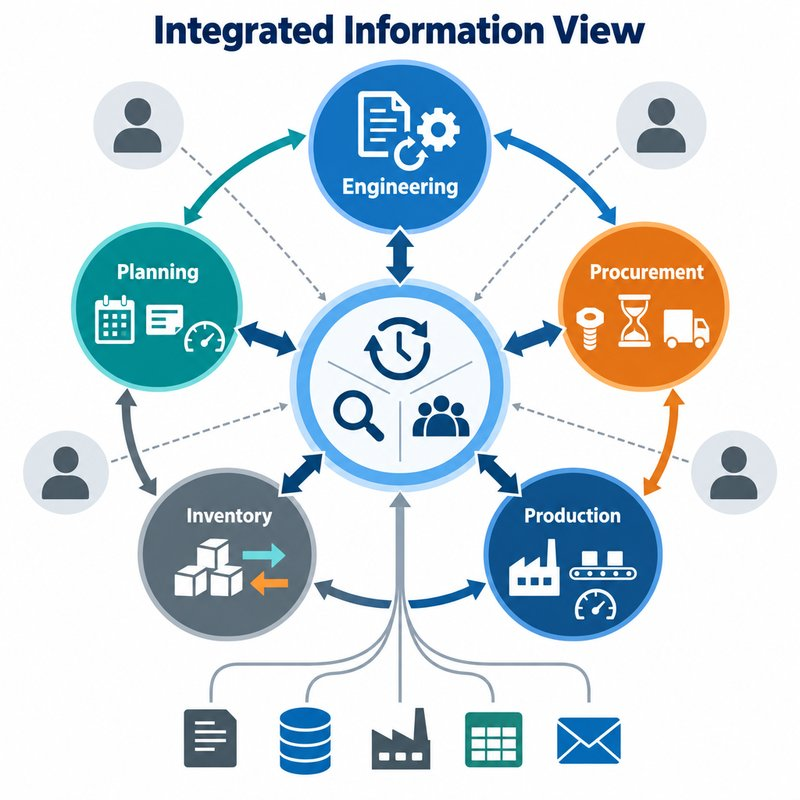
Suppose a planner needs to revise the production plan after an engineering change. The relevant engineering details are in PLM, material records are in ERP, production information is in MES, supplemental updates appear in Excel, and the latest explanation remains in someone’s mailbox. Each source may contain part of the answer, but no participant can readily see the whole operational picture. An integrated information view addresses this gap by giving the production and supply chain team unified, searchable access to current engineering, planning, procurement, and production information.
From Separate Records to One Operational Picture
Earlier lessons examined fragmented systems and the absence of a single source of truth. The focus now shifts from diagnosing those conditions to defining the information view required for coordinated daily decisions.
The source describes operational information distributed across:
-
ERP
-
PLM
-
MES
-
Excel lists
-
Knowledge stored in mailboxes
These sources support different parts of a process that runs from engineering and forecasting through planning, procurement, and assembly. The operational problem is therefore not simply that several systems exist. It is that people must manually combine their contents before they can understand the current situation.
An integrated information view connects the information needed across this flow. It allows the team to examine related engineering, material, supplier, planning, and production conditions as one decision context rather than as isolated records.
Integration does not mean treating every piece of information as interchangeable. Instead, it means making related information accessible together so that a user can determine:
- What has changed?
- Which materials and orders are affected?
- What procurement constraints apply?
- What production capacity is available?
- What is the current status across the process?
This shared context is essential because engineering, planning, procurement, and production decisions depend on one another.
Connecting Four Information Domains
Engineering information
Engineering information includes the current status of engineering changes. A change can alter what must be purchased, planned, released, or assembled. Consequently, its status must be visible beyond the engineering function.
In an integrated view, engineering-change information is connected to the operational areas that use it. This helps the team distinguish between information that reflects the current engineering situation and information that may no longer be valid.
The lesson is not merely to provide access to an engineering-change record. The change must be visible within the wider production and supply chain picture.
Planning information
Planning decisions require a current view of:
-
Material availability
-
Capacity utilization
-
Order status
-
Engineering-change status
These elements cannot be assessed reliably in isolation. Available capacity, for example, does not by itself show whether the required materials are available or whether an engineering change affects the planned work.
An integrated view places these dependencies together. The planner can then evaluate the plan against current material, capacity, order, and change conditions rather than reconstructing that picture through separate searches and inquiries.
Procurement information
Procurement needs current material availability and the lead times of critical components. Lead-time information establishes when a needed component can be supplied, while material information establishes what is already available or moving through the operation.
When procurement information is disconnected from engineering and planning information, a component lead time may be known without sufficient visibility into the order, plan, or engineering change that makes it important. Integration gives the lead time operational meaning by placing it alongside the conditions driving demand.
Production information
Production information includes current capacity conditions and the status of work moving toward or through assembly. MES contributes to this operational picture, but MES information alone does not provide the full context. Production must also be viewed in relation to the approved engineering information, material position, procurement lead times, and current plan.
Bringing these domains together supports the entire production and supply chain team rather than one role or system.
Making the View Current, Searchable, and Shared
An integrated information view has three central qualities.
Current visibility
The team needs real-time visibility into:
-
Engineering changes
-
Lead times
-
Inventory movements
-
Capacity
“Real-time” emphasizes that the view must reflect current operational conditions. A consolidated display of outdated records would still produce an unreliable picture.
Inventory movements are particularly important because material availability is not static. The team must be able to see the current material position as it changes, rather than relying only on an earlier record.
Searchable access
Information must be searchable by the people who need it. Searchable access reduces dependence on knowing:
-
Which spreadsheet contains the relevant entry
-
Which mailbox holds the latest explanation
-
Which colleague knows the current status
-
Which separate system must be checked next
Searchability therefore applies across the connected information, not only within one application. The objective is to let a team member locate relevant operational information without manually reconstructing its storage history.
Team-wide use
The integrated view supports multiple roles, including:
-
Technical component buyers
-
Quality and compliance engineers
-
Operational planners
-
Manufacturing process engineers
-
Supply chain managers
These roles do not necessarily ask identical questions, but they depend on overlapping information. Shared access allows each role to examine the same current operational context from its own responsibility.
This reduces the risk that one function works from a current change status while another works from an older spreadsheet or mailbox update. The view becomes a common basis for decisions across engineering, planning, procurement, and production.
Seeing Relationships, Not Just Data Fields
The value of an integrated view lies in the relationships it reveals. Consider the following chain:
Engineering change → revised material requirement → critical-component lead time → inventory movement → planning adjustment → capacity effect
Each item may originate in a different part of the organization. Viewed separately, the records provide only fragments. Viewed together, they show how one change affects the production and supply chain flow.
The same principle applies when starting from another point:
Capacity condition → affected production plan → required material availability → procurement constraint → relevant engineering status
An integrated view must therefore support movement across related information. A user investigating capacity should be able to reach the associated plan, materials, procurement conditions, and engineering changes. Integration is achieved when the information forms a coherent operational picture rather than a larger collection of disconnected records.
The Integrated View at a Glance
| Information area | Required visibility | Connection to the wider view |
|---|---|---|
| Engineering | Current engineering-change status | Shows whether planning, purchasing, and production are working from current requirements |
| Planning | Material availability, order status, and capacity utilization | Brings operational dependencies into one decision context |
| Procurement | Lead times for critical components | Connects supply constraints to material needs, plans, and changes |
| Production | Capacity and current execution information | Relates production conditions to engineering, materials, and planning |
| Inventory | Current inventory movements | Shows how the material position is changing |
| Shared knowledge | Searchable access for the whole team | Replaces scattered retrieval across spreadsheets, mailboxes, systems, and colleagues |
Design the Information View
1. Build a Decision-Centered View
A production plan may need revision after an engineering change.
Create a compact information-view design that includes all of the following:
-
Engineering-change status
-
Current material availability
-
Lead times for critical components
-
Inventory movements
-
Order status
-
Capacity utilization
For each item, state which decision it supports and which other information item must be viewed alongside it.
2. Analyze the Fragmented Example
Assume the following information is available:
-
The engineering change is recorded in PLM.
-
Material records are held in ERP.
-
Production capacity is visible in MES.
-
A supplemental component list is stored in Excel.
-
The latest order explanation is in a mailbox.
Answer these questions:
- What must be brought together to create a complete operational picture?
- Which relationships between records should be visible?
- What should a planner, buyer, and process engineer each be able to search?
- Why would displaying these sources separately fail to create an integrated view?
3. Test the View Across Roles
Choose one of these roles: technical component buyer, quality and compliance engineer, operational planner, manufacturing process engineer, or supply chain manager.
Then:
- Write one daily operational question that the role must answer.
- Identify the engineering, planning, procurement, production, and inventory information needed.
- Trace how the user should move from one related item to another.
- Check whether the resulting view is current, searchable, and shared across the production and supply chain team.