

The Missing Single Source of Truth
- View
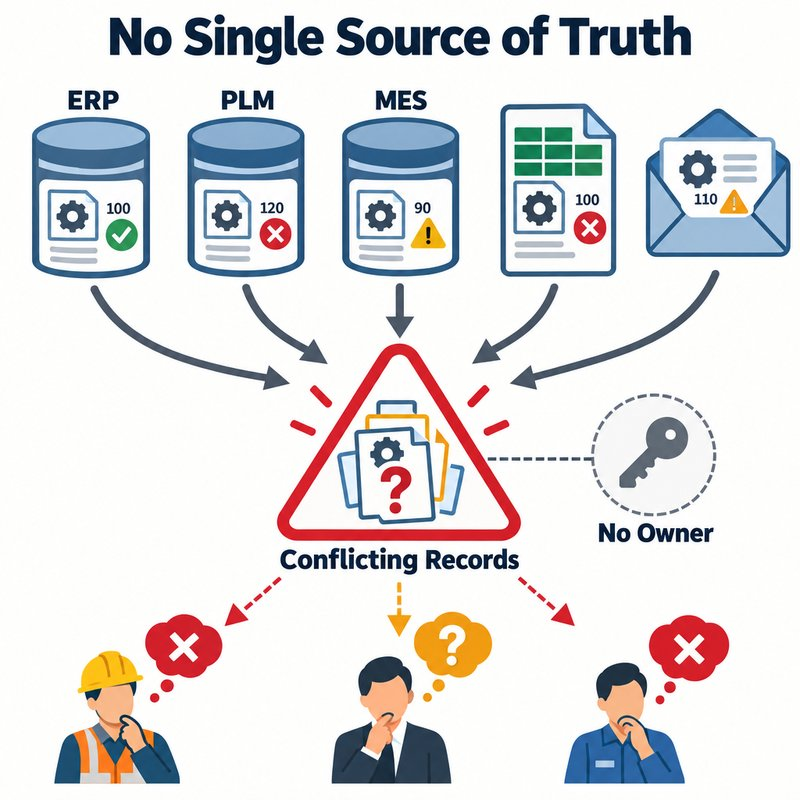
“There is no single source of truth.” This is more than a statement about information being stored in several places. It means that ERP, PLM, MES, Excel lists, and mailbox-held knowledge can present different versions of the same operational reality. When records are duplicated, outdated, or contradictory, employees cannot immediately determine which version should guide action. This lesson examines that deeper problem: data inconsistency across systems and the uncertainty created when ownership of operational information is unclear.
From Multiple Sources to Multiple Truths
Lesson 3.1 examined how information is distributed across ERP, PLM, MES, spreadsheets, mailboxes, and employees. That fragmentation makes people search for information and assemble the operational picture manually.
The missing single source of truth creates a related but distinct problem. Finding all the records does not necessarily resolve the question. The records themselves may disagree.
A single source of truth is an authoritative version of information that people can rely on when making operational decisions. When such a source is missing, several locations may appear equally valid even though they contain different values or statuses.
This creates three recurring record conditions:
-
Duplicate records: The same operational subject is represented in more than one system, file, or message.
-
Outdated records: One location contains information that has not been updated after the operational situation changed.
-
Contradictory records: Two or more sources provide incompatible accounts of the same material, order, capacity position, or engineering change.
These conditions make data inconsistency a daily problem in environments such as Precision Components & Cleanroom Fabrication and High-Tech Modules & Mechatronics, both identified in the source.
How Inconsistency Appears Across the Information Landscape
ERP, PLM, and MES each form part of the information environment. Excel lists and knowledge stored in mailboxes supplement them. The difficulty arises when these locations are not aligned.
Consider an operational record that exists in several places:
- One enterprise system contains a recorded status.
- A spreadsheet contains a separately maintained version.
- An email reports a more recent development.
- Another system still displays an earlier state.
- Employees must decide which version reflects the current situation.
The immediate problem is not simply that the information takes time to find. Even after gathering it, the employee must reconcile competing versions before acting.
This distinction is important:
-
Fragmentation asks: Where is the information?
-
Inconsistency asks: Which version is correct?
-
Missing ownership asks: Who is responsible for deciding and maintaining the authoritative version?
A team can therefore have extensive access to data while still lacking dependable operational truth.
The Operational Cost of Conflicting Records
The source identifies data inconsistency between systems as a daily issue. This affects the same categories of operational information used for planning and execution, including current material availability, critical-component lead times, capacity utilization, order status, and engineering-change status. These categories were introduced in Lesson 2.2; the present issue is whether their recorded values agree.
Suppose a planner needs current material availability and production capacity. If the relevant records disagree, the planner cannot treat the information as decision-ready. Before planning can continue, someone must determine:
-
whether one record is newer than another;
-
whether a spreadsheet has superseded a system entry;
-
whether an email contains an update not yet reflected elsewhere;
-
and which source has authority for the final status.
The same uncertainty affects other roles named in the source:
-
A Technical Component Buyer needs dependable operational information before acting on material and supplier requirements.
-
A Quality & Compliance Engineer must know whether the information being used reflects the current operational condition.
-
An Operational Planner needs consistent material, lead-time, capacity, and status information.
-
A Manufacturing Process Engineer depends on an accurate current view rather than competing records.
-
A Supply Chain Manager needs aligned information across the wider production and supply chain picture.
The issue is shared across roles, even though each role uses the information for different decisions.
Unclear Ownership Keeps Inconsistency Alive
A contradiction between records requires more than a technical comparison. Someone must have the authority and responsibility to determine which value is valid and ensure that the authoritative record is maintained.
When ownership is unclear, employees may respond in different ways:
-
one person trusts the ERP record;
-
another relies on PLM or MES;
-
another uses a locally maintained Excel list;
-
another accepts the latest mailbox update.
Each person may be using an available source, yet the organization still lacks a common basis for action. Local choices can therefore preserve or amplify inconsistency.
Clear information ownership concerns responsibility for the operational record: who maintains it, who updates it when conditions change, and which version others should treat as authoritative. Without that clarity, a newer update can remain isolated in a spreadsheet or mailbox while older information continues to circulate through enterprise systems.
The resulting problem is organizational as well as informational. Teams spend effort validating records, asking colleagues which status is current, and resolving disagreements before they can decide. In effect, employees must manufacture certainty by hand.
Recognizing the Missing-Truth Pattern
| Condition | What it means | Operational question it creates |
|---|---|---|
| Duplicate records | The same subject is recorded in multiple places | Which record should be maintained? |
| Outdated records | A source still shows an earlier state | Has this information been superseded? |
| Contradictory records | Sources report incompatible values or statuses | Which version is correct? |
| Unclear ownership | No clear responsibility exists for the authoritative record | Who decides and updates the truth? |
| No single source of truth | Teams lack one dependable basis for action | What information should guide the decision? |
Together, these conditions explain why collecting more data does not automatically improve decisions. Information must also be consistent, current, and authoritatively owned.
Test the Authority of Operational Records
1. Separate Fragmentation from Inconsistency
A planner finds material information in ERP, an Excel list, and an email. ERP and the spreadsheet show the same quantity, but finding all three sources takes considerable effort.
Answer:
-
Is the primary problem fragmentation, inconsistency, or both?
-
What additional evidence would establish whether a single source of truth exists?
-
Why does agreement between two records not automatically identify the authoritative one?
2. Diagnose a Contradictory Status
MES displays one production status, while a mailbox message reports that the situation has changed. No one knows whether the MES record has been updated.
Identify:
- the outdated record that may exist;
- the contradiction that must be resolved;
- the ownership question the team needs to answer;
- the risk of allowing different roles to choose their preferred source.
3. Audit One Operational Information Category
Choose one category: material availability, critical-component lead time, capacity utilization, order status, or engineering-change status.
Create a small record map with these columns:
-
information category;
-
locations where it appears;
-
duplicate versions;
-
possible outdated versions;
-
known contradictions;
-
current owner;
-
authoritative source, if one is clearly defined.
Conclude whether the organization has a dependable single source of truth for that category—or merely several available sources.