

Data Quality Failures and Their Consequences
- View
A production line can be ready to proceed—people, capacity, and demand aligned—yet still stop because a bill of materials or item record is wrong. The source identifies a direct chain of consequences: incorrect data blocks material release or causes production fallout, which then triggers production escalations and emergency supplier orders. This lesson examines that chain and shows why data quality failures must be understood through their operational effects on throughput and lead time.
When Incorrect Records Reach the Production Flow
The source highlights two data categories whose accuracy is operationally critical:
-
Bill-of-material data
-
Item data
A bill of materials specifies the materials or components associated with a product. Item data identifies and describes the individual materials or components used in the process. When either is incorrect, the problem does not remain confined to a record or system. It affects whether materials can move into production and whether production can proceed correctly.
This distinguishes a data quality failure from the broader information fragmentation covered in Section 3. Fragmentation concerns where information is stored and how difficult it is to reconcile. Here, the focus is narrower: the operational consequences when the underlying bill-of-material or item data is wrong.
The source describes two immediate failure paths:
- Material release is blocked.
- Production fallout occurs on the line.
These paths arise at different points in the flow, but both delay completion.
Failure Path 1: Material Release Is Blocked
Material release is the point at which required material can be issued for production. Incorrect bill-of-material or item data can prevent that release.
The causal sequence is:
Incorrect bill-of-material or item data → blocked material release → delayed production progress → increased lead time
A release block may prevent the process from moving forward even when the physical material is present. The operational issue is therefore not necessarily a lack of stock; it is that the data does not support correct issue or use of that stock.
This is why unreliable inventory data has a direct lead-time cost. As discussed in Lesson 2.3, a record may suggest that material is available without making it operationally releasable. In the present lesson, the emphasis is on what follows: throughput is interrupted because the material cannot enter the process when needed.
Failure Path 2: Production Fallout Occurs
Incorrect data may also pass further into the process before the problem becomes visible. In that case, the source states that production fallout can occur on the line.
Production fallout means that production cannot continue as expected because the material or component information does not align with operational requirements. The failure has now moved beyond record handling and become a line-level disruption.
The sequence becomes:
Incorrect bill-of-material or item data → production fallout → production escalation → emergency supplier order → additional lead-time pressure
This second path can have a wider operational effect because the issue emerges during execution. At that point, production is already depending on the accuracy of the data.
From One Data Error to Multiple Consequences
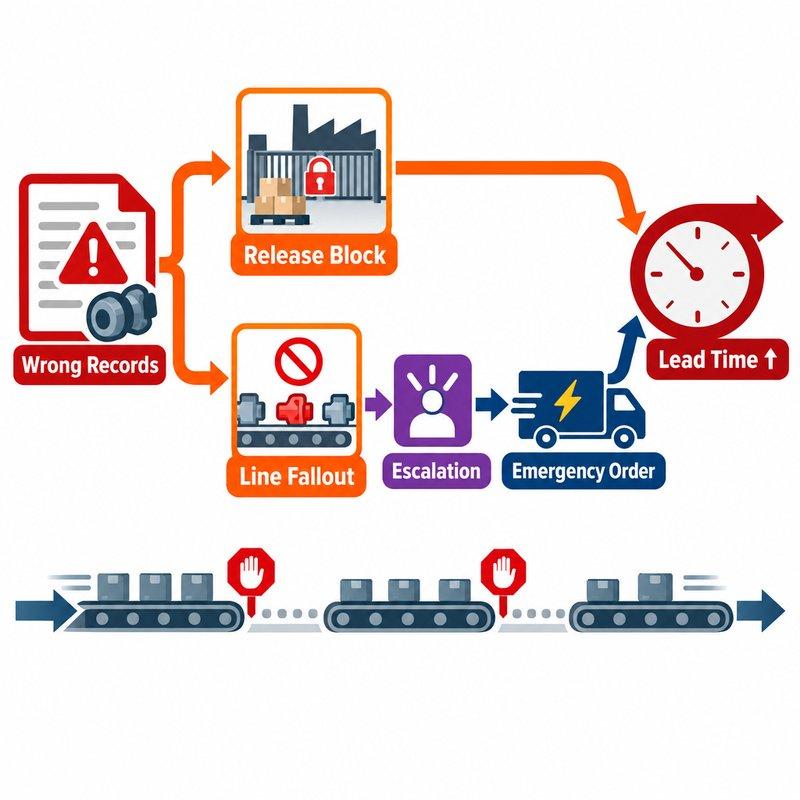
A useful way to understand data quality is to separate the original failure from its downstream consequences.
| Stage | What happens |
|---|---|
| Data failure | Bill-of-material or item data is incorrect. |
| Immediate operational effect | Material release is blocked or production fallout occurs. |
| Organizational response | Production raises an escalation. |
| Supply response | An emergency order is placed with a supplier. |
| Performance consequence | Throughput is disrupted and lead time increases. |
Production Escalations
When incorrect data blocks or disrupts work, production cannot resolve the issue simply by following the planned flow. The problem is escalated because normal execution has stopped or become unreliable.
An escalation is therefore not the original data-quality problem. It is a response to the operational consequence of that problem. This distinction matters when analyzing performance: counting escalations without tracing them back to incorrect records can hide the underlying cause.
Emergency Supplier Orders
The source also connects production fallout directly to emergency supplier orders. Once production encounters a material-related problem, procurement may need to react urgently.
An emergency order is not part of stable planned execution. It is a recovery action triggered by a failure already affecting production. The order may address the immediate need, but it does not remove the data error that caused the disruption.
The complete chain is important:
-
Incorrect data affects material handling.
-
Material handling affects production continuity.
-
Production interruption creates escalation.
-
Escalation creates urgent supplier activity.
-
The combined disruption increases lead time.
Throughput and Lead Time as Measures of Data Quality
The source repeatedly states that unreliable inventory data directly costs lead time. This frames data quality in operational rather than purely administrative terms.
Throughput concerns the movement of work through the production process. When material cannot be released or the line experiences fallout, that movement is interrupted.
Lead time is the time required for work to progress through the process. A data failure increases lead time when teams must stop, escalate, investigate, or obtain material through an emergency order.
The relationship can be summarized as:
Poor data quality reduces the ability to keep work moving, and reduced movement extends lead time.
This consequence is direct. The source does not describe unreliable data merely as inconvenient or time-consuming to correct. It identifies a concrete production cost: lost throughput and longer lead time.
Reading the Failure Chain Correctly
The essential distinction is between the data defect, the operational failure, and the recovery response:
-
The data defect is incorrect bill-of-material or item data.
-
The operational failure is blocked material release or production fallout.
-
The recovery response is escalation and an emergency supplier order.
-
The performance result is disrupted throughput and increased lead time.
Treating only the escalation or emergency order as the problem starts the analysis too late. The source points back to the quality of the records on which material and production decisions depend.
Trace the Operational Cost
1. Analyze a Blocked Material Release
A required component is physically present, but incorrect item data prevents it from being released to production.
Answer the following:
- What is the original data-quality failure?
- What is the immediate operational consequence?
- How does the block affect throughput?
- Why can lead time increase even though the component is physically available?
2. Reconstruct a Production Fallout
Use the source’s consequence chain to complete this sequence:
Incorrect bill-of-material data → __ → _ → ___ → increased lead time
Then explain why correcting only the emergency supplier order would not address the root failure.
3. Separate Cause, Consequence, and Response
Classify each item below as a data defect, operational failure, organizational or supply response, or performance consequence:
-
Emergency supplier order
-
Incorrect item record
-
Production fallout
-
Increased lead time
-
Blocked material release
-
Production escalation
Finally, arrange the items into one or more plausible causal chains.