

Current Supplier Communication Channels
- View
A forecast has been shared with a supplier through a portal, but the next change arrives by email—or is explained later by telephone. Each channel supports communication, yet the complete supplier picture may not move with the change. In the semiconductor-equipment supply chain described in the source, supplier coordination relies on portals, email, and telephone. Forecasts are shared, but changes are communicated too late, leaving internal teams and external partners working with different levels of awareness. This lesson examines the role of each current channel and the information gaps created when communication crosses channel boundaries.
Three Channels, One Supplier Relationship
Supplier coordination does not occur through a single communication route. It takes place through three channels:
- Portals
- Telephone
These channels collectively carry the information exchanged between the manufacturer and its suppliers. The issue is therefore not an absence of communication. Suppliers and internal teams are communicating, and forecasts are being shared. The problem is that the channels do not necessarily function as one connected communication flow.
Portals
A portal is one of the formal channels used to coordinate with suppliers. It provides a designated location through which information such as forecasts can be shared.
Within the communication pattern described in the source, however, using a portal does not guarantee that every later change will reach the supplier through that same route. A forecast may be available in the portal while a subsequent adjustment travels by email or telephone. The supplier relationship then spans multiple channels rather than remaining contained within one shared exchange.
Email provides another route for supplier coordination. It can carry a written update directly between participants, but it also creates a separate communication thread alongside the portal.
For example, an original forecast may be shared formally, while a change is sent in an email. Anyone consulting only the original forecast may not see the revised position. The critical distinction is between sharing information and communicating a change to that information. The source indicates that forecasts are shared, but changes come through too late. This means the initial communication is not enough to keep coordination current.
Telephone
Telephone communication adds a direct, person-to-person channel. It forms part of the actual supplier-coordination environment, especially when participants need to communicate outside the portal or email exchange.
A telephone call can convey a change, but that information is received initially by the people involved in the call. If internal teams or supplier contacts depend on another channel, the update must still cross those communication boundaries. The supplier conversation may therefore be current while the wider group’s understanding remains incomplete.
When Channels Do Not Form a Continuous Update Path
The main weakness in this arrangement appears when a forecast changes. The source describes a clear sequence:
-
Forecasts are shared.
-
Changes are communicated too late.
-
The organization falls behind events, particularly where component availability is constrained.
The lesson here is not simply that three channels are used. It is that an update must travel across an extended communication network involving internal teams and external suppliers. A change sent through one route may not immediately update what others know through the remaining routes.
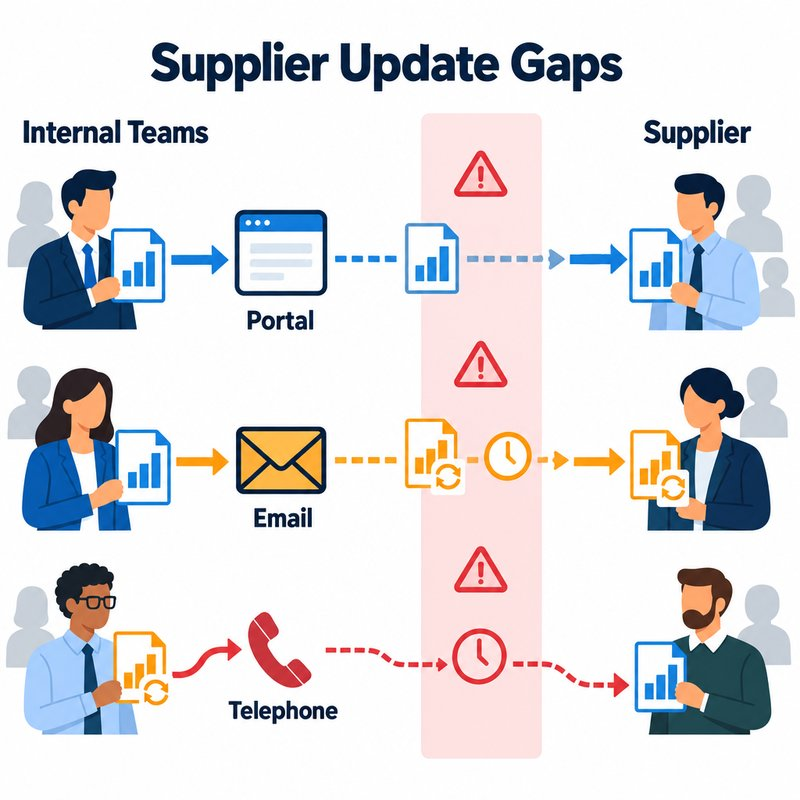
This creates an information gap: a difference between the information available to one participant and the information available to another. The gap can occur:
-
between the manufacturer and the supplier;
-
between different supplier contacts;
-
between the internal employee who receives an update and other internal teams that depend on it; or
-
between the original shared forecast and the latest communicated change.
Earlier lessons examined fragmented internal information sources and the absence of a single source of truth. Supplier communication adds an external boundary to that challenge. The focus here is not on reexamining internal systems, but on recognizing that information must also pass between organizations through several communication channels.
The Difference Between Forecast Sharing and Change Propagation
A forecast communicates expected future demand. Sharing it establishes an initial basis for coordination with suppliers. Yet supplier alignment depends on more than transmitting the first forecast: later changes must also propagate through the communication arrangement.
Change propagation means that a revision reaches all relevant participants, rather than remaining in the channel where it was first communicated. The source shows that this propagation is not consistently timely. As a result, the communication environment may contain:
-
a previously shared forecast;
-
a later adjustment communicated through another channel; and
-
participants who have not yet received that adjustment.
This produces a timing gap between the decision to change and shared awareness of the change. Even when every individual communication is understandable, the overall exchange can remain incomplete because the messages are distributed across portals, email, and telephone.
Reading the Current Communication Pattern
The current pattern can be summarized as follows:
Supplier coordination occurs through portals, email, and telephone. Forecasts are shared, but later changes do not always reach all relevant parties in time. The resulting gap is not merely between messages; it is between internal teams and external partners that may be acting on different versions of the situation.
Recognizing this pattern requires looking beyond whether communication occurred. The more useful question is whether the initial forecast and every subsequent change formed one timely, shared information path.
Trace a Supplier Update
1. Follow the Channels
Consider this sequence:
-
A forecast is shared through a supplier portal.
-
A change is sent by email.
-
Additional clarification is provided by telephone.
Answer the following:
-
Which channel contains the original forecast?
-
Which channel contains the written change?
-
Who receives the telephone clarification directly?
-
At what points could internal teams or the supplier lack the latest information?
2. Distinguish Sharing from Updating
For each statement, classify it as initial forecast sharing or change propagation:
- A supplier receives the current expected demand.
- A revised expectation is communicated after the original forecast.
- The revision reaches the relevant internal and external participants.
- A forecast remains available, but some participants have not received the later change.
Then identify which statements reveal an information gap.
3. Map One Real Supplier Exchange
Choose one supplier-coordination example from your work or a familiar manufacturing setting. Create a simple map with four columns:
| Information event | Channel used | Internal recipient | External recipient |
|---|---|---|---|
| Original forecast | |||
| Forecast change | |||
| Clarification |
Review the completed map and identify where information moves from one channel to another. Mark any point where a change could arrive later than the original information or fail to reach one of the relevant parties.