

Cross-Industry Data Architecture Patterns
- View
Change the manufacturing environment—from precision components to medical imaging or semiconductor equipment—and the same data architecture problem remains visible. Teams need current planning, material, capacity, and engineering-change information, yet that information does not consistently agree across systems. This recurrence matters: it shows that data inconsistency is not confined to one product type or operating environment. This lesson identifies the shared pattern across the high-tech industries in the source and clarifies which operational and engineering information must be connected.
One Pattern Across Different Manufacturing Environments
The source identifies daily data inconsistency in several distinct high-tech manufacturing environments:
-
Precision Components & Cleanroom Fabrication
-
High-Tech Modules & Mechatronics
-
Consumer Electronics & Personal Health
-
Medical Systems & Imaging
-
Semiconductor Equipment, including lithography supply
These environments differ in what they produce, but the reported information problem is remarkably stable. Operational teams require current information, while records held in different systems may be inconsistent. The recurrence across industries indicates a cross-industry data architecture pattern: different manufacturing contexts depend on a similar set of information connections.
This does not mean that every industry has an identical production process. It means that the information architecture must repeatedly support the same operational questions:
-
Are the required materials currently available?
-
When will critical components arrive?
-
How much production capacity is occupied?
-
What is the current status of engineering changes?
If these questions cannot be answered from mutually consistent information, planning and execution are exposed to the same basic risk regardless of industry.
The Shared Operational Information Core
Four information requirements recur throughout the source.
1. Current Material Availability
Teams need an up-to-date view of whether required materials are available. The architecture must make material information usable for operational decisions, not merely present somewhere in the organization.
As established in Lesson 2.3, unreliable inventory data directly costs lead time. The cross-industry insight is that this dependency appears in multiple manufacturing environments rather than in only one specialized setting.
2. Critical-Component Lead Times
Knowing that a component is required is not enough. Teams also need its current lead time, especially when the component is critical to production.
This information has to connect with material availability and planning. A component that is unavailable but expected soon creates a different planning situation from one with a long or uncertain lead time. The architecture therefore needs to keep the timing of supply visible alongside current availability.
3. Capacity Utilization
Material information must be interpreted together with production capacity. The source repeatedly identifies capacity utilization as part of the daily information required for decision-making.
A planning view that shows materials without capacity is incomplete. Likewise, capacity data alone cannot confirm whether production can proceed. The two categories must be available as parts of the same operational picture.
4. Engineering-Change Status
Engineering changes connect engineering information to operational execution. Teams need to know the status of a change because it can affect what is planned, purchased, assembled, or released.
This is the critical bridge between two information domains:
-
Operational information: material availability, component lead times, and capacity utilization
-
Engineering information: the current status of engineering changes
A cross-industry architecture must connect these domains. Otherwise, planning may be based on operational data that no longer corresponds to the current engineering situation.
Connecting the Information Rather Than Viewing It Separately
The recurring architecture pattern is not simply a list of four data categories. Its significance lies in their interdependence.
Consider the relationships:
-
Material availability affects whether planned work can begin.
-
Critical-component lead times affect when missing material may become available.
-
Capacity utilization affects whether work can be scheduled when the material arrives.
-
Engineering-change status affects whether the material and plan remain valid.
These relationships create a connected decision structure:
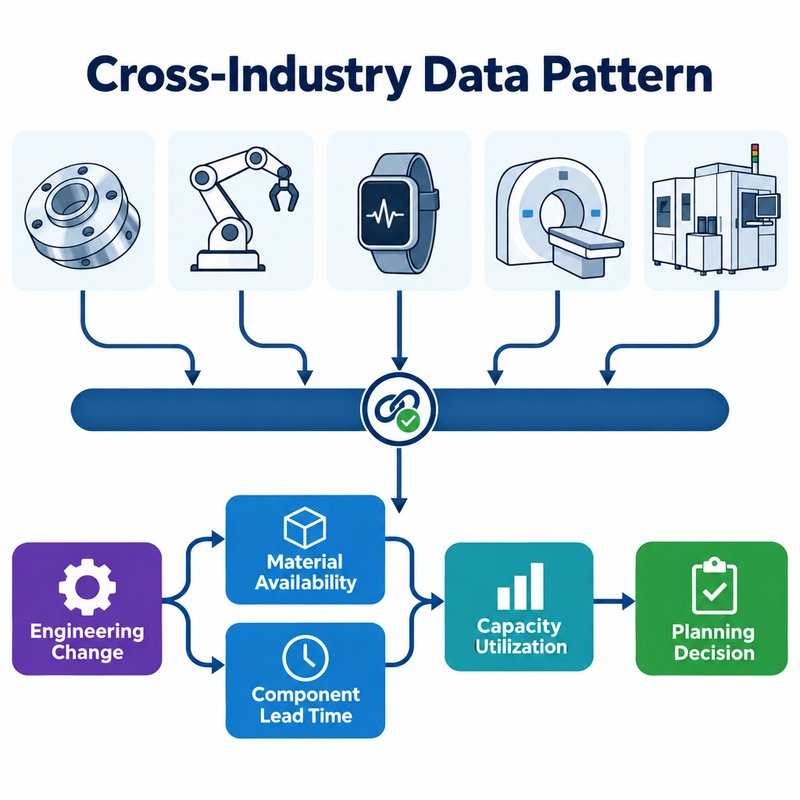
Engineering-change status → material requirements → component availability and lead times → capacity and planning decisions
The source does not present these as isolated reporting needs. They are all described as information needed daily to make sound decisions around planning, material availability, and production capacity. A useful architecture must therefore bring operational and engineering information into alignment.
Lessons 3.1 and 3.2 examined fragmented sources and the absence of a single source of truth. The specific lesson here is broader: the same need for connected, consistent information appears repeatedly across multiple high-tech industries. The architecture challenge travels across sector boundaries.
Recurrence Reveals an Architectural Requirement
When the same problem occurs in cleanroom fabrication, mechatronics, consumer electronics, medical imaging, and semiconductor equipment, it should not be treated as an isolated local exception. It points to a common requirement.
The required architecture pattern has three defining characteristics:
-
It spans operational and engineering information.
Planning cannot be separated from the status of engineering changes. -
It connects the information used in the same decision.
Material availability, lead times, and capacity utilization must be read together rather than as unrelated records. -
It supports consistency across systems.
The recurring daily problem is data inconsistency between systems. Connections are valuable only when the information presented does not contradict itself.
The source does not prescribe a specific technology or implementation procedure. It establishes the requirement that architecture must connect the relevant information and prevent cross-system inconsistency from undermining daily decisions.
The Cross-Industry Pattern at a Glance
| Recurring element | Architectural significance |
|---|---|
| Multiple high-tech manufacturing environments | The problem is cross-industry rather than industry-specific |
| Current material availability | Planning needs an accurate view of what can be used now |
| Critical-component lead times | Supply timing must be connected to material and planning decisions |
| Capacity utilization | Material readiness must be evaluated alongside production capability |
| Engineering-change status | Engineering information must remain connected to operational execution |
| Data inconsistency between systems | Connected information must also be mutually consistent |
Test the Pattern in Context
1. Compare Two Industry Environments
Choose two environments from the source—for example, Medical Systems & Imaging and High-Tech Modules & Mechatronics.
For each one, map the following four information requirements:
-
Current material availability
-
Critical-component lead times
-
Capacity utilization
-
Engineering-change status
Then identify which requirement connects engineering most directly to operational planning. Explain why the underlying architecture pattern remains the same even though the products differ.
2. Analyze an Incomplete Architecture
A planning team can see current material availability and capacity utilization, but it cannot see critical-component lead times or the status of engineering changes.
Answer the following:
- Which two connections are missing?
- Why can the team not form a complete planning picture?
- What decisions could become unreliable if an engineering change affects a critical component?
Base your analysis only on the four recurring information requirements in this lesson.
3. Build a Connected Decision Chain
Create a four-stage chain showing how an engineering change could influence:
- Material requirements
- Material availability or critical-component lead times
- Capacity utilization
- A planning decision
Label each stage as either engineering information or operational information. Use the chain to show why cross-industry data architecture must connect both domains rather than display each category independently.