

Fragmented Information Sources
- View
“Most time is lost manually bringing together data from different systems and asking colleagues for the current status of orders and changes.” This observation shifts attention from the information itself to where it is stored. The required facts may exist, but they are distributed across formal platforms, personal files, messages, and people. As a result, employees must assemble an operational picture before they can act. This lesson maps those fragmented sources and examines how fragmentation turns information retrieval and reconciliation into daily work.
Where Operational Information Is Scattered
The source identifies three core enterprise platforms:
-
ERP
-
PLM
-
MES
These platforms are supplemented by:
-
Excel spreadsheets
-
Knowledge stored in email inboxes
-
Knowledge held by employees
Fragmentation therefore extends beyond having several enterprise systems. It includes the parallel records and informal sources that employees use when the systems do not provide a complete, current picture by themselves.
ERP, PLM, and MES as Separate Information Locations
ERP, PLM, and MES each form part of the information environment, but the operational user must often move among them. Information relevant to planning, material availability, production, orders, or engineering changes is not presented in one place.
The central problem is not simply the number of systems. It is that a decision may depend on facts distributed across those systems. A user can find one part of the answer in one platform and another part elsewhere. Before making a decision, the user has to locate and combine the separate records.
This differs from the information requirements covered in Lesson 2.2. That lesson identified what teams need to know each day. Here, the issue is how many locations must be consulted to obtain that information.
Spreadsheets as Supplemental Records
Excel lists supplement the enterprise platforms. These spreadsheets become additional information sources alongside ERP, PLM, and MES.
Once a spreadsheet is part of operational work, the employee may need to determine:
-
whether the relevant spreadsheet exists;
-
where it is stored;
-
which list contains the needed information; and
-
whether its contents reflect the current operational situation.
The source does not present spreadsheets as an integrated extension of the enterprise platforms. It presents them as another location that must be checked. This increases the number of places involved in reconstructing current status.
Email Inboxes as Information Stores
Knowledge is also stored in mailboxes. An email may contain a status update or other information that has not been made readily available through the formal platforms.
This creates a different retrieval problem. System records can be searched within an organizational platform, while mailbox knowledge may be tied to a particular conversation or employee. A person who needs the information may have to:
- know that the message exists;
- identify who received or sent it;
- locate the relevant conversation; and
- interpret whether the message still describes the current status.
Email consequently functions as more than a communication channel. It becomes a supplemental repository for operational knowledge.
Employees as Information Sources
Some information must be obtained by asking colleagues. The excerpt specifically highlights inquiries about the current status of:
-
orders, and
-
changes.
In this situation, a colleague becomes part of the information path. The employee seeking an answer cannot complete the operational picture from the available records alone and must request clarification or confirmation.
Knowledge held by experienced employees can also include process settings, supplier-specific practices, and approaches to deviations. Those forms of tacit knowledge are addressed in Lesson 5.1. For this lesson, the important architectural point is narrower: information held by individuals is another separate source that must be reached and consulted.
The Hidden Task: Building the Picture by Hand
When information is fragmented, retrieval is only the beginning. The employee must manually bring the pieces together.
A typical information path can be represented as:
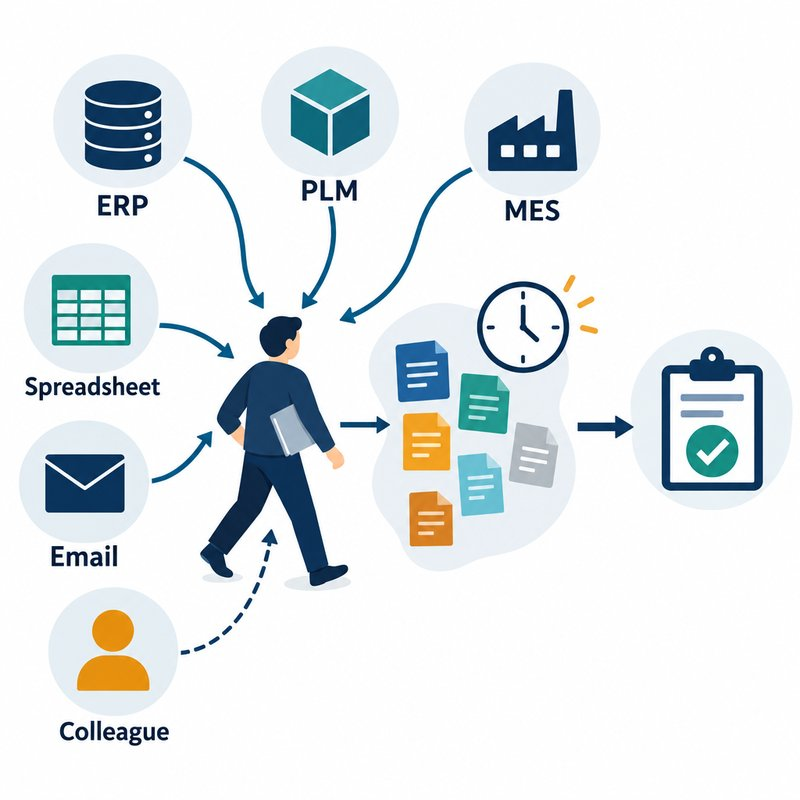
Check enterprise platforms → inspect spreadsheets → search mailbox knowledge → ask colleagues → assemble current status
Each step is an information-gathering action rather than the operational decision itself. The employee is spending effort preparing the evidence required for planning, material, production, order, or change decisions.
The source emphasizes that substantial time is lost in two related activities:
- Manually combining data from different systems
- Asking colleagues for the current status of orders and changes
These activities are connected. When the systems and supplemental records do not produce a sufficiently current picture, employees compensate through interpersonal checking. A colleague may confirm which order status is current or explain the latest state of a change.
Fragmentation thus creates a recurring reconciliation task. Employees must determine which pieces belong together and whether additional confirmation is needed. The time cost occurs before the underlying operational issue can be addressed.
Separating Fragmentation from Data Reliability
Fragmentation and unreliable data are related but distinct problems.
-
Fragmentation means that relevant information is distributed across multiple locations.
-
Data reliability problems arise when records cannot be trusted for a decision, as covered in Lesson 2.3.
-
Data inconsistency among sources will be examined directly in Lesson 3.2.
A team can experience fragmentation even before it discovers a contradiction. Simply finding and assembling information from ERP, PLM, MES, spreadsheets, inboxes, and colleagues consumes time. If the retrieved records then disagree, an additional problem begins: deciding which record is current or authoritative.
Keeping these issues separate improves diagnosis. If employees cannot locate all required information without visiting several sources, the architecture is fragmented. If they locate several records and those records conflict, the problem has progressed from fragmentation to inconsistency.
The Fragmentation Pattern in Brief
The essential pattern is straightforward: operational information is distributed across ERP, PLM, MES, Excel lists, email inboxes, and employees. Teams compensate by manually assembling records and requesting updates from colleagues, particularly for current order and change status. The resulting time loss is not caused only by making difficult decisions; it is also caused by constructing the information base on which those decisions depend.
Map the Information Search
1. Trace a Status Request
A planner needs the current status of an order and a related engineering change.
Using only the sources named in this lesson:
- List every location the planner might need to consult.
- Mark which checks can be performed directly and which require another person.
- Identify where manual combination occurs.
- Explain which effort is caused specifically by fragmentation, without introducing data inconsistency.
2. Classify the Information Sources
Place each item into one of three categories: enterprise platform, supplemental record, or person-dependent source.
-
ERP
-
PLM
-
MES
-
Excel list
-
Email inbox
-
A colleague’s current order update
-
An experienced employee’s knowledge
Then explain why the last two sources make information access dependent on employee availability.
3. Diagnose the Architecture
Consider this situation:
An employee checks ERP for one part of an order’s status, opens an Excel list for additional details, searches an email thread for the latest update, and then contacts a colleague to confirm the current change status.
Answer the following:
-
What evidence shows that the information environment is fragmented?
-
Which actions represent retrieval?
-
Which action represents manual reconciliation or confirmation?
-
What work could not begin until this information search was completed?