

Inventory Reliability and Decision Quality
- View
“Unreliable inventory data directly costs us lead time.”
A material record may indicate that a component is available, yet the material cannot be released when production needs it. A bill of materials may identify one requirement while another source shows something different. In both cases, the problem extends beyond inaccurate data: operational decisions are being made from an unreliable picture of inventory. This lesson examines how missing, outdated, or conflicting inventory, bill-of-material, and item data weakens decision quality and disrupts the movement of material into production.
When Recorded Availability Cannot Be Trusted
As covered in Lesson 2.2, teams need current material availability to make daily decisions. The additional issue is whether that availability information is reliable.
Inventory reliability means that the recorded material position can be trusted when planning work or releasing material. If inventory data is unreliable, a team cannot confidently determine whether the materials required for production are actually available. A recorded quantity alone is therefore not enough. It must correspond to the relevant bill of materials and item records.
The source identifies three conditions that undermine this reliability:
-
Information is missing.
-
Information is outdated.
-
Information does not match across different sources or departments.
Each condition introduces uncertainty into operational decisions. Missing information leaves the team without a complete basis for action. Outdated information presents an earlier situation as though it were current. Conflicting information forces people to decide which record to trust before they can decide what to do.
Bills of Materials and Item Data Shape Material Decisions
Two record types are especially important to inventory reliability:
-
A bill of materials identifies the material associated with a product or assembly.
-
Item data contains the records used to identify and manage those materials.
These records give operational meaning to inventory quantities. A component can appear to be in stock, but that does not establish that it is the correct material for the current production requirement. The stock record, bill of materials, and item data must agree.
When bill-of-material or item data is incorrect or contradictory, the problem reaches the physical flow of production. The source identifies two immediate outcomes:
-
Material release is blocked.
Material cannot move forward as expected because the underlying records do not provide a dependable basis for issuing it. -
Fallout occurs on the production line.
A data problem that is not resolved before release can become a production interruption when the material reaches the line.
These outcomes show why inventory reliability is not simply a reporting concern. Data records determine whether material can be released and used.
The Chain from Data Conflict to Lead-Time Loss
The relationship can be traced as a direct operational chain:
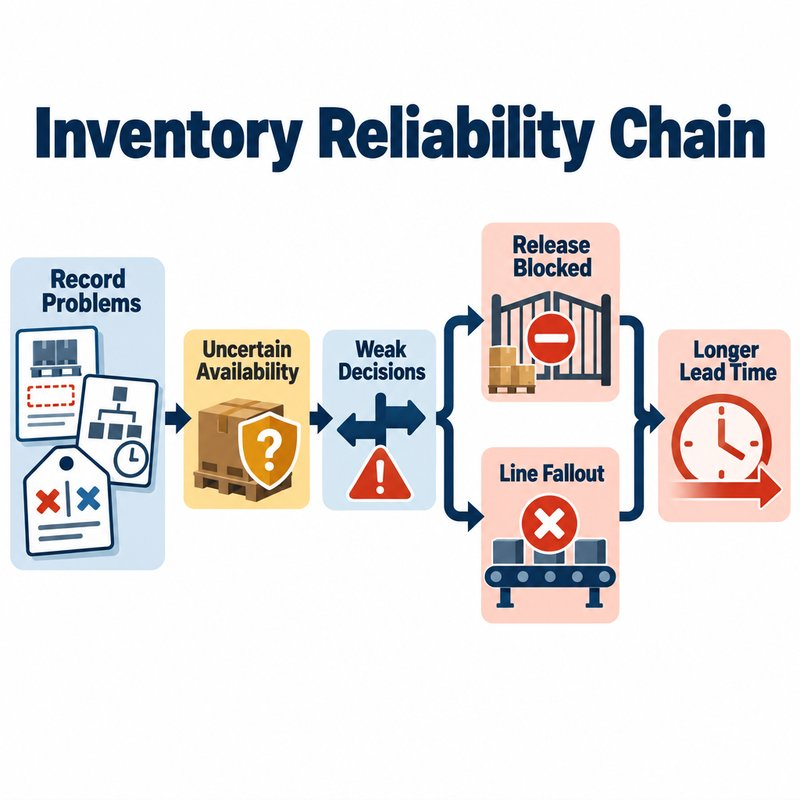
Missing, outdated, or conflicting records
→ uncertain material availability
→ weaker planning and material decisions
→ blocked material release or production-line fallout
→ longer lead time
The first effect is uncertainty. If different records or departments present different information, the team must first establish which version reflects the current situation. Until that happens, a decision to release, hold, or plan material rests on an unstable foundation.
The second effect is reduced decision quality. Here, decision quality means the ability to make planning and material decisions from dependable information. A decision may appear reasonable based on one record and still prove wrong when another record reveals that the bill of materials, item definition, or inventory position is different.
The final effect is time loss. If the inconsistency prevents material release, production waits before work can proceed. If the inconsistency reaches the line, the interruption occurs later in the flow. Either way, unreliable inventory data directly increases lead time.
Why Agreement Matters as Much as Completeness
A complete-looking record is not necessarily a reliable record. Information may exist in several places and still fail to support a sound decision if those places disagree.
Consider a situation in which one source indicates that a required component is available, while the applicable bill of materials or item record indicates something different. The team does not have one usable answer to the question, “Can this material be released?” It has competing answers.
This distinction is central:
-
Availability asks whether material is recorded as present.
-
Reliability asks whether that recorded position can be trusted for the current requirement.
-
Decision quality depends on using the reliable position rather than merely finding a quantity somewhere.
The source therefore connects inventory reliability with consistency among records and departments. The issue is not only whether data has been entered, but whether the relevant records represent the same current material situation.
The Reliability Test in One Sentence
A material decision is only as dependable as the inventory, bill-of-material, and item records supporting it: when those records are missing, outdated, or contradictory, material release may be blocked, production may be interrupted, and lead time increases.
Examine the Decision Before Releasing Material
1. Trace the Consequence Chain
A planner sees sufficient inventory for a required component, but the bill of materials and item record do not agree.
Write the sequence of consequences using these stages:
-
Record problem
-
Effect on confidence in availability
-
Effect on the material decision
-
Possible operational outcome
-
Effect on lead time
Then explain why the displayed inventory quantity is not enough to support release.
2. Classify the Reliability Failure
For each case, identify whether the primary issue is missing, outdated, or conflicting information. Then state how it could affect decision quality.
- The current item record cannot be found.
- A material quantity reflects an earlier inventory position.
- Two departments use different bill-of-material records for the same production requirement.
- An inventory record indicates availability, but the applicable item data does not support release.
3. Evaluate Two Release Decisions
Compare these two responses to contradictory records:
-
Decision A: Release the material because one source shows sufficient inventory.
-
Decision B: Hold the decision until the relevant inventory, bill-of-material, and item records agree.
Answer the following:
-
Which decision is based on a more reliable material picture?
-
What risk does Decision A introduce?
-
At what point could that risk appear: during material release, on the production line, or at either point?
-
How does the choice affect lead-time risk?