

Manual Handoffs and Process Delays
- View
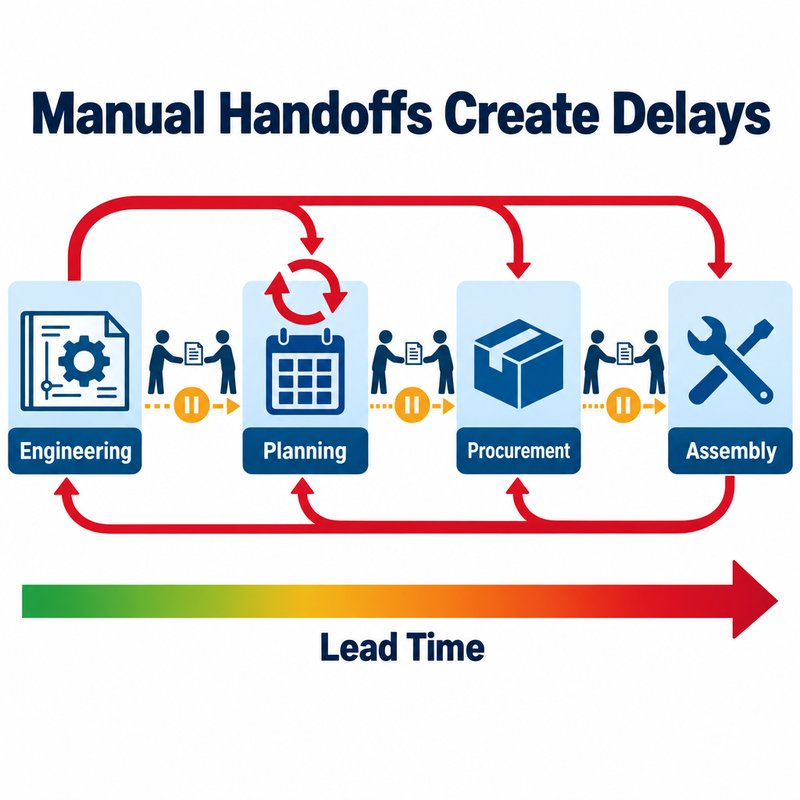
“Between those steps, there is a great deal of manual coordination.” This recurring observation identifies a central source of friction in high-tech manufacturing. The production flow may be defined, yet transitions between consecutive stages still depend on people manually aligning information and actions. Engineering changes and replanning repeatedly disturb these handoffs, extending lead time and making workflow less stable. This lesson examines how that disruption develops and why a process can remain fragile even when its major stages are clearly understood.
Where the Flow Loses Stability
Lesson 1.2 traced the end-to-end flow from engineering and forecasting through planning, procurement, assembly, and delivery. The issue here is not the sequence itself, but what happens between its stages.
A handoff occurs when information, requirements, or responsibility passes from one stage to the next. In the source, these transitions require substantial manual coordination. Instead of each stage proceeding smoothly from current shared information, people must actively align what has changed, what remains valid, and what should happen next.
The resulting problem can be expressed as a chain:
Manual handoff → repeated coordination → delayed transition → longer and less stable lead time
Manual coordination is not presented as an isolated exception. It appears repeatedly across the high-tech environments and roles in the source, including technical component buyers, quality and compliance engineers, operational planners, manufacturing process engineers, and supply chain managers. This makes it a process-wide issue rather than a difficulty experienced by only one function.
Engineering Changes Create Moving Handoffs
An engineering change modifies an engineering requirement while the broader production and supply process is already underway. Because engineering stands upstream of planning, procurement, and assembly, such a change can disturb multiple downstream transitions.
The difficulty is not simply that something has changed. The handoff must now be coordinated again. People need to determine which information is current and how the change affects work that has already been planned or initiated. When this alignment is manual, the transition between stages becomes a recurring point of delay.
Consider a handoff from engineering to planning. Planning may have begun working from an earlier engineering position. When a change occurs, the existing handoff no longer provides a stable basis for action. The revised engineering information must be communicated and incorporated before the process can reliably continue.
The same disruption can carry into later transitions:
-
Planning may need to revise its previous decisions.
-
Procurement may be operating from requirements that have changed.
-
Assembly may depend on the coordinated outcome of those revisions.
These are not separate problems. They are connected consequences of a change moving through manually coordinated boundaries.
Replanning Repeats the Disruption
Replanning means that an existing plan must be revised. The source links replanning directly to continuous disturbance of lead time. Each revised plan can alter what another stage expects to receive, use, or execute.
This creates a repeated pattern:
- A stage prepares its work using the available plan.
- The plan changes.
- Consecutive stages must realign manually.
- Work waits, shifts, or must be coordinated again.
- The transition takes longer than expected.
The word continuously is important. The source does not describe engineering changes and replanning as occasional events with one-time effects. They repeatedly interfere with progress. Consequently, a handoff that was aligned at one moment may become misaligned later.
Manual coordination therefore becomes both reactive and repetitive. People do not merely transfer work once; they must keep restoring alignment as conditions change.
How Fragmented Handoffs Affect Lead Time
Lead time is the elapsed time required for work to move through the process. The source states that engineering changes and replanning continuously disrupt it.
A delay at a handoff is significant because later work depends on that transition. If information or action cannot pass cleanly from one stage to the next, the downstream stage cannot proceed on a stable basis. The delay is therefore not confined to the boundary where it began.
Three effects emerge from the source:
1. More coordination is required
Employees must spend effort aligning consecutive stages whenever changes or revised plans disturb the existing flow.
2. Progress becomes less predictable
A process stage may appear ready to continue, but its inputs can be altered by an engineering change or replanning decision. This weakens workflow stability.
3. Lead time is repeatedly extended
Because alignment must be restored before dependable progress can resume, changes and replanning add delay throughout the process.
The fundamental distinction is between a defined flow and a stable flow. An organization can know that work moves from engineering and forecasting to planning, procurement, and assembly while still experiencing unstable execution. Naming the stages does not eliminate the manual effort required to connect them.
The Delay Pattern at a Glance
| Process condition | Effect at the handoff | Operational result |
|---|---|---|
| Consecutive stages rely on manual coordination | People must actively align information and actions | Transitions require additional effort |
| An engineering change occurs | Previous assumptions or requirements may no longer hold | Downstream stages must realign |
| Replanning changes the expected course of work | Existing coordination must be repeated | Workflow becomes less stable |
| Changes continue over time | Handoffs are disrupted repeatedly | Lead time is continuously affected |
The central lesson is that process friction concentrates at transitions. Manual coordination makes those transitions vulnerable, while engineering changes and replanning repeatedly activate that vulnerability.
Diagnose the Handoff Friction
1. Trace an Engineering-Change Disruption
Use this sequence:
Engineering → Planning → Procurement → Assembly
Assume an engineering change occurs after planning has already begun.
-
Identify each handoff that may need to be coordinated again.
-
Explain why the original alignment may no longer be sufficient.
-
Mark where delay can enter the process.
-
Describe how the disruption could extend lead time without introducing issues not stated in the lesson.
2. Distinguish Flow Design from Flow Stability
Evaluate the following statement:
“Because every process stage is clearly defined, the workflow is stable.”
Write a short response that explains why this conclusion does not follow. Use all three source concepts in your answer:
-
manual coordination,
-
engineering changes,
-
replanning.
3. Examine a Recurring Replanning Cycle
Imagine that planning is revised several times while procurement and assembly are preparing their work.
Create a simple cycle showing:
- the current plan,
- a replanning event,
- renewed manual alignment between stages,
- the resulting disturbance to lead time.
Then identify which part of the cycle makes the problem continuous rather than a one-time delay.