

End-to-End Production Flow
- View
A forecast changes. Planning must respond, purchasing must align material supply, and assembly must work from the resulting plan—all while engineering information remains current. What appears to be a sequence of separate activities is therefore one connected production and supply chain flow. This lesson follows that flow from engineering and forecasting through planning, procurement, assembly, and delivery, focusing on the dependencies between stages and the coordination needed to keep work moving across functional and organizational boundaries.
Following the Flow from Demand to Delivery
The source describes a recurring end-to-end process across high-tech manufacturing environments:
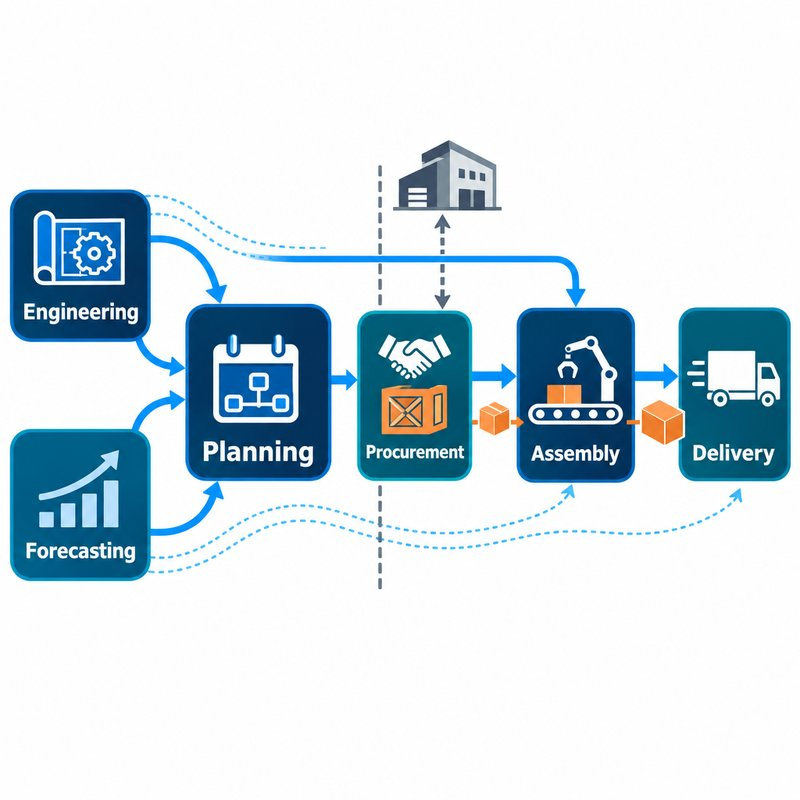
Engineering and forecasting → Planning → Procurement → Assembly → Delivery
This sequence provides a useful overview, but it should not be interpreted as a set of isolated departments completing independent tasks. Each stage creates or updates information that another stage needs. The flow is therefore both:
-
a production flow, in which materials and assemblies move toward completion; and
-
an information flow, in which engineering, demand, planning, and purchasing inputs guide that movement.
Engineering and Forecasting Establish the Inputs
The flow begins with engineering and forecasting.
Engineering provides the product definition that the rest of the process must follow. The excerpt specifically identifies bills of materials and engineering changes as information that must remain connected to the production and supply chain process.
A bill of materials identifies the components associated with the product. An engineering change alters relevant engineering information. Because later stages depend on that information, engineering is not simply an activity completed before production begins. Its outputs remain important throughout planning, procurement, and assembly.
Forecasting provides an expectation of future demand. It gives planning an input for deciding what production activity and material supply may be required. Engineering and forecasting serve different purposes—one concerns what is to be made, while the other concerns anticipated demand—but both feed the next stage.
Planning Converts Inputs into Coordinated Requirements
Planning connects engineering and forecast information to operational action. It must align anticipated demand with the requirements that purchasing and production will need to support.
This position makes planning a central dependency point:
-
It relies on current engineering information.
-
It uses forecast information.
-
It informs procurement requirements.
-
It supports the work that will move into assembly.
Planning is therefore not a self-contained step. If its inputs change, the effects can continue downstream. The source notes that engineering changes and replanning can affect the overall flow; the detailed delays created by such disruption are addressed in Lesson 2.1.
Procurement Connects the Plan to Material Supply
Procurement, or purchasing, acts on the material requirements associated with the plan. This stage connects internal production needs with the suppliers that provide components.
Its place in the sequence reveals two directions of dependency:
- Procurement depends on engineering and planning information to understand what is required.
- Assembly depends on procurement to support the required material supply.
This also marks an important organizational boundary. Engineering, planning, and production may operate within the organization, while purchasing must coordinate with external suppliers. The end-to-end flow therefore extends beyond a single team—and, in practice, beyond the organization itself.
Supplier coordination methods and their information gaps are examined later in Section 4. Here, the essential point is that supplier activity forms part of the production flow rather than sitting outside it.
Assembly Turns Coordinated Inputs into Production Output
Assembly is the stage at which planned work and procured materials come together. It depends on the alignment of the preceding stages:
-
Engineering defines the relevant product information.
-
Forecasting contributes the demand signal.
-
Planning organizes the operational requirements.
-
Procurement supports material availability.
-
Assembly carries out the production work based on those combined inputs.
This means that assembly performance cannot be understood only by examining work on the production floor. A problem visible during assembly may have originated in an earlier stage or at the boundary between stages.
Delivery Completes the End-to-End View
The process continues from assembly to delivery. Delivery is the final stage named in the lesson’s end-to-end scope, but it is supported by every stage before it. The ability to deliver depends on the product definition, demand expectation, plan, purchased materials, and assembly activity remaining sufficiently aligned.
This perspective prevents a common analytical error: optimizing one function while ignoring the complete flow. A stage may complete its own work, yet the overall process can still fail to advance if the next stage lacks the information, materials, or coordination needed to proceed.
Dependencies Across the Chain
The flow can be summarized through its principal handoffs:
| Stage | Contribution to the flow | Principal dependency |
|---|---|---|
| Engineering | Product information, including bills of materials and changes | Its information must remain usable by downstream functions |
| Forecasting | Expected demand | Planning needs the forecast as an input |
| Planning | Coordinated operational and material requirements | Depends on engineering and forecast information |
| Procurement | Connection between requirements and material supply | Depends on the plan; supports assembly |
| Assembly | Production using coordinated information and materials | Depends on engineering, planning, and procurement alignment |
| Delivery | Completion of the end-to-end process | Depends on successful execution of all preceding stages |
The core lesson is that production does not move merely because each function performs its own tasks. It moves when the outputs of one stage are available and meaningful to the next. Coordination must therefore cross functional boundaries among engineering, planning, purchasing, and production, as well as the organizational boundary between the manufacturer and its suppliers.
Test the End-to-End Perspective
1. Trace a Change Through the Flow
Assume engineering information changes after the forecast has already been translated into a production plan.
Using only the stages covered in this lesson, trace the likely coordination path:
- Which stage originates the new information?
- Which stage must reconsider its requirements?
- Which stage may need to adjust material activity?
- Which stage must receive aligned information and materials?
- Which final stage depends on the combined result?
Do not diagnose delays; focus on the dependencies among stages.
2. Analyze the Assembly Boundary
A team says, “Assembly is responsible for delivery, so an assembly problem belongs only to production.”
Evaluate this statement by identifying at least three upstream dependencies that assembly carries into its work. Explain why viewing assembly in isolation gives an incomplete picture of the end-to-end flow.
3. Map a Flow Without Mapping Departments
Create a simple diagram containing these six elements:
Engineering, Forecasting, Planning, Procurement, Assembly, Delivery
For every connection, label what crosses the boundary—for example, engineering information, demand expectations, operational requirements, or material supply. Then mark which connection crosses the boundary between the organization and external suppliers.