

Roles and Industry Environments
- View
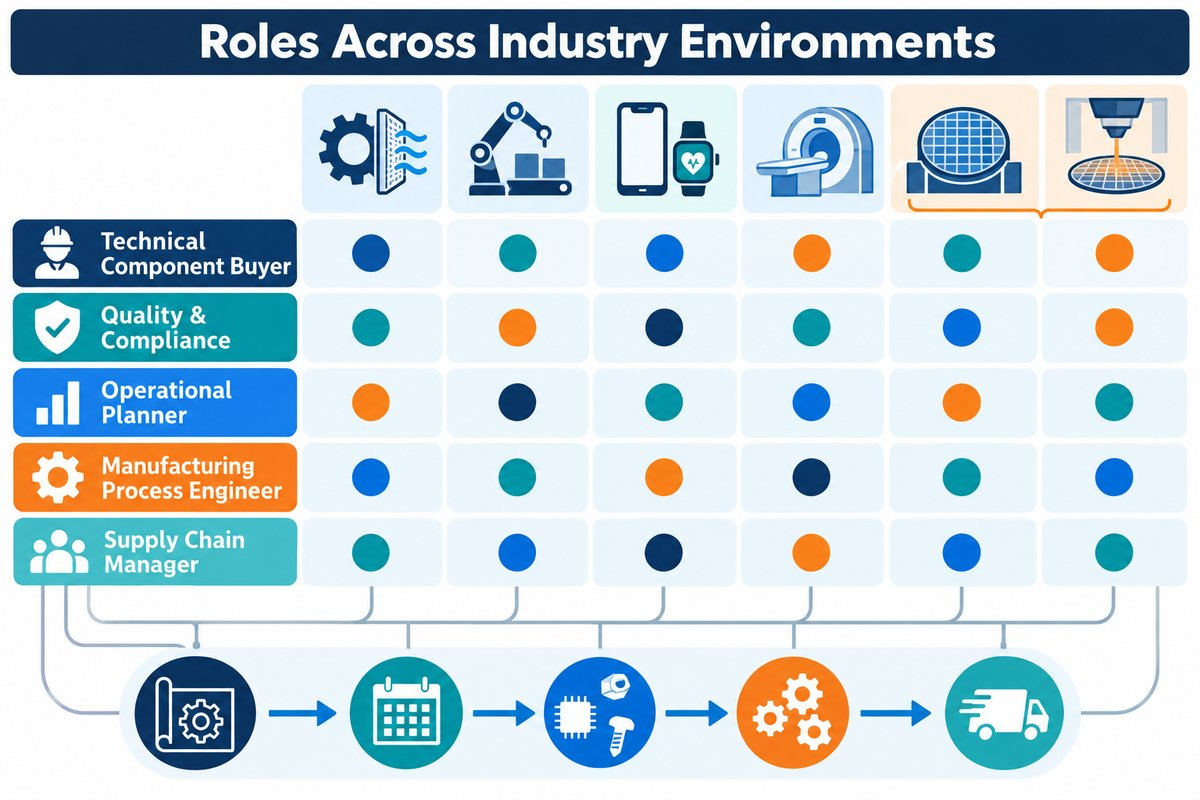
A technical-component buyer, a quality and compliance engineer, and an operational planner are asked the same question: “How does production and supply move through your organization today?” Their answers concern a shared process, but each person views that process from a different organizational position. The source material applies this approach across six high-tech manufacturing environments and five professional roles. This lesson maps that landscape, establishing who contributes a perspective and where that perspective is situated without yet examining the detailed production flow or its operational problems.
Five Views of a Shared Manufacturing System
The source represents five roles within production and supply chain organizations:
- Technical Component Buyer
- Quality & Compliance Engineer
- Operational Planner
- Manufacturing Process Engineer
- Supply Chain Manager
These are not presented as five separate processes. Instead, respondents in each role are asked about the same broad production and supply process. The repeated question spans activities from engineering and planning to assembly and delivery. This structure highlights an important distinction: a process can be organizationally shared while being experienced from several role-specific positions.
Technical Component Buyer
The Technical Component Buyer is the procurement perspective included in the source. Respondents with this title appear in every listed industry environment. Their inclusion positions technical procurement as part of the same landscape as engineering, planning, quality, production, and supply chain management.
The source specifically labels the role as a buyer of technical components, rather than using procurement as an abstract organizational category. This wording connects the role directly to the materials and components involved in manufacturing.
Quality & Compliance Engineer
The Quality & Compliance Engineer provides the quality and compliance perspective. This role also appears in all six environments.
The combined title is significant: quality and compliance are represented through one role in the source rather than as separate respondent groups. At this stage, the key point is not to infer particular inspections, standards, or regulatory duties that the excerpt does not specify. It is to recognize that quality and compliance participate in the same production and supply chain context examined by the other roles.
Operational Planner
The Operational Planner represents operational planning. Like the other roles, the planner is questioned about the broader process rather than only one isolated planning task.
This creates a cross-functional frame. Planning is not treated as a standalone activity disconnected from procurement, engineering, assembly, or delivery. It is one professional viewpoint on a process that crosses those areas.
Manufacturing Process Engineer
The Manufacturing Process Engineer supplies the process-engineering viewpoint. The source also associates this role with a question about knowledge held primarily by experienced colleagues, including references to:
-
certain process settings,
-
supplier-specific practices or “tricks,” and
-
approaches used when deviations occur.
Those knowledge issues belong to later lessons on tacit manufacturing knowledge. Here, they simply show that the process-engineering role is situated within both formal operations and experience-based organizational knowledge.
Supply Chain Manager
The Supply Chain Manager provides the supply chain management perspective. This role is represented across the full set of industries, including precision manufacturing, mechatronics, consumer products, medical systems, and semiconductor equipment.
The source asks this role about the same overall process addressed by the other respondents. It also includes a prompt about making one thing easier for the production and supply chain team. The visible response calls for an integrated, intuitively searchable view that brings together items such as bills of materials, engineering changes, and lead-time information. The architecture of that integrated view is addressed later in the course; its appearance here confirms that the supply chain perspective extends across multiple kinds of operational information.
Six High-Tech Industry Environments
The five roles are repeated across six industry settings. The Dutch source labels are rendered below in English while preserving their specific scope.
| Industry environment | Scope named in the source |
|---|---|
| Precision Components & Cleanroom Fabrication | Precision-component production combined with cleanroom manufacturing |
| High-Tech Modules & Mechatronics | High-tech module and mechatronic manufacturing |
| Consumer Electronics & Personal Health | Consumer electronics and personal-health products |
| Medical Systems & Imaging | Medical systems and imaging |
| Semiconductor Equipment | Specifically identified with the lithography supply chain |
| Semiconductor Equipment (lithography supply chain) | The source’s explicit qualification emphasizes the supply-chain setting around lithography equipment |
The final two rows refer to the same named environment; the second preserves the full qualification used in the source. Consequently, the source contains six distinct environments overall, not seven.
Precision Components & Cleanroom Fabrication
This environment combines two descriptors: precision components and cleanroom fabrication. The source places all five roles within it, from technical buying through supply chain management. The environment therefore serves as more than a production category; it is an organizational setting in which procurement, quality, planning, process engineering, and supply chain perspectives coexist.
High-Tech Modules & Mechatronics
The high-tech modules and mechatronics environment uses the same five-role structure. This repetition allows equivalent organizational viewpoints to be considered in a different industrial setting without assuming that the environments are operationally identical.
Consumer Electronics & Personal Health
Consumer electronics and personal health are grouped as one environment in the source. Again, technical procurement, quality and compliance, operational planning, process engineering, and supply chain management are all represented.
The excerpt also associates this environment with a question about collaboration and information exchange with suppliers and supply chain partners. Details of supplier communication belong to Section 4, but the question establishes that this environment includes both internal operations and external relationships.
Medical Systems & Imaging
Medical systems and imaging form another combined environment. All five roles are included, preserving the same cross-functional lens used elsewhere.
The value of this repeated role set is comparability: the role categories remain stable while the industrial context changes. This makes it possible to distinguish a role perspective from an industry setting instead of treating the two as interchangeable.
Semiconductor Equipment and the Lithography Supply Chain
The final environment is Semiconductor Equipment, explicitly qualified as the lithography supply chain. The source again includes all five roles.
Questions associated with this environment include where teams spend time searching for information, bringing data together, and improving work for production and supply chain teams. Those issues will be examined in later lessons on fragmented information and integrated operational insight. For now, the important point is that the semiconductor-equipment setting is framed as a supply-chain environment involving the same cross-functional role network found in the other industries.
Reading the Role–Environment Matrix
The source can be understood as a matrix rather than a simple list:
| Perspective | Appears across the industry environments? |
|---|---|
| Technical component procurement | Yes |
| Quality and compliance | Yes |
| Operational planning | Yes |
| Manufacturing process engineering | Yes |
| Supply chain management | Yes |
One axis is the role: the organizational position from which the process is described. The other axis is the industry environment: the manufacturing context in which that role operates.
This distinction prevents two common interpretive errors:
-
A role should not be treated as though it represents the entire organization.
-
An industry environment should not be reduced to the viewpoint of one role.
Instead, each response is a situated perspective: one role, operating within one industry environment, commenting on a shared manufacturing and supply chain process. The detailed sequence of that shared process belongs to Lesson 1.2.
The Landscape at a Glance
The source establishes a consistent cross-functional structure:
-
Five roles: Technical Component Buyer, Quality & Compliance Engineer, Operational Planner, Manufacturing Process Engineer, and Supply Chain Manager.
-
Six environments: Precision Components & Cleanroom Fabrication; High-Tech Modules & Mechatronics; Consumer Electronics & Personal Health; Medical Systems & Imaging; and Semiconductor Equipment within the lithography supply chain.
-
One shared frame: Each role is asked about an end-to-end production and supply process.
-
Multiple perspectives: Role and environment jointly shape the position from which that shared process is described.
-
Cross-functional participation: Procurement, quality, planning, process engineering, and supply chain management all belong within the manufacturing landscape represented by the source.
Map and Compare the Perspectives
1. Build a Role–Environment Grid
Create a grid with the five roles as rows and the six industry environments as columns. In every applicable cell, write one question that could be asked about the shared production and supply process.
Keep each question within the source’s boundaries. Do not invent industry-specific technologies, standards, or procedures that the excerpt does not identify.
2. Identify the Perspective
For each statement below, identify whether it primarily signals a role, an industry environment, or the shared process frame:
- “Quality & Compliance Engineer”
- “Semiconductor Equipment (lithography supply chain)”
- “From engineering and planning to assembly and delivery”
- “Technical Component Buyer”
- “Medical Systems & Imaging”
Then explain why role and environment must both be known before interpreting a respondent’s perspective.
3. Analyze a Cross-Functional Scenario
Imagine that representatives of all five roles are discussing production within High-Tech Modules & Mechatronics.
Answer these questions using only the landscape established in this lesson:
-
Which five professional perspectives must be represented?
-
What industry context do they share?
-
Why would one person’s account not be sufficient to represent the entire process?
-
Which details should be deferred until the end-to-end production flow is examined in Lesson 1.2?