

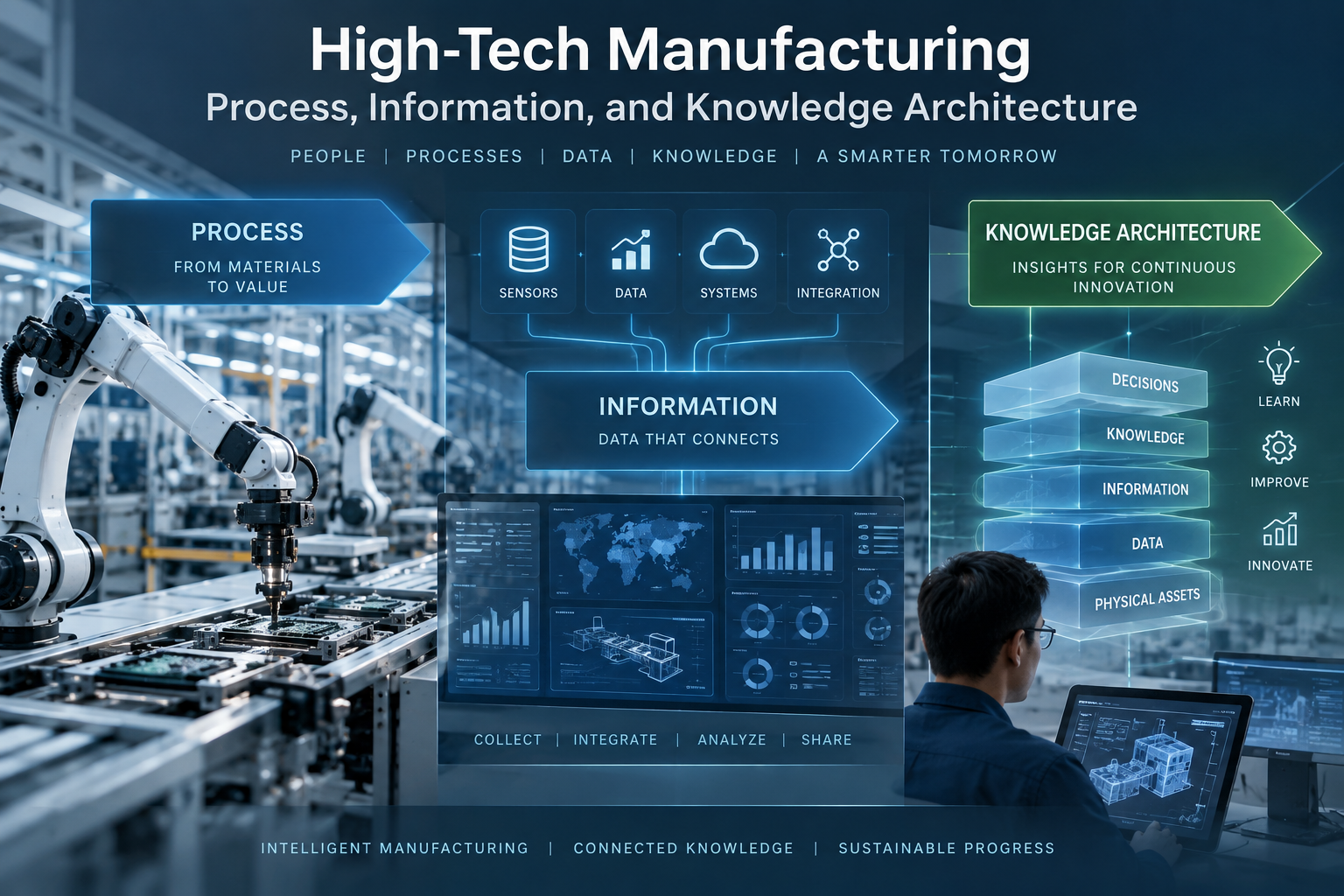
High-Tech Manufacturing Process, Information, and Knowledge Architecture
Section 1: Manufacturing and Supply Chain Landscape
Lesson 1.1: Roles and Industry Environments
-
Technical procurement, quality and compliance, operational planning, process engineering, and supply chain management
-
Precision components, cleanroom fabrication, mechatronics, consumer electronics, medical imaging, and semiconductor equipment
-
Role-specific perspectives on shared manufacturing and supply chain processes
Lesson 1.2: End-to-End Production Flow
-
Flow from engineering and forecasting through planning, procurement, assembly, and delivery
-
Dependencies between engineering, material planning, purchasing, and production
-
Coordination requirements across organizational boundaries
Section 2: Process Friction and Operational Variability
Lesson 2.1: Manual Handoffs and Process Delays
-
Manual coordination between consecutive process stages
-
Continuous disruption caused by engineering changes and replanning
-
Effects of fragmented handoffs on lead time and workflow stability
Lesson 2.2: Critical Operational Information
-
Current material availability and critical-component lead times
-
Production capacity, order status, and engineering-change status
-
Information needed by each role for daily operational decisions
Lesson 2.3: Inventory Reliability and Decision Quality
-
Consequences of unreliable inventory information
-
Conflicting bills of materials and item records
-
Connections among data reliability, material release, production interruptions, and lead time
Section 3: Information Architecture and Data Integration
Lesson 3.1: Fragmented Information Sources
-
Information distributed across ERP, PLM, and MES platforms
-
Supplemental records in spreadsheets, email, and employee-held knowledge
-
Time lost reconciling records and requesting current order or change status
Lesson 3.2: The Missing Single Source of Truth
-
Data inconsistencies among enterprise systems
-
Duplicate, outdated, and contradictory operational records
-
Organizational effects of unclear information ownership
Lesson 3.3: Cross-Industry Data Architecture Patterns
-
Recurring information problems across high-tech manufacturing environments
-
Shared requirements for planning, material availability, capacity, and change control
-
Architecture patterns that connect operational and engineering information
Section 4: Supplier and Partner Information Exchange
Lesson 4.1: Current Supplier Communication Channels
-
Supplier coordination through portals, email, and telephone
-
Forecast sharing and delayed communication of changes
-
Information gaps between internal teams and external partners
Lesson 4.2: Scarcity, Forecast Changes, and Supplier Response
-
Late updates affecting scarce-component decisions
-
Disconnected supplier records across systems, files, and individuals
-
Impact of communication delays on procurement and production continuity
Section 5: Knowledge Architecture and Organizational Resilience
Lesson 5.1: Tacit Manufacturing Knowledge
-
Process settings known primarily by experienced engineers
-
Supplier-specific practices and informal approaches to deviations
-
Operational dependence on individual experts
Lesson 5.2: Knowledge Loss and Workforce Transition
-
Process interruption when experienced employees become unavailable
-
Extended onboarding caused by undocumented expertise
-
Relationship between searchable knowledge and operational continuity
Section 6: Integrated Operational Insight
Lesson 6.1: Data Quality Failures and Their Consequences
-
Material-release blocks caused by incorrect bill-of-material or item data
-
Production fallout, escalations, and emergency supplier orders
-
Direct effects of poor data quality on throughput and lead time
Lesson 6.2: Building an Integrated Information View
-
Unified access to engineering, planning, procurement, and production information
-
Real-time visibility into engineering changes, lead times, inventory movements, and capacity
-
Searchable information supporting the entire production and supply chain team
Lesson 6.3: Managing Operational Disruptions
-
Response to material shortages, quality deviations, engineering changes, and supplier problems
-
Cross-functional decision-making among engineering, planning, procurement, quality, and production
-
Replacing informal improvisation with reliable information and defined response pathways