

Map Protections and Next Steps
- View
3.2: Map Protections and Next Steps [12 minutes]
Building on the identity risks and access needs identified earlier in this section, the next step is to connect each risk to a practical protection. The result should be more than a list of security tools: it should show where controls apply, who owns them, and what the organization should improve first.
Turn identity findings into a protection map
A protection map links important identities and workflows to the controls that reduce their risks. In healthcare, the map must account for employees, clinicians, contractors, patients, service accounts, medical devices, and connected applications.
A useful map answers five questions:
- What identity or workflow is being protected?
- What could go wrong?
- Which protection reduces that risk?
- Who is responsible for the protection?
- How will the organization confirm that it works?
The map can be maintained in a spreadsheet, governance platform, risk register, or security management system. Its value comes from the connections between these elements—not from the format used to store them.
A control is not fully mapped until it has a defined scope, an owner, and a way to verify its operation.
Connect protections to the identity lifecycle
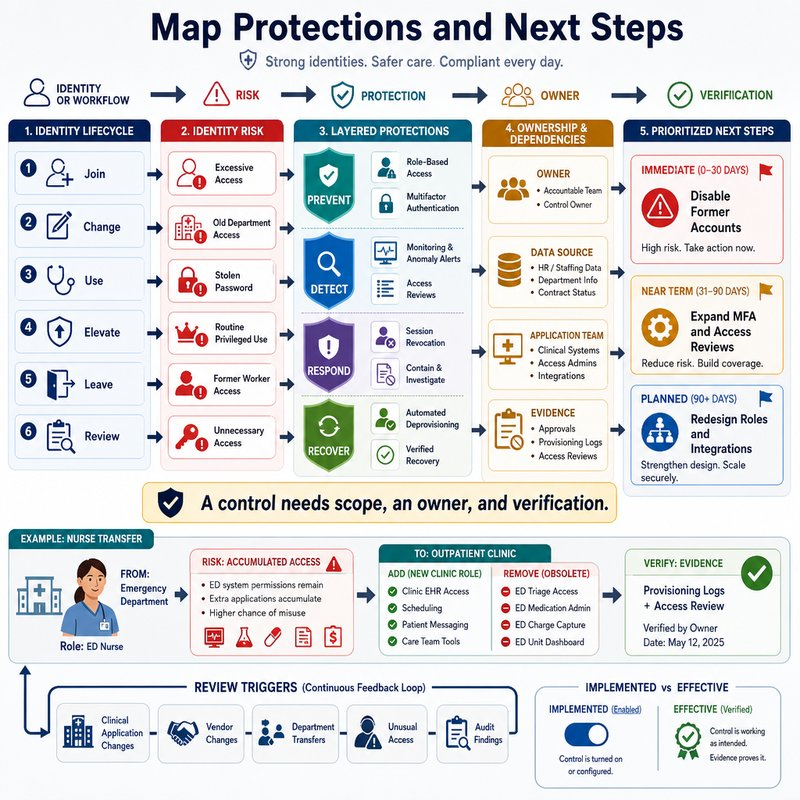
Identity protections should cover the complete lifecycle rather than focus only on sign-in.
| Lifecycle stage | Healthcare risk | Appropriate protections | Verification evidence |
|---|---|---|---|
| Join | A new worker receives excessive access | Role-based access, manager approval, separation of duties | Approved access request and assigned role |
| Change | A clinician keeps access from a previous department | Access review, role reassignment, automated provisioning rules | Updated role and removed entitlements |
| Use | An attacker signs in with a stolen password | Multifactor authentication, conditional access, session monitoring | Authentication and alert logs |
| Elevate | An administrator uses powerful access for routine work | Separate privileged accounts, time-limited elevation, approval | Privileged session and approval records |
| Leave | A contractor retains access after the engagement ends | Automated deprovisioning, account disabling, token revocation | Termination event and disablement record |
| Review | Unnecessary access remains unnoticed | Periodic access certification and exception review | Completed certification and remediation record |
These protections should be applied according to risk. For example, access to a public cafeteria schedule does not require the same controls as access to electronic health records, medication systems, or administrative consoles.
Map controls in layers
A single control can fail or be bypassed. Effective identity security therefore uses layers that prevent, detect, and respond to identity-related events.
-
Preventive controls reduce the chance of inappropriate access. Examples include least-privilege roles, approval workflows, multifactor authentication, and automated deprovisioning.
-
Detective controls reveal unusual or unauthorized activity. Examples include dormant-account reports, failed sign-in alerts, and privileged-access monitoring.
-
Responsive controls limit damage after a problem is detected. Examples include disabling an account, revoking active sessions, rotating credentials, and opening an incident investigation.
-
Recovery controls restore safe access and normal operations. Examples include verified account recovery and controlled emergency-access procedures.
Consider a workforce account used to reach patient records. Multifactor authentication helps prevent account takeover, monitoring can detect access from an unusual location, session revocation can stop ongoing misuse, and a verified recovery process can safely restore access to the legitimate user. Together, these controls provide stronger coverage than any one control alone.
Identify gaps and dependencies
Once current protections are mapped, missing or incomplete coverage becomes easier to see. A gap may mean that no control exists, but it can also mean that an existing control has limited scope, unclear ownership, or weak verification.
Common gap types include:
-
Coverage gaps: A protection applies to employees but not to contractors or service accounts.
-
Lifecycle gaps: Accounts are provisioned correctly but not updated when people change roles.
-
Integration gaps: The identity platform does not receive timely information from human resources, vendor management, or clinical staffing systems.
-
Ownership gaps: Multiple teams assume that another team is responsible for reviewing access.
-
Evidence gaps: A control is believed to operate, but the organization cannot produce logs, approvals, or review records.
-
Exception gaps: Emergency or shared access exists without expiration, monitoring, or documented justification.
Dependencies should be recorded alongside these gaps. Automated deprovisioning, for example, may depend on accurate and timely workforce status information. Privileged-access controls may depend on administrators having separate named accounts. An access review may depend on managers understanding what each entitlement permits.
This prevents an organization from treating a control as an isolated purchase or configuration task. Identity protections usually cross organizational and technical boundaries.
Mini-case: Mapping a departmental transfer
A nurse transfers from an emergency department to an outpatient clinic. The identity platform assigns the new clinic role, but the previous emergency department permissions remain active.
The protection map might record the situation as follows:
| Map element | Entry |
|---|---|
| Identity event | Department transfer |
| Main risk | Access accumulates across roles |
| Affected resources | Clinical records and emergency department applications |
| Preventive protection | Replace role-based access when the department changes |
| Detective protection | Report incompatible or accumulated access |
| Responsive protection | Remove obsolete entitlements after validation |
| Owner | Workforce identity administration |
| Dependency | Accurate department and transfer dates |
| Evidence | Provisioning logs and access review results |
The important lesson is that successful assignment of the new role does not prove that the transfer was handled securely. Both adding required access and removing obsolete access must be verified.
Prioritize the next steps
Not every gap can be corrected at once. Prioritization should reflect potential harm, exposure, urgency, and implementation dependencies.
A beginner-friendly prioritization method uses three levels:
Immediate
Address conditions that create direct or widespread exposure, such as:
-
Active accounts belonging to former workers
-
Uncontrolled privileged or emergency access
-
Shared credentials with no individual accountability
-
Missing strong authentication for high-risk remote access
-
Known unauthorized access to sensitive healthcare systems
Immediate actions may include disabling accounts, revoking sessions, changing credentials, or applying temporary restrictions while a durable solution is developed.
Near term
Improve recurring processes that affect multiple identities or systems, such as:
-
Automating joiner, mover, and leaver events
-
Expanding multifactor authentication coverage
-
Establishing access reviews for sensitive applications
-
Separating privileged accounts from routine user accounts
-
Assigning owners to service accounts and vendor access
-
Setting expiration dates for temporary access
These improvements typically require coordination among identity, security, human resources, clinical operations, application owners, and compliance teams.
Planned
Address structural improvements that may require broader design or integration work, such as:
-
Redesigning overly broad roles
-
Connecting additional applications to centralized identity governance
-
Replacing persistent privilege with time-limited elevation
-
Improving identity data quality across source systems
-
Reducing legacy shared-account dependencies
“Planned” should not mean indefinitely postponed. Each item still needs an owner, a target outcome, and a review date.
A practical roadmap can be captured with six fields:
| Field | Purpose |
|---|---|
| Gap | Describes the missing or incomplete protection |
| Risk | States the possible impact |
| Action | Defines the improvement to make |
| Owner | Names the accountable role or team |
| Target | Defines the expected result and timing |
| Evidence | Shows how completion and effectiveness will be verified |
Avoid prioritizing only by ease of implementation. Quickly enabling a low-impact control may produce visible activity while leaving high-risk access unchanged. Conversely, do not delay every improvement until a perfect enterprise-wide design is available. Temporary restrictions and focused pilots can reduce risk while longer-term work continues.
Maintain the map as an operational record
A protection map is not a one-time assessment. Identities, applications, clinical workflows, vendors, and staffing arrangements change continuously, so the map must be reviewed and updated.
Useful review triggers include:
-
Deployment or replacement of a clinical application
-
Introduction of a new vendor or workforce category
-
Department transfers or organizational restructuring
-
Changes to privileged roles
-
Identification of unauthorized or unusual access
-
Audit findings or failed control checks
-
Repeated use of emergency-access procedures
The organization should also distinguish between implementation and effectiveness. A control may be enabled without producing the intended result. For example, an access review process technically exists, but reviewers approve every entitlement without investigating whether access is still needed.
Evidence of effectiveness may include:
-
Obsolete access removed after role changes
-
Former-worker accounts disabled within the defined process
-
Privileged access granted only after approval
-
Temporary access expiring as intended
-
Detected identity events leading to documented response
-
Exceptions having owners, reasons, expiration dates, and compensating controls
One common misconception is that mapping a security product to a risk completes the task. Products support protections, but people and processes determine scope, approvals, exceptions, monitoring, and response. The protection map must represent this complete operating model.
Recap
A protection map connects identities and workflows to risks, layered controls, accountable owners, dependencies, and verification evidence. Reviewing that map exposes gaps and creates a defensible path from current conditions to prioritized improvements.
The next steps should address urgent exposure first, strengthen repeatable lifecycle processes next, and schedule structural improvements with clear ownership and measurable outcomes. With this roadmap established, the organization can continue its identity security work from a shared view of what is protected, what remains exposed, and what must happen next.