

Map Identities to Healthcare Resources
- View
1.1: Map Identities to Healthcare Resources [12 minutes]
Build the identity-to-resource map
Identity security begins with understanding who or what interacts with each healthcare resource. An identity may represent a person, a device, an application, or an automated process. A resource is anything the organization needs to protect, such as a patient record, clinical application, medical device, database, or administrative system.
An identity-to-resource map records these relationships in a structured form:
Identity → organizational role or purpose → healthcare resource
For example, a registered nurse may be associated with an electronic health record system because documenting patient care is part of the nurse’s job. A laboratory interface may be associated with that same system because it transfers test results. Although both identities interact with the same resource, they represent different identity types and different operational purposes.
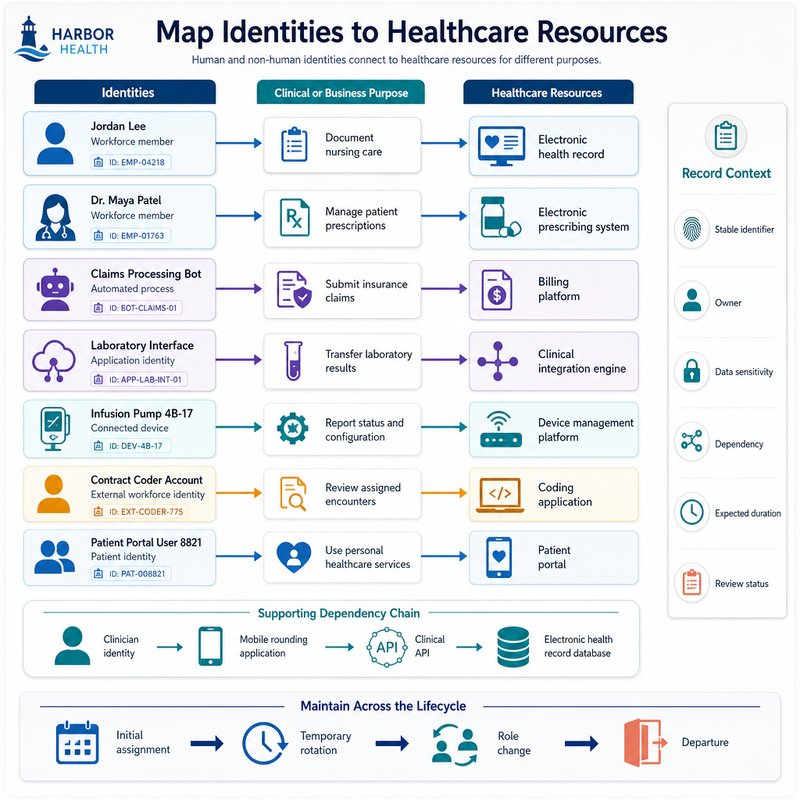
At Harbor Health, the recurring healthcare organization in this course, an initial map might include these relationships:
| Identity | Identity type | Healthcare resource | Business or clinical purpose |
|---|---|---|---|
| Jordan Lee | Workforce member | Electronic health record | Document nursing care |
| Dr. Maya Patel | Workforce member | Electronic prescribing system | Manage patient prescriptions |
| Claims Processing Bot | Automated process | Billing platform | Submit insurance claims |
| Laboratory Interface | Application identity | Clinical integration engine | Transfer laboratory results |
| Infusion Pump 4B-17 | Connected device | Device management platform | Report status and configuration |
| Contract Coder Account | External workforce identity | Coding application | Review assigned encounters |
| Patient Portal User 8821 | Patient identity | Patient portal | Use personal healthcare services |
This map does not yet determine whether an interaction should be permitted. Its immediate purpose is to establish visibility: which identities exist, which resources they are associated with, and why those associations are needed.
Identify both sides of the relationship
A useful map depends on accurate inventories of identities and resources. If either side is incomplete, security teams may overlook relationships that expose sensitive clinical or business information.
Identity categories in healthcare
Healthcare environments contain more than employee accounts. A complete identity inventory commonly includes:
-
Clinical workforce identities: Physicians, nurses, pharmacists, technicians, therapists, and other care team members.
-
Administrative workforce identities: Billing specialists, schedulers, human resources staff, and finance personnel.
-
Temporary and external identities: Students, traveling clinicians, contractors, vendors, researchers, and partner organizations.
-
Patient and caregiver identities: Patients, legal guardians, family caregivers, and authorized representatives.
-
Application and service identities: Interfaces, background services, integration accounts, scheduled jobs, and software agents.
-
Device identities: Workstations, mobile clinical devices, diagnostic equipment, and connected medical devices.
-
Emergency or shared operational identities: Accounts maintained for tightly controlled exceptional or workflow-specific situations.
Each identity should have a stable identifier. Names alone are unreliable because two people can share a name, and a person’s name may change. An internal workforce ID, patient identifier, device ID, or application registration ID provides a stronger mapping key.
Group labels also require care. A label such as Nurse describes a broad profession, but it may not reveal the person’s facility, department, specialty, employment status, or current assignment. Those details can materially change which resources are relevant.
Healthcare resource categories
Resources should be recorded at a level that supports meaningful security analysis. Treating an entire hospital network as one resource would hide important distinctions between systems and data.
Common resource categories include:
-
Electronic health record and clinical documentation systems
-
Pharmacy and electronic prescribing systems
-
Laboratory and imaging systems
-
Patient portals and mobile applications
-
Scheduling, billing, claims, and revenue-cycle platforms
-
Research databases and analytics environments
-
Human resources and payroll systems
-
Cloud services, file repositories, and collaboration platforms
-
Integration engines, APIs, and application databases
-
Clinical workstations and mobile devices
-
Connected medical and diagnostic devices
-
Physical locations, such as medication rooms or data centers
A resource record should include enough context to explain its significance. Useful details include its owner, clinical or business function, location, technical identifier, data handled, and upstream or downstream dependencies.
For example, “laboratory system” may be too vague if Harbor Health operates separate production, training, and research environments. Mapping identities to the specific environment prevents unrelated relationships from being combined.
Record context, ownership, and dependencies
A list of identity names paired with system names is a starting point, not a complete map. The relationship must include context so that security, clinical, and operational teams interpret it consistently.
For each identity-to-resource relationship, record:
| Mapping field | Question it answers |
|---|---|
| Identity identifier | Which exact person, device, or process is involved? |
| Identity type | Is it human, application, service, or device identity? |
| Resource identifier | Which exact system, dataset, device, or location is involved? |
| Relationship purpose | Why does the identity interact with the resource? |
| Organizational context | Which facility, department, team, or partner is involved? |
| Resource owner | Who is accountable for the resource? |
| Identity sponsor or manager | Who confirms that the identity still has a valid purpose? |
| Data sensitivity | What kind of information might the resource contain? |
| Dependency | Does another application, device, or service support the interaction? |
| Expected duration | Is the relationship permanent, temporary, or assignment-based? |
| Review status | When and by whom was the mapping last confirmed? |
Ownership is especially important. The identity team may maintain account records, but it may not understand the clinical purpose of every application. A pharmacy leader, for example, is better positioned to explain why a medication-management interface exists and whether it is still required.
Dependencies can reveal relationships that are otherwise easy to miss. A clinician may use a mobile rounding application, which connects to an API, which then retrieves information from the electronic health record. Mapping only the clinician to the mobile application leaves the supporting API and its application identity invisible.
A simplified relationship chain could be recorded as:
-
Clinician identity → mobile rounding application
-
Mobile application identity → clinical API
-
Clinical API service identity → electronic health record database
The chain shows that human activity may depend on several non-human identities. Those supporting identities belong on the map even when users never see them.
Apply the map across the identity lifecycle
Identity-to-resource relationships change as people, devices, and systems move through their lifecycles. The map must therefore be maintained rather than treated as a one-time inventory.
Consider Jordan Lee, a registered nurse at Harbor Health:
- Initial assignment: Jordan joins the medical-surgical unit and is associated with its clinical documentation, scheduling, and communication resources.
- Temporary rotation: Jordan supports the cardiology unit for six weeks, creating time-limited relationships with cardiology resources.
- Role change: Jordan becomes a clinical educator. Some bedside-care relationships are no longer relevant, while training systems become relevant.
- Departure: Jordan leaves Harbor Health. The organizational relationship ends, and the map should no longer show Jordan as an active workforce identity.
The same principle applies to non-human identities. A laboratory interface may be replaced, a device may be retired, or a cloud application may move from a pilot environment into production. If obsolete relationships remain on the map, they create a misleading picture of the environment.
Build a reliable mapping process
Harbor Health can construct and maintain its map using a repeatable sequence:
- Collect identity records from workforce, patient, contractor, application, and device sources.
- Inventory healthcare resources using application catalogs, device platforms, cloud inventories, and system-owner records.
- Normalize identifiers so records from different systems refer to the same identity or resource consistently.
- Connect identities to resources using observed system associations, assignments, application registrations, and owner input.
- Document the purpose of each relationship in clinical or business terms.
- Assign accountable owners for both the identity context and the resource.
- Flag unknown relationships rather than guessing their purpose.
- Review changes when assignments, contracts, applications, or devices change.
Automated discovery can help collect relationships, but it does not replace human context. A system log may show that an account interacted with a database, yet it may not explain whether the account belongs to a current application, a retired integration, or a temporary migration process. Technical evidence and owner knowledge must be combined.
Several common misconceptions can weaken the map:
-
“Every identity is a user account.” Devices, applications, and services also have identities.
-
“Job title is enough to explain the relationship.” Department, facility, assignment, and employment status may also matter.
-
“One person always equals one identity.” A person may have separate workforce, research, administrative, or patient-facing identities.
-
“A system name identifies one resource.” Production, testing, research, and training instances may need separate records.
-
“Discovered activity proves a valid business purpose.” Activity shows a technical relationship, but its purpose still needs confirmation.
-
“The map is complete once created.” Healthcare identities and resources change continuously.
Recap
An identity-to-resource map connects people, applications, services, and devices to the healthcare resources they use or support. A useful map records stable identifiers, relationship purpose, organizational context, ownership, sensitivity, dependencies, and expected duration.
The result is a current, explainable view of who or what is connected to which healthcare resource and why. The next lesson, Distinguish Verification and Access, will clarify two separate security functions applied to these mapped relationships.