

Distinguish Verification and Access
- View
1.2: Distinguish Verification and Access [10 minutes]
Building on the identity security foundation from the previous lesson, the next distinction is between confirming identity and deciding what that identity may do. These activities are closely connected, but they answer different questions and require separate controls.
Verification establishes confidence in identity
Verification determines whether an identity claim can be trusted. When someone enters a username, presents a badge, or selects an account, the system still needs evidence that the person or system is genuinely associated with that identity.
Three related steps are often involved:
-
Identification: The claimant states an identity, such as
maria.chen@hospital.org. -
Verification: Evidence is evaluated to determine whether the identity claim is credible.
-
Authentication: The system accepts or rejects the claim based on that evidence.
In everyday technical discussions, verification and authentication are sometimes used interchangeably. A useful distinction is that verification is the broader act of establishing confidence, while authentication is the system decision that permits an identity to proceed as recognized.
Verification evidence can come from several categories:
| Evidence category | What it demonstrates | Healthcare example |
|---|---|---|
| Something the person knows | Knowledge associated with the identity | A password or PIN |
| Something the person has | Possession of a registered object | A security key, badge, or managed phone |
| Something the person is | A measured physical characteristic | A fingerprint or facial match |
| Context about the request | Conditions consistent with expected behavior | A managed workstation in a hospital facility |
Presenting evidence does not itself determine which patient records, applications, or clinical functions become available. It only increases confidence that the claimant is the identity they claim to be.
Verification answers: “Are you the identity you claim to be?”
Verification is not permanent certainty
A successful verification creates confidence for a particular interaction and time. It does not prove that every later action is legitimate.
For example, a nurse might authenticate correctly at the beginning of a shift. If the nurse leaves an unlocked workstation unattended, another person could act through the verified session. The original login was valid, but the current user of the session might not be.
Verification can therefore occur at more than one point:
-
When an account is created or enrolled
-
When a session begins
-
When a sensitive action requires renewed confirmation
-
When unusual conditions reduce confidence in an existing session
These checks strengthen confidence in the identity behind an action. They do not define the identity’s permissions.
Access determines what is allowed
After a system recognizes an identity, it must decide whether that identity may use a particular resource or perform a particular action. This decision is commonly called authorization.
Authorization can consider information such as:
-
The verified identity
-
The requested resource
-
The requested action
-
Assigned job responsibilities
-
Current organizational relationships
-
Relevant request conditions
If authorization succeeds, the system grants access to the requested function or information. If it fails, access should be denied—even when the user authenticated successfully.
Access answers: “What is this recognized identity allowed to do here?”
Consider a clinician who signs in successfully to a healthcare system. Authentication may confirm that the user is Dr. Elena Ruiz, but that result alone does not establish whether she may:
-
View a specific patient’s record
-
Update medication orders
-
Access employee health information
-
Export clinical data
-
Change another user’s permissions
Each action requires an access decision. The fact that the clinician’s identity is genuine is necessary, but it is not sufficient.
Authentication success is not authorization success
The basic sequence is:
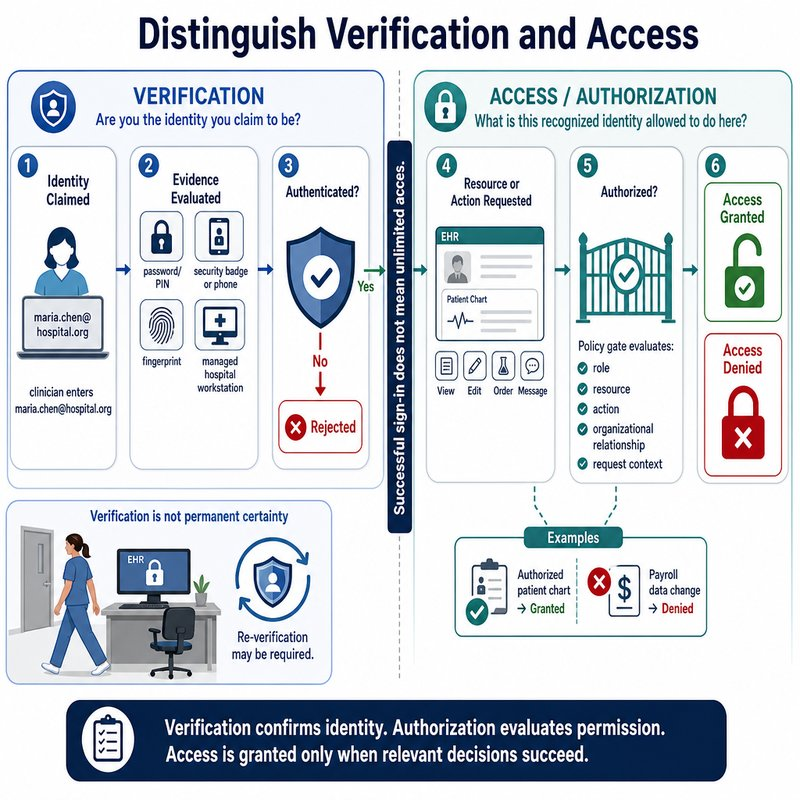
- An identity is claimed.
- Evidence is evaluated.
- The identity is authenticated.
- A resource or action is requested.
- Authorization determines whether access is allowed.
- The system permits or blocks the action.
[[flowchart-placeholder]]
Separating the steps makes failures easier to interpret. An authentication failure means the system could not establish sufficient confidence in the claimed identity. An authorization failure means the system recognized the identity but did not permit the requested action.
| Situation | Verification result | Access result |
|---|---|---|
| A clinician enters an incorrect password | Unsuccessful | Not evaluated or denied |
| A clinician signs in and opens an authorized patient chart | Successful | Granted |
| A clinician signs in and attempts to change payroll data | Successful | Denied |
| A disabled account presents a previously valid password | Evidence may be correct, but authentication is rejected | Denied |
| A service account authenticates but requests an unapproved API operation | Successful | Denied |
This separation prevents a dangerous assumption: “If the person can sign in, the person can use everything in the system.” Sign-in establishes identity confidence; it does not provide unlimited access.
Keeping the controls separate
Verification and access controls often appear together in the same application, which can make them seem like one operation. They should still be managed as distinct decisions.
A healthcare identity may also exist in multiple access contexts. A physician could be verified through the same organizational account when using both a scheduling application and an electronic health record. However, each application can authorize different actions because each protects different resources.
The distinction also applies to nonhuman identities. An interface service may authenticate with a certificate or another credential. The receiving system must still decide which records the service may read, create, or update. Strong verification of the service does not justify unrestricted API access.
Mini-case: a role change
Continuing the course’s healthcare scenario, suppose a registered nurse transfers from the emergency department to outpatient care.
The nurse’s identity remains the same, and the nurse may continue using the same authentication methods. However, the resources required for the new assignment are different. If the organization changes only the nurse’s login details, it has addressed verification without addressing access.
Conversely, assigning new permissions without confirming that the account still belongs to the correct worker creates a different problem. Appropriate access attached to an unreliable identity is not secure.
The organization must therefore treat two questions independently:
-
Verification: Does this account still reliably represent the nurse?
-
Access: Which systems and actions should that nurse now be permitted to use?
A change in one area does not automatically produce the correct change in the other.
Common misconceptions
“A stronger password gives a user safer permissions.”
A stronger password can improve confidence in authentication, but it does not correct excessive permissions.
“Multifactor authentication prevents unauthorized data access.”
It can reduce the risk of an attacker signing in with stolen credentials. A properly authenticated user can still receive or misuse access that should not have been granted.
“Access denied means the login failed.”
A user may authenticate successfully and still be denied a specific resource or action.
“Internal users are already trusted.”
Employment or physical presence does not eliminate the need to verify identity and authorize each relevant request.
“Service accounts only need secure credentials.”
Secure credentials help authenticate a service account. The account must also be limited to its approved operations and resources.
Recap
Verification establishes confidence that an identity claim is genuine. Access control determines what that recognized identity may do with a particular resource.
The key distinction is simple:
-
Verification confirms identity.
-
Authorization evaluates permission.
-
Access is granted only when the relevant decisions succeed.
Keeping these decisions separate helps healthcare organizations avoid treating a successful sign-in as permission to reach every system or record. The next lesson, Apply Core Access Principles, builds on this distinction by examining how access decisions should be approached.