

Manage Access Through Its Lifecycle
- View
2.1: Manage Access Through Its Lifecycle [15 minutes]
Access is a lifecycle, not a one-time decision
Identity security does not end when a user receives an account. People join an organization, change responsibilities, take temporary assignments, go on leave, and eventually depart. Their access must change with them.
This continuous process is the access lifecycle. It connects workforce events and business decisions to the creation, modification, review, and removal of access.
Access should reflect what a person needs now—not what the person needed when the account was first created.
In healthcare, lifecycle management applies to more than employees. A healthcare organization may manage access for:
-
Physicians, nurses, pharmacists, and other clinical staff
-
Administrative and billing personnel
-
Contractors, consultants, students, and volunteers
-
Temporary, agency, and traveling clinicians
-
Researchers and external collaborators
-
Vendors who maintain medical devices or information systems
-
Service accounts and other non-human identities
Each population may follow a different process, but the underlying objective is the same: establish a reliable relationship between an identity, its current responsibilities, and its authorized access.
The main lifecycle stages
The lifecycle is commonly described through three workforce events:
| Stage | What changes | Identity security response |
|---|---|---|
| Joiner | A person enters the organization or begins a relationship with it | Create or register the identity and provide approved initial access |
| Mover | The person changes role, department, location, employment status, or duties | Reevaluate access, add what is needed, and remove what is no longer justified |
| Leaver | The relationship ends or access is no longer required | Disable access promptly, revoke active sessions where appropriate, and remove or retain accounts according to policy |
These stages are not always linear. A physician may leave an employed position but continue as an affiliated provider. A contractor may complete one engagement and return several months later. A nurse may move temporarily to another unit and then return to the original assignment.
For this reason, lifecycle management should respond to the person’s authoritative status, not merely to a help desk request or an expected end date.
The identity record anchors the lifecycle
Lifecycle decisions depend on trusted information about each identity. For workforce identities, the authoritative source is often a human resources system. For physicians, students, contractors, or vendors, the source may instead be a credentialing, student, procurement, or vendor management system.
Useful identity attributes may include:
-
Unique workforce or affiliate identifier
-
Employment or affiliation status
-
Role or job code
-
Department and cost center
-
Facility or location
-
Manager or sponsor
-
Start and end dates
-
Professional or clinical status
-
Leave or suspension status
An identity platform can use changes in these attributes to initiate lifecycle actions. For example, changing a nurse’s department from outpatient cardiology to the emergency department can trigger a reassessment of the nurse’s access.
The authoritative source should establish identity status and organizational context. It should not automatically be treated as the source of every access decision. A job title alone may not capture a person’s exact responsibilities, especially in organizations where staff work across several facilities or perform multiple functions.
From business event to access change
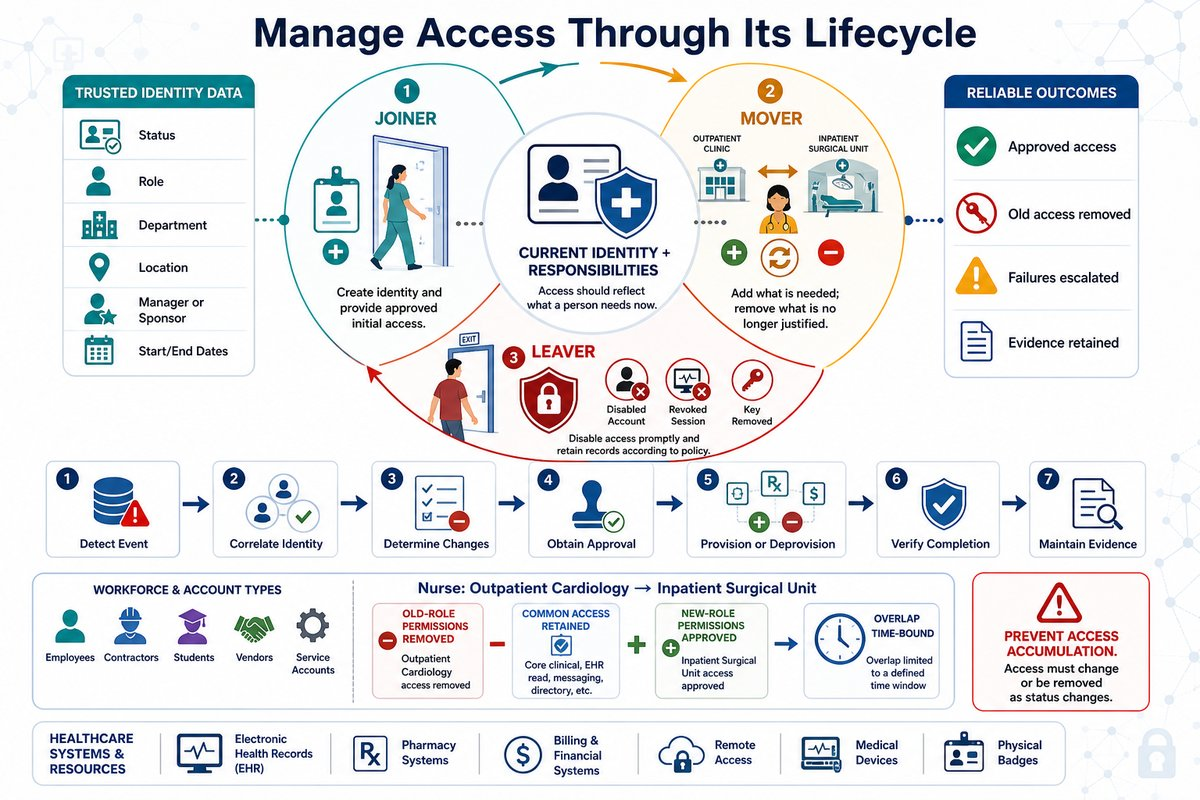
A lifecycle process converts a business event into a controlled access outcome. Effective processes do more than create and disable accounts; they document why access exists, who approved it, when it should change, and whether the change was completed.
[[flowchart-placeholder]]
A typical lifecycle flow includes the following steps:
- Detect the event. A trusted source reports that a person has joined, changed roles, or ended a relationship.
- Correlate the identity. The organization determines whether the person already has an identity record or accounts.
- Determine required changes. Rules and responsible decision-makers identify which access should be created, retained, modified, or removed.
- Obtain required approvals. The appropriate manager, sponsor, system owner, or data owner confirms access that is not assigned automatically.
- Provision or deprovision access. Connected systems receive and process the approved changes.
- Verify completion. The organization confirms that the intended state was reached and records any failures.
- Maintain evidence. The process retains a traceable record of the event, decision, approval, and resulting action.
Automation can make this process faster and more consistent, but automation does not eliminate accountability. Someone must still own the rules, approve exceptions, and address failed changes.
Joiners: provide access at the right time
A joiner process should coordinate access with the person’s verified start date. Providing access too late can disrupt patient care and operations. Providing it too early can create an active account before the organization is ready to supervise or support the user.
Initial access usually combines two types of assignment:
-
Baseline access supports common needs, such as organizational communication or required workforce services.
-
Role- or assignment-based access supports the person’s actual responsibilities, department, facility, or approved project.
Any additional access should follow the organization’s documented request and approval process. The resulting record should identify who requested the access, why it was needed, who approved it, and whether it has an expiration date.
Account creation must also be separated from account activation when necessary. An account might be prepared before a clinician’s first shift but remain unusable until the approved start time and other onboarding conditions have been satisfied.
Movers: remove before access accumulates
Mover events are often the most difficult lifecycle stage because the person remains active. When someone transfers, the organization naturally focuses on adding access for the new responsibilities. Old access can be overlooked because disabling the entire identity is not appropriate.
This creates access accumulation, sometimes called permission or privilege creep. Over time, the user retains access from several previous roles, even though much of it no longer supports current duties.
A mover process should therefore evaluate access in both directions:
-
What access must be added?
-
What existing access remains justified?
-
What access should be removed?
-
Is any access required only during a transition period?
-
Does the change affect the person’s manager, sponsor, location, or ownership responsibilities?
Removal should not depend on a user remembering every system previously used. The lifecycle process should maintain enough information to identify the user’s current accounts and access assignments.
Leavers: terminate the relationship consistently
A leaver event can be planned, such as retirement or the scheduled end of a contract, or unplanned, such as immediate termination. The required speed and coordination may differ, but the organization needs a defined process for both.
A complete leaver process may need to address:
-
Interactive user accounts
-
Remote access and active sessions
-
Application-specific accounts
-
Physical access records
-
Shared resources owned by the departing person
-
Delegated access and approval responsibilities
-
Devices, credentials, tokens, or certificates
-
Data, records, and work products that must be transferred or retained
Disabling an identity is often safer as an immediate first action than deleting it. Deletion can remove information needed for investigation, operational continuity, or record retention. The organization can later remove accounts and data according to its approved retention process.
The lifecycle process must also distinguish among termination, leave, and temporary inactivity. A staff member on approved medical leave may require suspended access without being treated as a permanent leaver. A vendor whose contract has ended should not remain active simply because an internal sponsor failed to request account closure.
Operating lifecycle management reliably
Lifecycle management depends on clear ownership. Human resources, credentialing, procurement, or another source owner reports the business event, but those teams do not necessarily decide every application entitlement. Managers understand current responsibilities, while system and data owners understand the consequences of granting access to their resources.
A practical division of responsibilities looks like this:
| Responsibility | Typical owner |
|---|---|
| Maintain accurate identity status and organizational attributes | Authoritative source owner |
| Confirm the person’s duties and ongoing business need | Manager or sponsor |
| Define access available within an application | System or application owner |
| Decide who may access sensitive information | Data or resource owner |
| Execute and monitor automated lifecycle processes | Identity and access management team |
| Investigate unresolved failures or policy exceptions | Security, compliance, and relevant business owners |
Ownership should also cover orphaned resources. If a departing manager owns a shared mailbox, reporting schedule, service account, or approval queue, that responsibility must transfer to another accountable person.
Track states, not just tickets
A help desk ticket records that someone requested work. It does not necessarily prove that the intended access state was achieved.
Lifecycle management should distinguish among states such as:
-
Event received
-
Identity matched
-
Change calculated
-
Approval pending
-
Provisioning submitted
-
Provisioning completed
-
Provisioning failed
-
Exception accepted
-
Access verified
-
Case closed
This distinction matters when a downstream healthcare application is unavailable or does not support automated changes. A ticket may be marked complete after a task is assigned, even though the account remains active. Reliable lifecycle management confirms the result or escalates the failure.
For every material lifecycle action, the organization should be able to answer:
-
What event caused the change?
-
Which identity and accounts were affected?
-
What access was added, retained, suspended, or removed?
-
Which rule or person authorized the decision?
-
When was the change requested and completed?
-
Did any system fail to apply it?
-
Was an exception granted, and when does it expire?
Manage temporary and exceptional access explicitly
Healthcare operations frequently involve time-bound relationships: agency clinicians, residents, researchers, emergency support personnel, and vendor technicians. Temporary access should have a defined owner and end date whenever the end of the relationship can be predicted.
An expiration date is not enough by itself. The organization must monitor whether the expiration action succeeded and determine what should happen if the person’s assignment is extended.
Exceptions require similar discipline. If access that would normally be removed must remain during a transition, the exception should include:
-
A documented reason
-
An accountable approver
-
The exact access covered
-
A defined expiration or review date
-
A plan for final removal
An exception without an owner or end point can quietly become permanent access.
Applying the lifecycle in a healthcare setting
Continuing the course scenario, consider a nurse who transfers from an outpatient cardiology clinic to an inpatient surgical unit.
The department change appears in the workforce system with an effective date. The identity process correlates the workforce record to the nurse’s existing digital identity and identifies access associated with the old and new assignments.
The process should not simply add the surgical unit’s access. It should:
- Identify access justified by the former outpatient role.
- Determine which common access remains valid.
- Remove access that no longer has a current business justification.
- Submit required new access for approval and fulfillment.
- Time the changes to support the effective transfer date.
- Record successful and failed changes.
- Escalate any unresolved access that remains after the transition.
Some access may legitimately overlap for a short handoff period. If so, that overlap should be treated as a documented, time-bound transition rather than an informal decision to leave all previous access in place.
This example also demonstrates why account counts alone do not measure lifecycle quality. The nurse may use one central identity across several applications, yet still retain inappropriate application roles. Conversely, the nurse may legitimately need several separate accounts because different clinical technologies maintain distinct identity stores. The key question is whether each access assignment remains connected to a current, approved need.
Common lifecycle misconceptions
“Disabling the network account removes all access.”
Applications, remote services, local accounts, credentials, and active sessions may not depend entirely on the network account. Deprovisioning must cover the systems and access paths relevant to the identity.
“Only terminated users are leavers.”
Contract completion, affiliation expiration, revoked sponsorship, and the end of a student placement can all create leaver events.
“A transfer only requires adding the new role.”
Mover processes must also remove access associated with responsibilities the person no longer performs.
“Automation makes lifecycle decisions automatically correct.”
Automation executes the rules and data it receives. Incorrect identity attributes, outdated rules, or poor account correlation can produce incorrect access at greater speed.
“Deleting an account is always the best final step.”
Immediate deletion may interfere with operational transfer, investigation, or retention requirements. Disablement, ownership transfer, retention, and eventual deletion should be handled as distinct actions.
Recap
Access lifecycle management keeps access aligned with a person’s current relationship and responsibilities. It coordinates joiner, mover, and leaver events with approvals, provisioning, verification, exception handling, and evidence.
The most reliable lifecycle processes use trusted identity data, evaluate both additions and removals, confirm that changes actually occurred, and assign clear ownership for unresolved cases. With that lifecycle foundation in place, the next lesson, Apply Stronger Access Controls, will address how access can receive additional protection according to its risk and context.