

Connect Core Identity Controls
- View
3.1: Connect Core Identity Controls [12 minutes]
Identity security works as a connected system
Identity controls are most effective when they operate as a chain rather than as isolated safeguards. In a healthcare environment, that chain must support rapid clinical work while protecting electronic health records, medication systems, diagnostic platforms, billing data, and administrative functions.
A complete identity decision answers several connected questions:
- Who is requesting access?
- How strongly has that identity been verified?
- What is the identity permitted to do?
- Does the request make sense in the current context?
- Can the organization review and prove what happened?
- Will access change or end when the person’s responsibilities change?
No single control answers all six questions. Authentication can confirm that a user presented valid credentials, for example, but it does not determine whether that user should modify a medication order. Authorization can permit the action, but it cannot prove that the account still belongs to an active employee.
A trustworthy access decision depends on multiple controls reinforcing one another throughout the identity lifecycle.
[[flowchart-placeholder]]
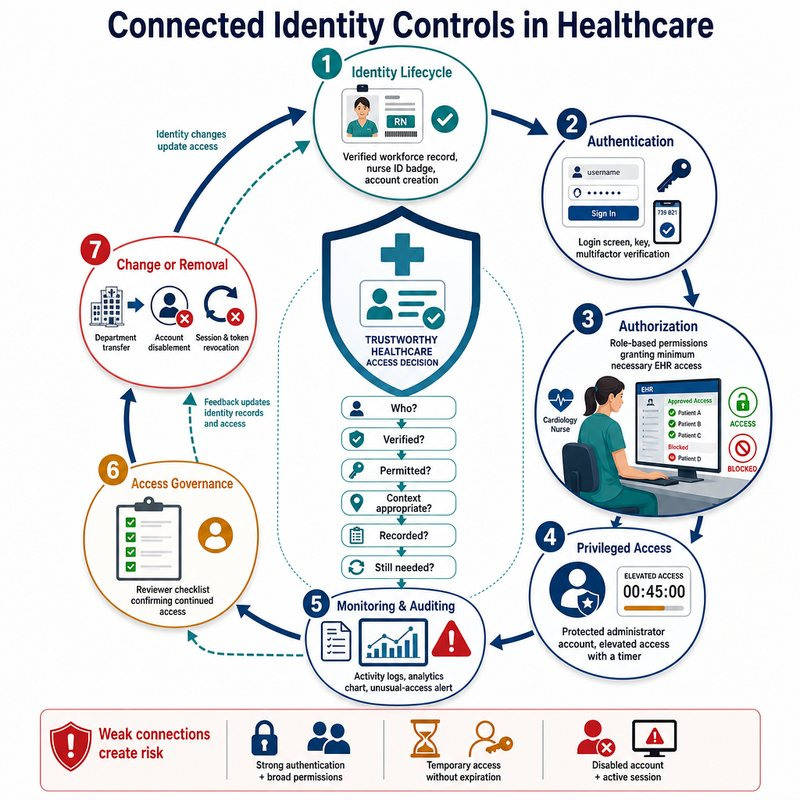
The core controls can be understood as connected layers:
| Control | Primary purpose | Healthcare application |
|---|---|---|
| Identity lifecycle management | Creates, changes, and removes identities and access | Updates a nurse’s access after a transfer or departure |
| Authentication | Verifies that a user, service, or device is presenting an identity | Requires stronger verification before remote EHR access |
| Authorization | Determines which resources and actions are permitted | Allows a pharmacist, but not a scheduler, to verify a medication |
| Privileged access management | Applies additional safeguards to powerful access | Controls administrator access to clinical databases |
| Monitoring and auditing | Records activity and identifies unusual behavior | Detects abnormal access to many patient records |
| Access governance | Reviews whether access remains appropriate | Confirms that department members still need assigned roles |
The controls overlap by design. An identity created through an approved lifecycle process receives access through authorization rules, proves its identity through authentication, generates activity for monitoring, and remains subject to governance reviews.
Follow the identity from creation to removal
The connection among controls becomes clearer when access is examined across its full lifecycle.
Establish the identity
The process begins with an authoritative source, such as an approved workforce or contractor record. That source should establish basic facts including the person’s status, department, role, manager, and start date.
Identity lifecycle management then creates the appropriate digital identity. It may also trigger access requests based on the person’s role. The goal is not to give every new worker immediate access to every possible system; it is to create a controlled starting point from verified organizational information.
For the healthcare organization in the course scenario, consider a newly hired registered nurse assigned to the cardiology unit. The workforce record establishes the nurse’s employment and assignment. The identity platform creates an account, while authorization rules provide baseline access associated with a cardiology nurse.
This first connection is critical:
Authoritative identity data → account creation → role assignment → approved access
If the initial data is wrong, later controls may enforce the wrong decision perfectly. For example, an incorrect department assignment could give the nurse access to patient populations unrelated to the nurse’s duties.
Verify access attempts
After the account exists, authentication verifies attempts to use it. Authentication factors may include something the user knows, has, or is. Stronger authentication is especially important for remote access, privileged actions, password recovery, and other higher-risk events.
Authentication should connect to context rather than apply every requirement identically. Relevant signals can include:
-
Whether the user is working remotely or within a trusted clinical environment
-
Whether the device is known and managed
-
Whether the location or access time is unusual
-
Whether the requested action involves sensitive or privileged capabilities
-
Whether the current behavior differs sharply from normal use
A successful authentication does not automatically justify every action. It establishes confidence that the user is connected to the identity being presented. Authorization must still decide what that identity may do.
Authorize the minimum necessary access
Authorization converts job responsibilities and approved exceptions into permissions. Common approaches include role-based access control, attribute-based decisions, and direct entitlements. Healthcare organizations often combine these approaches because clinical responsibilities cannot always be represented by a single job title.
For example, the cardiology nurse’s access may depend on several pieces of information:
-
The user has an active nurse role.
-
The user is assigned to cardiology.
-
The patient is within an authorized care relationship or work queue.
-
The requested function is appropriate for nursing responsibilities.
-
Any temporary assignment is still valid.
The authorization decision should grant only the access needed for current responsibilities. This is the principle of least privilege. Least privilege does not mean assigning so little access that clinical work becomes impractical. It means avoiding permissions that are unnecessary, excessively broad, or retained longer than needed.
Temporary access should also have a defined reason, owner, and expiration. An indefinite permission created for a short-term coverage assignment is a common source of access accumulation.
Add safeguards around privileged identities
Some identities can change systems, security settings, databases, or other users’ permissions. These privileged identities require controls beyond ordinary workforce access because misuse can affect many systems or records at once.
Privileged access management can strengthen the chain by:
-
Separating routine user accounts from administrator accounts
-
Requiring stronger authentication for privileged sessions
-
Granting elevated access only when needed
-
Limiting how long elevated access remains active
-
Recording or closely monitoring administrative actions
-
Protecting powerful credentials from direct exposure
A clinical systems administrator, for example, may use a standard account for email and documentation but activate a separate administrative identity for an approved system change. This separation reduces the likelihood that a compromised everyday account will immediately provide privileged capabilities.
Maintain trust after access is granted
An access decision is not permanently trustworthy simply because it was correct when first approved. Employment status, care assignments, devices, threats, and job responsibilities all change.
Monitor activity and respond to risk
Monitoring connects identity decisions to actual behavior. Authentication logs show how an identity entered the environment, while application and system logs show what it did afterward. Combining these records provides more useful evidence than reviewing either source alone.
Suppose the cardiology nurse authenticates successfully from a managed workstation. The account then opens hundreds of patient records across unrelated departments within a short period. Authentication alone appears normal, but the activity pattern may indicate account misuse, inappropriate curiosity, or an automated process operating under the wrong identity.
A monitoring process may respond by:
-
Generating an alert for investigation
-
Requiring the user to authenticate again
-
Restricting or ending the session
-
Temporarily suspending selected access
-
Preserving relevant records for review
Monitoring should support proportionate responses. Not every unusual event proves malicious activity, especially in healthcare settings where emergencies and temporary assignments can create legitimate exceptions.
Govern access over time
Access governance evaluates whether assigned access remains justified. Managers, application owners, data owners, or other accountable reviewers may confirm that users still need their roles and entitlements.
Governance depends on understandable information. A reviewer is unlikely to make a reliable decision when presented only with technical entitlement names. The review should communicate what the access permits, why it was assigned, when it was last used, and whether it introduces elevated risk.
Governance also feeds corrections back into the lifecycle. If a reviewer rejects an entitlement, the result should trigger its removal rather than remain as an unimplemented recommendation.
The connection is therefore circular:
Identity changes → access changes → activity is monitored → access is reviewed → corrections update the identity
Remove or adjust access promptly
Lifecycle controls must react to changes, not only to initial hiring. Common change events include:
-
Transfer to another department
-
Promotion or change in clinical responsibilities
-
Leave of absence
-
Completion of a temporary assignment
-
Contractor engagement ending
-
Employment termination
When the cardiology nurse transfers to an outpatient clinic, adding the new clinic role is only half of the process. The organization must also evaluate and remove cardiology permissions that are no longer required. Otherwise, the user accumulates access with each change.
When the relationship ends, account disabling should connect to session termination, token revocation, remote access removal, and recovery of managed credentials or devices where applicable. Disabling one application account while leaving active sessions or secondary accounts available creates an incomplete termination process.
Recognize weak connections and misconceptions
Identity incidents often result from gaps between otherwise capable controls. Each control may function correctly on its own while the overall process remains unsafe.
| Weak connection | Resulting risk |
|---|---|
| Workforce records do not update the identity platform | Departed workers or obsolete roles retain access |
| Authentication is strong, but authorization is too broad | A verified user can perform unnecessary actions |
| Access is approved without an expiration date | Temporary permissions become permanent |
| Monitoring cannot connect actions to individual identities | Investigations cannot establish accountability |
| Governance findings do not trigger removal | Known excessive access remains active |
| Shared administrator credentials bypass individual accounts | Privileged activity cannot be attributed reliably |
Several misconceptions can hide these gaps.
“Multifactor authentication makes the account secure.”
Multifactor authentication strengthens identity verification, but it does not correct excessive permissions, inappropriate role assignments, or unsafe activity after sign-in.
“A valid role assignment means every use of access is appropriate.”
A role establishes permitted capabilities. Monitoring and contextual checks are still needed because a legitimate account can be misused or compromised.
“Removing the main account ends all access.”
Access may remain through active sessions, service accounts, local application accounts, cached credentials, API tokens, or privileged identities unless the termination process addresses them.
“More logging automatically creates accountability.”
Logs are useful only when identities are distinguishable, timestamps and events can be connected, records are protected, and authorized personnel can interpret the activity.
The objective is not to maximize the number of controls. It is to make each control provide useful information or enforcement to the next one. Reliable identity security emerges when identity data, authentication, authorization, privilege management, monitoring, governance, and lifecycle actions agree about who the user is and what the user should be able to do.
Recap
Core identity controls form a continuous system:
-
Lifecycle management establishes and updates trusted identities.
-
Authentication verifies attempts to use those identities.
-
Authorization limits actions according to current responsibilities.
-
Privileged access management adds protection around powerful capabilities.
-
Monitoring connects identity decisions to observed behavior.
-
Governance confirms that access remains justified.
-
Lifecycle actions remove access when it is no longer needed.
The strength of this system depends on the connections between its parts. In Map Protections and Next Steps, you will organize these protections and identify how to proceed from the connected control model.