

Apply Core Access Principles
- View
1.3: Apply Core Access Principles
Estimated reading time: 12 minutes
Building on the identity concepts established earlier in this section, the next step is deciding what an authenticated identity should be allowed to do. In healthcare, that decision must support patient care while limiting unnecessary exposure to clinical, financial, and operational systems.
Turn job responsibilities into access decisions
Authentication answers, “Who is requesting access?” Authorization answers, “What may that identity do?” Core access principles guide authorization decisions so that access is deliberate, limited, and defensible.
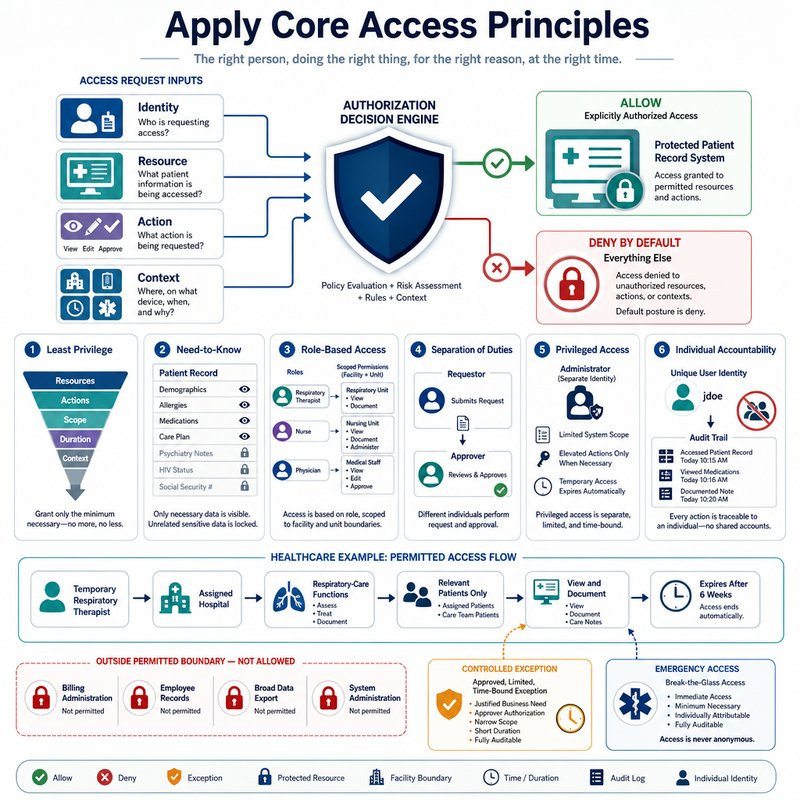
A sound access decision connects four elements:
-
Identity: The person, service, device, or workload making the request.
-
Resource: The application, patient record, report, interface, or administrative function being requested.
-
Action: What the identity wants to do, such as view, create, update, approve, export, or delete.
-
Context: Relevant conditions, such as location, device security, assigned facility, work schedule, or emergency status.
For example, identifying someone as a registered nurse does not automatically justify access to every electronic health record. Authorization must also consider the nurse’s assigned unit, relationship to the patient, required action, and current working context.
Access should be based on what an identity needs to accomplish an authorized responsibility—not on what might be convenient someday.
Apply least privilege
The principle of least privilege grants only the minimum access required to perform an approved task. “Minimum” applies to several dimensions:
| Dimension | Question to ask |
|---|---|
| Resources | Which systems, records, or data sets are required? |
| Actions | Must the identity only view data, or also change it? |
| Scope | Is access needed for one patient, one department, or the entire organization? |
| Duration | Is access permanent, scheduled, or temporary? |
| Context | Should access depend on location, device, assignment, or another condition? |
A pharmacist may need to view medication orders and allergy information, document medication-related interventions, and verify dispensing activity. That does not necessarily mean the pharmacist needs permission to edit surgical notes, change insurance information, or administer the identity platform.
Least privilege does not mean providing so little access that employees cannot perform their duties. It means removing permissions that are unrelated to those duties. Access that is insufficient can interrupt care and encourage unsafe workarounds, while excessive access increases the potential impact of mistakes, compromised accounts, and misuse.
Enforce need-to-know
Need-to-know narrows access according to whether specific information is necessary for an authorized purpose. It is closely related to least privilege, but the two principles emphasize different questions:
-
Least privilege asks, “What is the smallest set of capabilities this identity requires?”
-
Need-to-know asks, “Does this identity require this particular information for the current responsibility?”
A billing specialist may need diagnosis and procedure information to prepare a claim, but may not need full access to psychotherapy notes or unrelated clinical history. Similarly, a clinician may require clinical information for treatment but may not need access to payroll or employee disciplinary records.
Need-to-know should be translated into enforceable permissions wherever possible. Depending only on users to ignore irrelevant information leaves unnecessary exposure in place.
Deny access by default
A default-deny model starts with no access and adds permissions only when a valid requirement has been established. This is safer than granting broad access first and trying to remove unnecessary permissions later.
Under default deny:
- A new identity begins without business-system permissions.
- Approved responsibilities determine which access is added.
- Anything not explicitly permitted remains unavailable.
- Changes in responsibility lead to a new access decision.
Default deny is not the same as denying every unfamiliar request forever. It means that access requires a defined rule, approved exception, or controlled emergency process rather than an assumption that access should be allowed.
Design access around roles and boundaries
Healthcare organizations contain many job titles, but job titles alone are often too broad for accurate access decisions. Two nurses may work in different facilities, and two application administrators may support different systems. Access design therefore needs both reusable roles and clear boundaries.
Use roles as starting points
Role-based access groups permissions according to a job function or responsibility. Instead of assigning dozens of permissions directly to each employee, the organization can define roles such as:
-
Emergency department nurse
-
Outpatient scheduler
-
Inpatient pharmacist
-
Claims specialist
-
Laboratory technician
-
Electronic health record support administrator
Roles improve consistency because people performing comparable work receive comparable baseline access. They also make access easier to explain: permissions are tied to a defined responsibility rather than accumulated through unrelated individual requests.
However, a role should not become a collection of every permission that any member has ever requested. That produces role creep, in which a role gradually becomes broader than the actual needs of most users.
A well-designed role should have:
-
A clear business purpose.
-
A defined population of eligible identities.
-
An accountable owner.
-
A documented set of permissions.
-
Known restrictions or exclusions.
-
A process for handling exceptions.
Role membership may also need additional limits. An “inpatient nurse” role could provide a baseline set of clinical functions, while facility and unit assignments restrict which patient populations are visible.
Separate conflicting duties
Separation of duties divides sensitive processes among multiple identities so that one person cannot complete an entire high-risk transaction without oversight. The principle reduces the risk of fraud, concealed errors, and unauthorized changes.
Common patterns include separating the ability to:
-
Request access from the ability to approve it.
-
Create a vendor from the ability to issue payment.
-
Develop a system change from the ability to deploy it to production.
-
Modify identity roles from the ability to review those modifications.
-
Enter a controlled transaction from the ability to authorize it.
Separation of duties may be preventive or detective. Preventive controls block conflicting access or require a second participant before an action can be completed. Detective controls flag or report conflicting activity for review. Preventive controls are stronger when practical, but detective controls may be necessary when staffing or clinical operations make strict prevention difficult.
The goal is not to require two people for every routine task. Separation should focus on combinations of authority that create meaningful risk.
Limit privileged access
Privileged permissions allow identities to administer systems, change security settings, manage other users, or bypass normal restrictions. These permissions should be more tightly controlled than ordinary business access.
Core access principles apply to privileged identities with additional rigor:
-
Use a separate administrative identity instead of performing routine work with privileged access.
-
Limit privileges to the specific systems being administered.
-
Grant elevated access only for the required period when feasible.
-
Avoid shared administrator accounts because they weaken individual accountability.
-
Do not give human users unnecessary permissions assigned to service identities.
-
Remove privileged access promptly when the supporting responsibility ends.
A database administrator may need to maintain the infrastructure supporting an electronic health record. That technical responsibility does not automatically create a clinical need to read patient information. Administrative capability and permission to use data for a business purpose are separate concerns.
Technical ability to reach information is not the same as authorization to use that information.
Apply the principles as one decision
The principles work best when applied together rather than as independent slogans. Consider the continuing healthcare scenario of a temporary respiratory therapist assigned to one hospital for six weeks.
A broad approach might copy the permissions of a permanent clinician. A more precise decision proceeds from the therapist’s actual responsibility:
- Confirm the identity and assignment. The worker is verified as a temporary respiratory therapist assigned to a specific hospital.
- Identify required resources. The therapist needs the clinical application and respiratory-care functions.
- Limit allowed actions. Access permits viewing relevant clinical information and documenting respiratory assessments and treatments.
- Restrict the scope. Patient access is associated with the assigned facility and care relationships rather than the entire health system.
- Exclude unrelated capabilities. The therapist does not receive billing administration, employee records, broad data export, or system-administration permissions.
- Set a time boundary. The access is scheduled to end with the six-week assignment.
- Preserve accountability. The therapist uses an individually assigned identity rather than a shared departmental account.
- Handle unusual needs explicitly. Any additional permission requires a defined exception rather than being added to the baseline role.
This decision combines least privilege, need-to-know, default deny, role-based assignment, time limitation, and accountability. No single principle is sufficient by itself. For example, a well-designed role can still create excessive access if it is assigned to the wrong person or left active after the assignment ends.
Distinguish standard access from exceptions
Not every legitimate healthcare situation fits a standard role. A clinician may temporarily cover another unit, an external specialist may participate in a consultation, or support personnel may require elevated access to resolve an incident.
Exceptions should be handled as controlled additions to baseline access. A defensible exception identifies:
-
The business or clinical reason.
-
The exact permission required.
-
The person authorized to approve it.
-
Any time or context restrictions.
-
The individual identity using the access.
An exception should not silently become the new standard. If the same exception occurs repeatedly, the organization should determine whether the baseline role is incomplete or whether the repeated requests are unnecessarily broad.
Emergency access may also require an exception to normal restrictions when delaying access could interfere with patient care. The existence of an urgent need does not eliminate identity security principles. Emergency access should remain individually attributable, limited to the necessary capability, and distinguishable from normal access.
Avoid common access design mistakes
Core principles can be undermined by implementation choices that appear efficient in the short term.
“Everyone in the department needs the same access”
Departments often contain multiple responsibilities. A health information management department, for example, may include employees who process record corrections, release information, manage coding, or supervise operations. Department membership can inform access, but it should not replace analysis of specific job functions.
“View-only access is harmless”
Read access can expose sensitive information even when the user cannot change it. Viewing, searching, printing, downloading, and exporting may carry different levels of risk and should not automatically be treated as one harmless permission.
“More access helps people work faster”
Excessive access may reduce the number of requests a user must make, but convenience alone is not a sufficient business justification. Broad access can increase accidental disclosure, allow unauthorized changes, and expand the consequences of account compromise.
The better approach is to make correctly scoped access efficient to obtain rather than granting broad permissions in advance.
“A manager’s approval makes any access appropriate”
Approval is an important control, but it does not replace sound access design. An approver may misunderstand a technical permission or request a broader role than the employee needs. Access should satisfy both an authorized business decision and established security rules.
“Shared accounts are acceptable if the team trusts each other”
Trust among coworkers does not provide individual accountability. Shared accounts make it difficult to establish who viewed a record, changed a configuration, or performed a sensitive action. Each person should use an individual identity whenever the system supports it, with permissions appropriate to that person’s responsibilities.
Recap
Core access principles convert verified identities and job responsibilities into controlled authorization decisions:
-
Least privilege minimizes resources, actions, scope, duration, and context.
-
Need-to-know limits information to what is required for an authorized purpose.
-
Default deny requires a valid basis before access is granted.
-
Role-based access creates consistent baselines without replacing scope restrictions.
-
Separation of duties prevents one identity from controlling an entire high-risk process.
-
Privileged access controls apply stronger limits to administrative capabilities.
-
Individual accountability ensures sensitive actions can be attributed to a specific identity.
Applied together, these principles allow healthcare personnel and systems to perform authorized work without creating unnecessary paths to patient data or critical operations.