

Knowledge representation and task planning
- View
Turning a laboratory request into executable action
A laboratory robot receives a seemingly straightforward instruction: transfer a sealed sample carrier from the preparation bench to an analyser. The carrier is visible, the destination is identifiable, and the robot has a functioning gripper. Yet the instruction leaves crucial dependencies unstated: the gripper must be available, the carrier must be accessible, and the analyser’s receiving position must be clear.
For this lesson, consider a deliberately simplified laboratory in which actions occur sequentially, their outcomes are deterministic, and all task-relevant facts are available. The robot must translate an operational request into explicit facts, action requirements, and a verifiable goal. This is the central problem of knowledge representation and task planning: deciding what the robot must represent before it can determine what to do.
The connection with metacognition is purposeful rather than metaphorical. METATOOL investigates computational models of synthetic awareness informed by human metacognition, with validation through robotic experiments. Here, the narrower concern is how explicit representations make a robot’s proposed actions and assumptions inspectable—not whether the robot possesses human-like awareness. METATOOL
Facts, goals and actions form different commitments
The request “transfer the carrier” becomes tractable when the robot separates the present situation from the desired outcome. Knowledge representation supplies a structured vocabulary for expressing relevant entities, properties and relationships. Task planning uses a model of available actions to identify a sequence that transforms an initial state into one satisfying a goal. These are complementary functions: describing a situation does not itself determine how to change it. PDDL4J tutorial
| Dimension | Knowledge representation | Task planning |
|---|---|---|
| Principal question | What entities, relationships and conditions matter? | Which applicable actions establish the goal? |
| Laboratory example | At(carrier_1, preparation_bench) |
Pick up carrier_1, then place it at the analyser |
| Primary output | A formal description of the task-relevant world | An ordered sequence of actions |
| Quality criterion | Relevant distinctions are represented consistently | Each action is applicable and the final state satisfies the goal |
In the laboratory model, objects include carrier_1, preparation_bench and analyser_station. A predicate, such as At, expresses a relationship; applying it to specific objects produces a proposition, such as At(carrier_1, preparation_bench). A state records the propositions that hold at a particular point in the model, while a goal condition specifies what must hold after execution. This separation follows the planning distinction between a reusable domain description and a particular problem’s objects, initial state and goal. PDDL4J tutorial
For the worked scenario, use the following commitments:
-
Initial location:
At(carrier_1, preparation_bench). -
Available manipulator:
GripperEmpty. -
Available destination:
Clear(analyser_station). -
Required outcome:
At(carrier_1, analyser_station)andGripperEmpty.
The final condition deliberately requires the robot to release the carrier. Merely holding it above the analyser does not satisfy the stated goal. A precise goal therefore distinguishes successful completion from an intermediate configuration that only resembles completion.
Represent enough of the world to distinguish success from failure
Suppose the robot records only that carrier_1 exists. That description cannot distinguish a carrier on the preparation bench from one already inside the analyser’s receiving position. Introducing a location predicate makes the distinction explicit and enables actions to refer to it. Abstraction means retaining distinctions needed for the task while omitting details that the chosen model does not require; feature-based representations avoid enumerating every possible state separately. Poole and Mackworth
For this laboratory model, retain location, gripper occupancy and receiving-position availability, but omit carrier colour. This is a modelling choice, not a claim that colour can never matter: a colour-coded handling protocol would require a different representation. The practical discipline is to justify each omission against the task’s requirements. A compact representation is useful only while it preserves every distinction needed to evaluate the proposed actions.
A common pitfall is to confuse an omitted fact with a verified negative. In the classical closed-world encoding used here, a ground proposition absent from the state is treated as false within the model. That convention makes reasoning manageable, but it does not establish that the robot has physically observed the proposition to be false. For the worked example, therefore, Clear(analyser_station) is explicitly established before planning rather than silently assumed. LaValle, Planning Algorithms
| Modelling decision | Chosen representation | Consequence in this scenario |
|---|---|---|
| Carrier identity | carrier_1 |
The goal concerns one identified carrier |
| Carrier location | At(carrier_1, preparation_bench) |
Pickup can require the correct source location |
| Gripper occupancy | GripperEmpty or Holding(carrier_1) |
The model distinguishes availability from possession |
| Destination availability | Clear(analyser_station) |
Placement cannot proceed into an occupied receiving position |
| Carrier colour | Omitted | No action or goal in this example depends on colour |
Describe actions through their requirements and consequences
Before pickup, the carrier occupies the preparation bench and the gripper is empty. After pickup, the robot holds the carrier and the bench-location proposition no longer holds. An action model captures this transition through preconditions, which specify when an action is applicable, and effects, which specify what changes. STRIPS-style representations express such changes through propositions added to and removed from the current state. LaValle, Planning Algorithms
For this example, assume that both stations lie within the robot’s validated working envelope and that each manipulation action includes the necessary local movement. PickUp(carrier_1, preparation_bench) requires both the carrier’s presence and an empty gripper. Its effects establish Holding(carrier_1) and remove the carrier’s bench location and GripperEmpty. Without those removals, the model could incorrectly represent the carrier as simultaneously resting on the bench and being held.
The associated best practice is to specify lost conditions as carefully as newly established ones. Conversely, an action should not arbitrarily alter unrelated facts: the STRIPS frame assumption preserves primitive features not mentioned in its effects. Pickup therefore leaves Clear(analyser_station) unchanged in this example. This is a modelling convention for predicting transitions, not a guarantee that the physical environment remains undisturbed. Poole and Mackworth
| Action component | PickUp(carrier_1, preparation_bench) |
Place(carrier_1, analyser_station) |
|---|---|---|
| Preconditions | At(carrier_1, preparation_bench); GripperEmpty |
Holding(carrier_1); Clear(analyser_station) |
| Added propositions | Holding(carrier_1) |
At(carrier_1, analyser_station); GripperEmpty |
| Removed propositions | At(carrier_1, preparation_bench); GripperEmpty |
Holding(carrier_1); Clear(analyser_station) |
Find a sequence whose intermediate states remain valid
From pickup to a verified goal
The robot cannot place the carrier first: the placement precondition Holding(carrier_1) is absent initially. Pickup establishes that missing condition, making placement applicable afterwards. A plan is therefore more than a plausible list of verbs; it must respect action requirements at every intermediate state and establish the goal at its end. Classical planning formalises this through an initial state, a goal and action-induced transitions. University of Rome planning notes
In the laboratory example, an applicable action is merely eligible for consideration, not necessarily useful. If the model also permits placing the carrier back on the preparation bench, that action may be executable after pickup without advancing the analyser-delivery goal. The distinction prevents a common misconception: executability alone does not constitute task success. A candidate sequence must be evaluated against its intended outcome, rather than against action availability alone.
For this lesson, inspect the sequence through forward state progression: start from the initial facts, apply an eligible action, and inspect the resulting facts. This makes dependencies visible without requiring a particular search algorithm. It also separates validity from optimality: a sequence may satisfy the task without being the shortest or least costly available sequence. No optimality claim is made for the worked examples; their purpose is to demonstrate explicit causal justification. PDDL4J tutorial
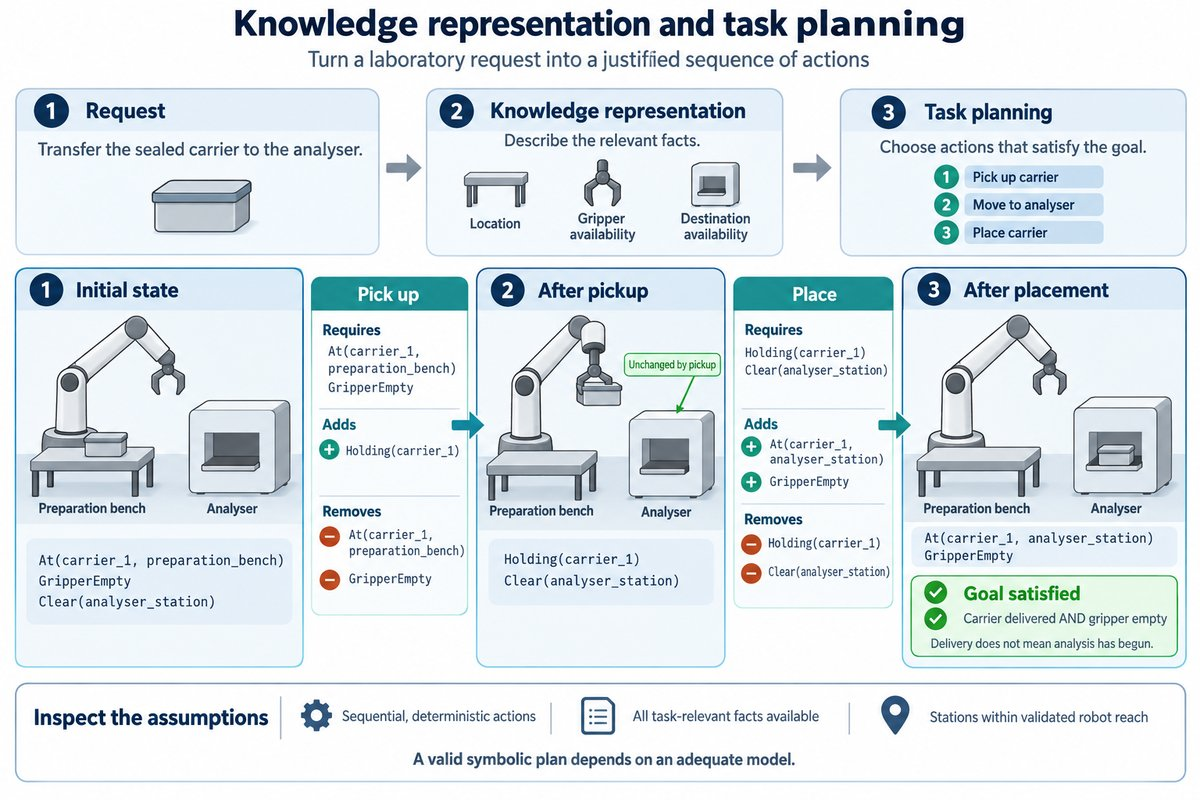
- Input: the initial state. Check pickup’s preconditions; output: pickup is applicable.
- Input: the initial state and pickup’s effects. Update the propositions; output: a state containing
Holding(carrier_1). - Input: the updated state. Check placement’s preconditions; output: placement is applicable.
- Input: the placement result and the goal condition. Check both required propositions; output: a model-valid completion.
[[flowchart-placeholder]]
Example: transferring a sample carrier to an analyser
Consider the first complete laboratory operation: carrier_1 must move from the preparation bench to the analyser’s receiving position. The initial state contains the carrier’s location, an empty gripper and a clear destination. The following walkthrough uses the stipulated action definitions; it is an illustrative model, not a report of measured robot performance.
- Input:
At(carrier_1, preparation_bench)andGripperEmpty. Apply pickup; output:Holding(carrier_1), with the source-location and empty-gripper propositions removed. - Input:
Holding(carrier_1)andClear(analyser_station). Apply placement; output:At(carrier_1, analyser_station)andGripperEmpty. - Input: the resulting state. Compare it with the delivery goal; output: both goal conditions hold.
| Tracked condition | Before pickup | After pickup | After placement |
|---|---|---|---|
| Carrier at preparation bench | True | False | False |
| Robot holding carrier | False | True | False |
| Carrier at analyser station | False | False | True |
| Gripper empty | True | False | True |
The immediate benefit is traceability: each required condition has an identifiable cause within the sequence. Within this modelled workflow, the transfer establishes the carrier’s location but does not establish that analysis has begun. A separate analyser operation would require its own action definition and completion criteria; treating arrival as analytical completion would overstate the plan’s achievement.
The limitation is equally important: a valid symbolic sequence does not, by itself, demonstrate physical executability. The supporting planning formulation assumes that lower-level control can implement the modelled actions. In this example, reachability and manipulation capability are stipulated prerequisites rather than conclusions derived from the two-action plan. Poole and Mackworth
Example: making a blocked receiving position available
Continue within the same laboratory: a second carrier, carrier_2, awaits transfer, but a reusable fixture occupies the analyser’s receiving position. The model now includes At(fixture_1, analyser_station) and Clear(storage_position), while Clear(analyser_station) is false. For this extension, assume one gripper and the same validated access to all three positions; pickup also establishes that its source position is clear.
- Input:
At(fixture_1, analyser_station)andGripperEmpty. Pick up the fixture; output:Holding(fixture_1)andClear(analyser_station). - Input:
Holding(fixture_1)andClear(storage_position). Store the fixture; output:At(fixture_1, storage_position)andGripperEmpty. - Input:
At(carrier_2, preparation_bench)andGripperEmpty. Pick up the carrier; output:Holding(carrier_2). - Input:
Holding(carrier_2)andClear(analyser_station). Place the carrier; output: the delivery goal is satisfied.
The fixture-removal action is useful even though it does not directly establish the delivery goal. It establishes a prerequisite, while storage restores the gripper availability needed for carrier pickup. This illustrates a central planning principle: useful actions may prepare conditions for later actions rather than directly produce the requested outcome. Preconditions and effects provide the explicit causal structure needed to express that dependency. LaValle, Planning Algorithms
The benefit in this stipulated workflow is that preparation becomes part of the plan rather than an unrecorded human intervention. The limitation is that fixture relocation is acceptable only under the model’s assumptions: an unrepresented requirement to keep the fixture installed would invalidate the operational interpretation. The metacognitive connection is the discipline of examining those assumptions explicitly, rather than equating an internally coherent plan with a complete account of the task.
A plan is a justified chain of changes
-
Represent relevant distinctions: identity, location and resource availability must support the task’s actual completion criteria.
-
Define actions causally: record what must hold, what becomes true and what ceases to hold.
-
Inspect intermediate states: each action must be applicable when reached.
-
Separate model validity from operational completeness: successful reasoning depends on the adequacy of its assumptions.
The laboratory scenario turns a broad instruction into a chain of inspectable commitments. Each action has a reason to occur, each state change has an explicit source, and completion has a testable meaning. That discipline makes task planning both more intelligible and more amenable to scrutiny.
Next, we'll build on this by exploring Decision-making under uncertainty.