

Feedback and behavioural regulation
- View
When an accurate command produces an inaccurate result
A laboratory robot attempts to place a specimen carrier at a position of 100 mm along a rail. Its motor receives the intended command, yet its position sensor reports 92 mm. The command is correct; the outcome is not. Throughout this lesson, this illustrative laboratory scenario provides a concrete setting for examining how a system detects discrepancies, corrects its actions and determines when its own strategy requires revision.
The distinction between issuing commands and evaluating consequences is fundamental to adaptive robotics. Feedback control connects measured outcomes to subsequent action, while metacognitive approaches extend this concern towards monitoring and evaluating the processes that produce those actions. The METATOOL project places this relationship within a research programme investigating computational models of synthetic awareness grounded in human metacognition and evaluated through robotic experiments. Its stated objectives concern self-evaluation and adaptation, rather than merely the execution of predetermined movements. (cds.caltech.edu)
By the end of the lesson, you should be able to:
-
Identify the reference, measurement, error and corrective action within a feedback loop.
-
Explain why corrective feedback can nevertheless produce unreliable behaviour.
-
Distinguish direct movement correction from the regulation of an underlying strategy.
-
Interpret robotic and human self-monitoring without conflating functional similarities with identical mechanisms.
How consequences become corrective information
The robot has a target position of 100 mm and a measured position of 92 mm. Subtracting the measurement from the target yields an error of +8 mm, which indicates the direction and magnitude of the remaining discrepancy. A controller uses that discrepancy to determine a new command, after which the sensor measures the result again. This circular relationship constitutes closed-loop control: information about an action’s consequences influences subsequent action. (cds.caltech.edu)
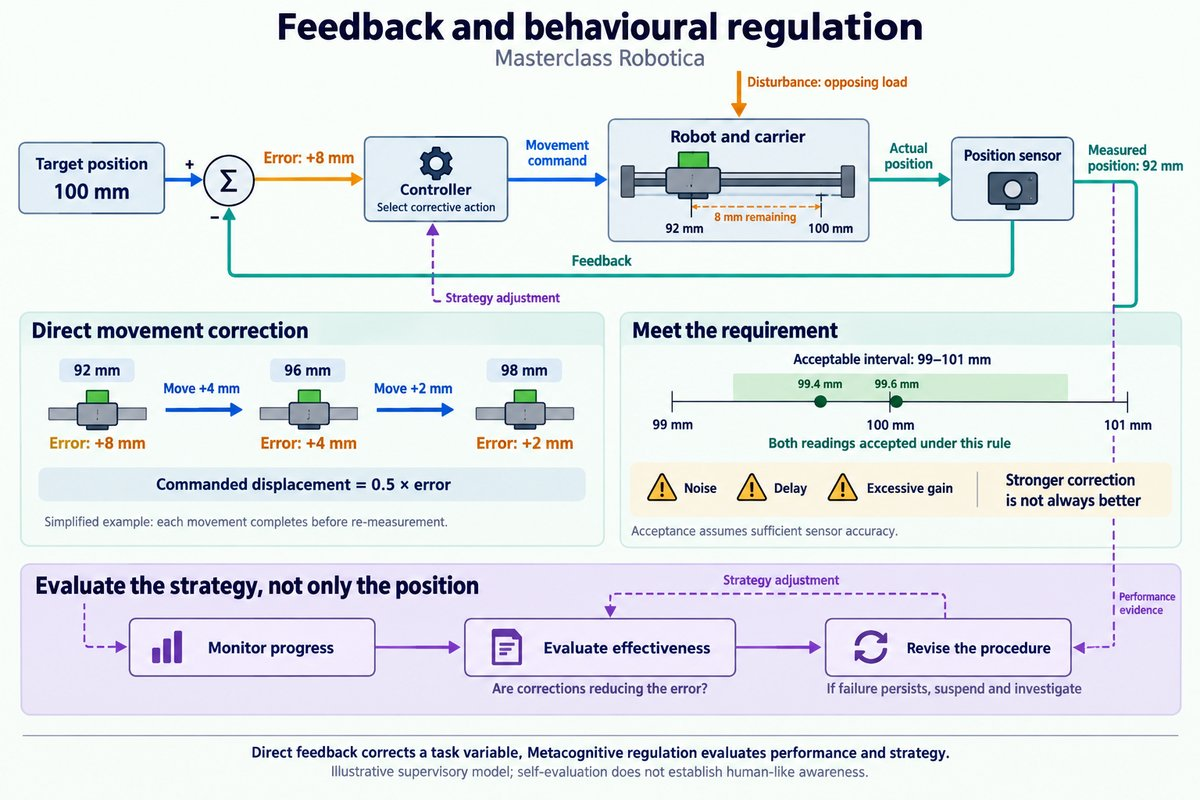
[[flowchart-placeholder]]
The following quantities define the illustrative positioning problem.
| Element | Meaning | Laboratory scenario |
|---|---|---|
| Reference | Desired value of the controlled quantity | Carrier position: 100 mm |
| Measurement | Sensor-reported value | Carrier position: 92 mm |
| Error | Reference minus measurement | 100 − 92 = +8 mm |
| Control action | Command selected to influence the system | A further forward movement |
| Disturbance | An influence not represented by the intended command | An external load opposing movement |
Feedback is information returned from a system’s output to influence its operation. Behavioural regulation is the broader adjustment of action in relation to a goal, available evidence and operating constraints. A measurement becomes regulatory only when it affects what the system subsequently does; displaying a position reading without using it to alter movement is monitoring rather than closed-loop correction. This distinction makes feedback an operational relationship, not simply a synonym for receiving information. (cds.caltech.edu)
| Dimension | Open-loop operation | Closed-loop operation |
|---|---|---|
| Basis for action | A predetermined command | A command informed by measured outcomes |
| Response to disturbance | No correction derived from the resulting output | Correction can follow a detected discrepancy |
| Measurement requirement | Output measurement is not required for the command | Relevant output measurement is required |
| Principal limitation | Outcomes depend on assumptions remaining adequate | Outcomes depend on measurement quality and loop design |
Closed-loop operation does not eliminate uncertainty; it changes how the system responds to it. A controller may compensate for a disturbance that was not anticipated when the command was constructed. Nevertheless, its corrective action remains constrained by what the sensor reveals and what the actuator can achieve. Feedback therefore enables correction without guaranteeing correctness. (cds.caltech.edu)
Why stronger correction is not necessarily better
Correct, measure, correct again
Suppose the robot responds to its +8 mm discrepancy by commanding a movement proportional to that error. In proportional control, the control signal follows (u = K_p e), where (e) denotes error and (K_p) denotes proportional gain. The gain determines how strongly the controller responds to a given discrepancy, although the resulting physical movement also depends on the robot’s dynamics. Increasing the gain can accelerate correction, but it does not establish that the resulting behaviour will be stable. (people.brandeis.edu)
For a deliberately simplified numerical illustration, assume that each commanded displacement occurs fully before the next measurement. Set the commanded displacement equal to half the current error. Starting from 92 mm, the first correction is therefore 4 mm, producing a new position of 96 mm and a remaining error of 4 mm. These values illustrate the arithmetic of proportional correction; they are not measurements from a physical robot.
- Measure: A target of 100 mm and a position of 92 mm produce an error of +8 mm.
- Correct: An error of +8 mm, multiplied by 0.5, produces a commanded displacement of +4 mm.
- Re-measure: The assumed completed displacement produces a position of 96 mm and an error of +4 mm.
- Correct again: The new error produces a displacement of +2 mm, giving a position of 98 mm.
Real actuators do not necessarily complete commands instantaneously, and measurements may arrive after the state has changed. A delayed correction can therefore act on an outdated discrepancy, contributing to overshoot or oscillation. Measurement noise can also enter the control loop and provoke unnecessary actuator activity. The appropriate design objective is consequently a well-behaved response under relevant conditions, rather than the largest possible correction. (people.brandeis.edu)
| Issue | Misconception | More defensible interpretation |
|---|---|---|
| Negative feedback | “Negative” means undesirable | The action opposes the detected deviation |
| High gain | Stronger correction always improves performance | Greater responsiveness can compromise stability |
| Sensor noise | Every measured fluctuation requires correction | Some variation reflects measurement rather than meaningful movement |
| Delay | The latest available reading describes the present state exactly | A reading may already be outdated when acted upon |
These distinctions are central to the treatment of feedback, stability and measurement limitations in control engineering. (cds.caltech.edu)
When regulation changes the strategy itself
The carrier repeatedly stops short of its target, even though the controller continues to command forward movement. A further correction may address the immediate position error, but it does not necessarily address the reason that progress remains inadequate. Metacognitive monitoring concerns evaluating one’s own performance or cognitive processes, while metacognitive regulation concerns adjustments informed by that evaluation. Human learning frameworks express this relationship through planning, monitoring and evaluation, rather than treating task execution alone as sufficient evidence of effective self-regulation. (lincs.ed.gov)
In the laboratory scenario, a supervisory mechanism could examine whether successive corrections actually reduce the position error. Its immediate concern would no longer be solely “Where is the carrier?” but also “Is the current corrective procedure effective?” This is an illustrative functional interpretation of the self-evaluation and adaptation sought within METATOOL, not a description of a particular implemented architecture. The project explicitly proposes enabling robots to monitor and evaluate performance and reuse that information when adapting to new circumstances. (cordis.europa.eu)
| Dimension | Direct feedback control | Metacognitive regulation |
|---|---|---|
| Object of evaluation | A task variable, such as position | Performance, strategy or the adequacy of an evaluation |
| Relevant discrepancy | Actual position differs from target position | Observed progress differs from expected progress |
| Illustrative response | Command another forward movement | Suspend the procedure and investigate persistent failure |
| Evidence required | A relevant state measurement | Evidence supporting an assessment of performance |
The distinction concerns the object being monitored, not merely the existence of multiple control layers. A controller adjusting another controller is not automatically metacognitive; the interpretation requires explicit attention to performance evaluation or cognitive regulation. Equally, describing a robot as self-evaluating does not, by itself, establish human-like subjective awareness. METATOOL treats synthetic awareness and metacognition as subjects of computational modelling and robotic investigation, rather than as conclusions warranted by ordinary corrective movement. (lincs.ed.gov)
Correcting a carrier without chasing the sensor
Consider an illustrative commissioning test using the same carrier and the same 100 mm target. For this example, the engineering team specifies an acceptable position interval of 99–101 mm and assumes that the sensor is sufficiently accurate for that requirement. The controller initially receives a reading of 92 mm and subsequently receives readings approaching the target. The figures below are constructed to show the decision sequence, rather than to report experimental performance.
- Establish the criterion: A 100 mm target and a ±1 mm tolerance produce an acceptance interval of 99–101 mm.
- Detect the discrepancy: A 92 mm measurement falls outside that interval, producing a requirement for correction.
- Evaluate the result: A subsequent 99.4 mm measurement falls inside the interval, producing an accepted positioning result.
- Interpret subsequent evidence: A 99.6 mm reading remains inside the interval, producing no requirement for further positional correction under this illustrative rule.
The example separates meeting the task requirement from making the displayed error exactly zero. Its acceptance rule permits both 99.4 mm and 99.6 mm, so neither reading requires correction merely to obtain a more aesthetically satisfying number. However, that conclusion depends on the stated measurement assumption: an acceptable sensor reading is not independent proof of an acceptable physical position. Feedback design must account for the relationship between the measured variable and the actual system state. (cds.caltech.edu)
Within a commissioning workflow, the position requirement, sensor capability and observed response need to be considered together. A useful outcome is not simply “the robot moved”, but “the measured result satisfied a defined criterion under stated conditions”. The limitation is equally important: this single illustrative sequence does not establish reliable performance across different loads, disturbances or measurement conditions. Control-system evaluation concerns the behaviour of the complete loop, not the command or reading in isolation. (people.brandeis.edu)
Regulating the engineer’s diagnosis
The engineer supervising the carrier also faces a feedback problem. In a second illustrative example, the engineer predicts that an initial diagnosis will correctly explain nine out of ten recorded positioning failures. Subsequent investigation supports the diagnosis in only six cases. The discrepancy concerns the engineer’s judgement, rather than the carrier’s position.
- Record the expectation: A prediction of nine correct diagnoses in ten cases produces an explicit benchmark.
- Collect outcome evidence: Investigation supports six diagnoses in ten cases, producing a record of observed performance.
- Identify the discrepancy: The prediction exceeds the observed count by three cases, producing evidence of overestimation in this sample.
- Revise the procedure: The discrepancy motivates an additional diagnostic check before accepting the same explanation in subsequent cases.
This illustrates the distinction between monitoring a judgement and regulating the process that generated it. Recognising the mismatch constitutes an evaluation; changing the diagnostic procedure turns that evaluation into regulation. Human metacognitive frameworks emphasise precisely this connection between evaluating progress and modifying strategies. Merely noticing that a prediction was inaccurate does not complete the regulatory cycle. (lincs.ed.gov)
The practical benefit in this constructed example is a more explicit connection between confidence, evidence and diagnostic action. Its limitation is that ten cases provide a narrow basis for judging performance, and the example does not establish which additional check would be most effective. In an engineering workflow, the record can support review rather than substitute for technical investigation. The connection to robotics remains functional: both the engineer and the proposed robotic supervisor use evaluated outcomes to reconsider how they proceed, without requiring identical underlying mechanisms. (tll.mit.edu)
Evidence-guided action in robotics
-
Feedback connects consequences to action: a command becomes part of a closed loop when measured outcomes influence subsequent commands. (cds.caltech.edu)
-
Effective regulation requires more than responsiveness: measurement quality, delay and system dynamics constrain the value of correction. (people.brandeis.edu)
-
Metacognitive regulation evaluates how performance is achieved: it connects monitoring with adjustments to strategies and procedures. (lincs.ed.gov)
-
Adaptive robotics gives self-evaluation a practical purpose: performance information can inform adaptation rather than remain a passive record. (cordis.europa.eu)
The central principle is evidence-guided action: establish an objective, evaluate the result and use that evaluation to regulate subsequent behaviour. This provides a coherent foundation for interpreting both robotic correction and human supervision within Masterclass Robotica. The essential distinction remains whether the system merely responds to a discrepancy or also evaluates the adequacy of its response. (cds.caltech.edu)