

Synthesising the equipment-delivery sequence
- View
From a delivery request to an accountable outcome
A laboratory technician requests a portable inspection camera at a testing station. A mobile robot must identify the correct equipment, collect it, transport it and establish that the requested delivery has actually occurred. Reaching the station with an empty carrier would satisfy a movement objective, but not the technician’s request.
This lesson uses one illustrative laboratory scenario throughout: robot R1 delivers camera C17 from storage bay S2 to inspection station B4. Assume that R1 has an equipment-identification sensor, a secured carrier and access to a designated transfer interface. All identifiers, measurements and acceptance thresholds are teaching assumptions, not reported experimental results or deployment recommendations.
The central design problem is synthesis: combining individual capabilities into a coherent sequence whose completion has an explicit, observable meaning. The sequence developed here separates intended actions from the evidence required to authorise subsequent actions. Its purpose is not merely to make R1 move, but to make the delivery claim defensible.
Defining what “delivered” actually means
Before selecting actions, specify the final condition. For this scenario, delivery means that C17 is recorded at B4, the transfer interface confirms acceptance, and R1’s carrier is empty. These requirements are deliberately conjunctive: satisfying only one or two does not complete the mission.
The following vocabulary gives that requirement a precise operational form. These are the working definitions used throughout the lesson. They distinguish what R1 intends to accomplish from what it currently knows.
| Term | Meaning in this delivery scenario |
|---|---|
| Goal state | The required final situation: C17 accepted at B4 and absent from R1’s carrier. |
| Action | An operation intended to change the situation, such as securing C17 or travelling to B4. |
| Precondition | A requirement that must hold before an action is authorised. |
| Postcondition | An observable requirement that must hold before an action is accepted as complete. |
| Invariant | A requirement maintained throughout a relevant interval, such as retaining the equipment during transport. |
| Evidence | An observation used to establish a condition, with its source and time of acquisition. |
For example, “secure C17” requires the correct camera to be present at the loading interface. Its completion requires evidence that C17 occupies the carrier and that the retaining mechanism is closed. The command itself is therefore neither the precondition nor the proof of completion.
Linking actions through explicit contracts
R1 receives a command to secure C17, but the next transport action remains unauthorised until the carrier reports the expected equipment and a closed retaining mechanism. This arrangement makes the boundary between actions explicit. An action contract specifies the conditions for starting an operation and the evidence required to accept its result.
BehaviourTree.CPP provides a related implementation mechanism through preconditions and postconditions attached to nodes. Such mechanisms help express execution constraints, although a software condition only establishes what its underlying data genuinely supports. A variable named equipment_secured does not independently demonstrate physical retention; its meaning depends on how the system produces and maintains that value. (behaviortree.dev)
For the proposed delivery design, the loading contract therefore requires both an identity observation and a retaining-mechanism observation. Suppose C17 is identified at 10:14:03, but loading occurs at 10:14:18 after another object enters the interface. The earlier identification does not establish the identity of the newly loaded object. The contract should require an observation associated with the actual loading event rather than silently carrying forward an outdated assumption.
The recommended design discipline is to make every transition depend on evidence relevant to that transition. A common pitfall is to substitute an actuator acknowledgement for the intended physical result. In this example, “retaining mechanism commanded closed” establishes an issued instruction; “closed-state sensor active with C17 detected in the carrier” satisfies the proposed loading contract.
Assembling the sequence without confusing progress with completion
A delivery action may remain active while R1 is travelling between S2 and B4. During that interval, the sequence must distinguish unfinished work from both success and failure. BehaviourTree.CPP expresses these outcomes as RUNNING, SUCCESS and FAILURE; a Sequence advances through its children and succeeds when all required children succeed. (behaviortree.dev)
For this lesson’s design, each action returns success only when its stated completion condition is established. Travel therefore remains running while R1 approaches B4, even if a route has already been calculated. Equally, successful arrival does not imply successful transfer: the transfer action has its own input conditions and completion evidence.
The resulting sequence is an ordered dependency structure rather than an itinerary. Its intermediate outputs establish the conditions required by subsequent operations. Nav2’s documentation makes a compatible architectural distinction: waypoint following can associate tasks with locations, while more elaborate application behaviour can use navigation within an application-level behaviour tree. (docs.nav2.org)
The important misconception to avoid is that a successful sequence node automatically proves a successful delivery. That conclusion holds only if the individual nodes represent the required outcomes faithfully. In the proposed design, a transport node that reports success on arrival is acceptable, provided a separate transfer node still establishes acceptance at B4.
- Validate the request. Input: the request for C17 at B4. Output: an accepted mission record linking that equipment identifier to that destination.
- Acquire the equipment. Input: the accepted mission record. Output: C17 identified in R1’s carrier with the retaining mechanism confirmed closed.
- Transport the equipment. Input: the confirmed loaded state. Output: R1 positioned at B4 with C17 still retained.
- Transfer the equipment. Input: the confirmed arrival state. Output: C17 accepted by the designated transfer interface and R1’s carrier confirmed empty.
- Close the mission. Input: the confirmed transfer record. Output: a completed delivery record for C17 at B4.
[[flowchart-placeholder]]
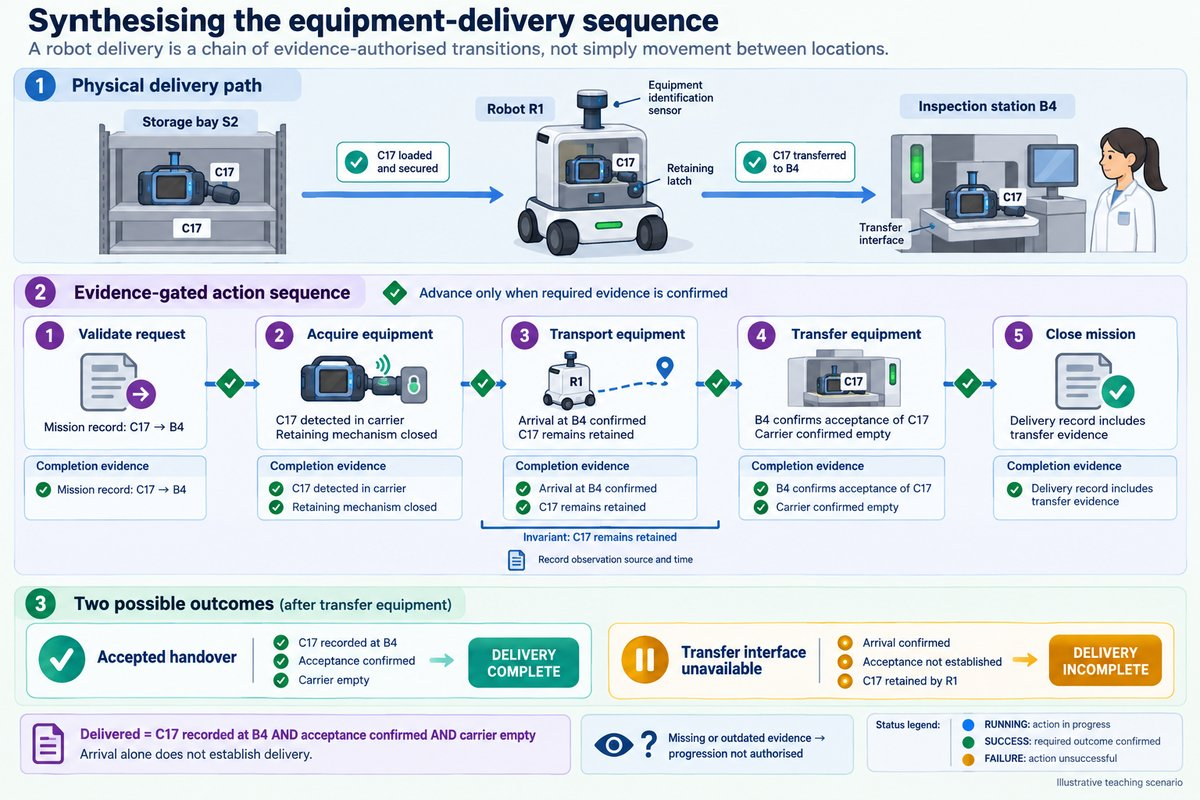
The table below makes the interfaces between these steps inspectable. It is a proposed specification for the teaching scenario, not a claim about an existing robot. Its principal value is that every completion statement names an observable result.
| Stage | Entry requirement | Required completion evidence |
|---|---|---|
| Request validation | A request identifies equipment and destination. | Mission record specifies C17 and B4. |
| Acquisition | C17 is available at S2’s loading interface. | C17 detected in the carrier; retaining mechanism closed. |
| Transport | Loaded state is confirmed. | Arrival at B4 confirmed; C17 remains retained. |
| Transfer | R1 occupies the designated transfer position. | B4 confirms acceptance of C17; carrier reports empty. |
| Mission closure | Transfer evidence is available. | Completion record contains the required transfer evidence. |
Keeping knowledge distinct from assumption
Consider a moment during transport when R1 still holds a record stating that C17 was loaded, but the equipment sensor no longer supplies a valid observation. The historical record and the current uncertainty must remain distinguishable. In this lesson’s specification, an unconfirmed required condition does not authorise progression.
This distinction also introduces the metacognitive dimension of the task: monitoring the adequacy of the information used to justify action. METATOOL investigates computational models informed by human metacognition and their validation in robotic experiments. Its stated research objectives include enabling robots to monitor and self-evaluate performance and applying metaprediction to conditional sequential tasks. (metatool-project.eu)
The delivery design here adopts a modest, operational interpretation of that research direction rather than claiming to reproduce the project’s architecture. R1’s mission record distinguishes an expected outcome, an observed outcome and an unresolved condition. For example, “C17 should remain retained” is an expectation; a current carrier observation is evidence; an unavailable observation leaves the condition unresolved.
The recommended discipline is to preserve this distinction in both execution and reporting. A high confidence score for an earlier identification does not, within this specification, replace current evidence of retention or transfer. The common pitfall is to convert “not known to be wrong” into “known to be correct”, allowing an incomplete evidential chain to masquerade as a completed mission.
Worked delivery: C17 reaches the inspection station
In the first illustrative execution, R1 receives the request for C17 at B4 and establishes the loaded state at S2. Assume the station’s configured arrival criterion is a positional error no greater than 0.10 metres. At the transfer position, R1 records an error of 0.06 metres; this satisfies the stipulated arrival criterion, but the delivery remains incomplete until transfer is established.
The execution then proceeds through the following evidence-bearing transitions. Each output becomes part of the mission record rather than disappearing when the next action starts. The figures below describe this teaching example only.
- Request becomes an authorised mission. Input: a request naming C17 and B4. Output: an accepted mission record with those identifiers.
- Equipment becomes a confirmed load. Input: C17 at S2’s loading interface. Output: an identity match and a closed retaining-mechanism observation.
- Transport becomes confirmed arrival. Input: the loaded robot. Output: arrival at B4 with 0.06 metres positional error and continued retention confirmed.
- Arrival becomes confirmed delivery. Input: the loaded robot at the transfer interface. Output: B4’s acceptance of C17 and an empty-carrier observation.
The outcome is a completed delivery supported by distinct evidence for acquisition, movement and transfer. Within the laboratory workflow, the technician can treat the completion record as confirmation that the specified handover occurred, rather than merely that R1 visited B4. The limitation remains explicit: this record does not establish that the camera functions correctly or is suitable for a particular inspection procedure.
Worked delivery: arrival without an accepted handover
In a second execution of the same mission, R1 again reaches B4 within the stipulated positional tolerance. The transfer interface is temporarily unavailable, and C17 remains secured in the carrier. The robot has completed transport, but the mission’s final condition remains unsatisfied.
The proposed sequence preserves that distinction rather than relabelling arrival as delivery. It also avoids treating elapsed time alone as evidence that acceptance occurred. The following transitions show precisely where progression stops.
- Transport produces an arrival state. Input: R1 carrying C17 towards B4. Output: confirmed arrival with the equipment retained.
- The transfer check produces a blocked authorisation. Input: the arrival state. Output: an observation that the designated interface is unavailable.
- The mission record preserves an incomplete delivery. Input: unavailable transfer authorisation. Output: transport complete, transfer unconfirmed and C17 still recorded with R1.
The immediate benefit is an accurate operational account: the technician does not receive a false completion message, and the equipment’s recorded custody remains unambiguous. The limitation is equally important: this sequence specifies what may legitimately be claimed, not how every interruption should be resolved. Determining an appropriate response requires further analysis of the unmet condition, rather than weakening the definition of delivery.
| Mission dimension | Accepted handover | Unavailable transfer interface |
|---|---|---|
| Arrival at B4 | Confirmed | Confirmed |
| C17 accepted at B4 | Confirmed | Not established |
| R1 carrier empty | Confirmed | No; C17 remains retained |
| Delivery status | Complete | Incomplete |
A sequence whose completion means something
Arrival is not delivery
The equipment-delivery sequence is now a chain of justified transitions, not simply a list of commands. Its strength lies in the alignment between the requested outcome, the action contracts and the evidence retained at each boundary. That alignment makes the final completion statement precise without claiming more than the observations establish.
-
Define the outcome first: delivery requires the specified equipment, destination and accepted transfer.
-
Connect actions through contracts: each required output establishes the next operation’s entry conditions.
-
Separate progress from completion: successful transport is an intermediate achievement.
-
Preserve uncertainty: an unresolved condition must not silently become permission to proceed.
Next, we will examine how an unmet verification condition informs failure evaluation and further learning.