

Section outline
-
Introduction
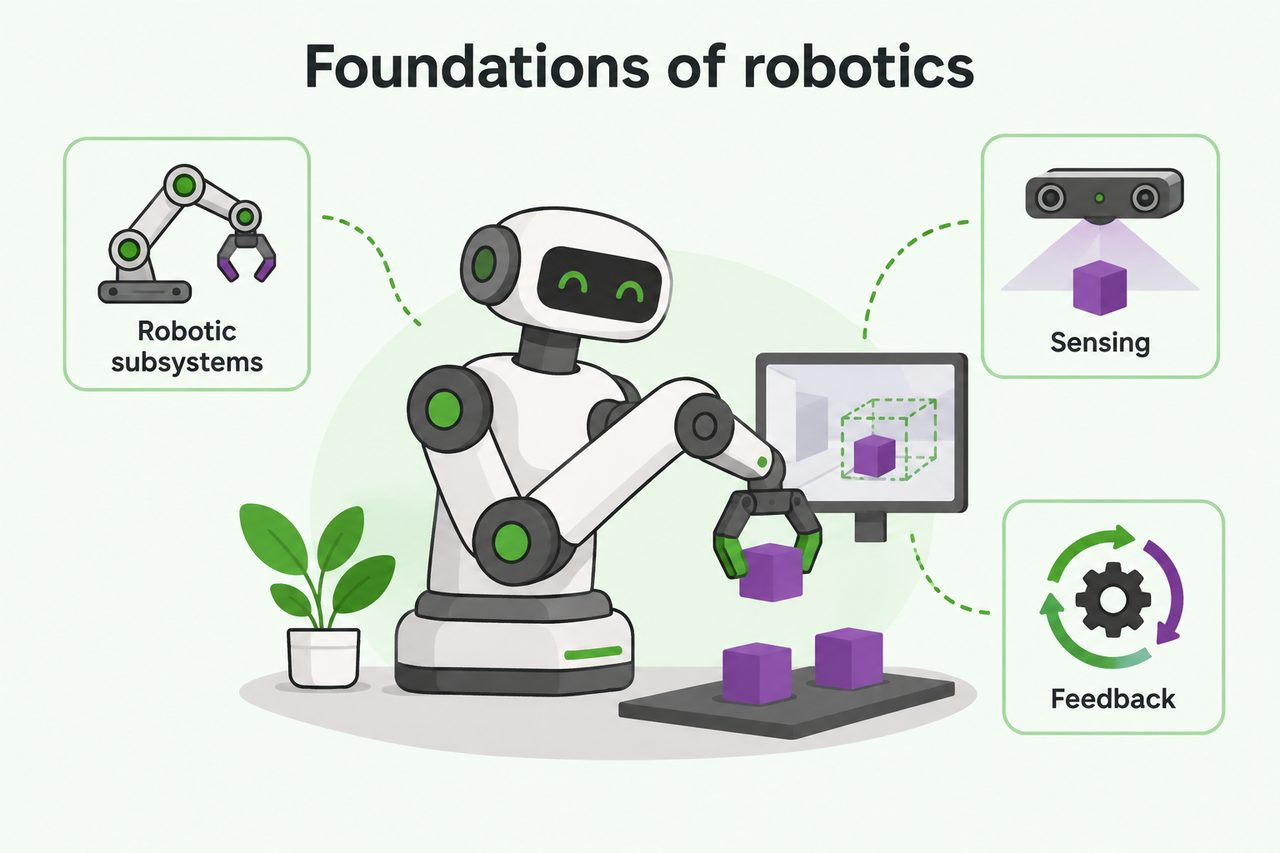
The laboratory robot’s equipment-delivery task provides a coherent basis for examining how physical configuration, sensory evidence and corrective action determine robotic capability. Through paper-based investigations, you will connect technological design with scientific observation, establishing the conceptual foundations for subsequent work on uncertainty monitoring and human metacognition. No programming experience or physical robotics hardware is required.
Learning Objectives
By the end of this section, you will be able to:
- Analyse the robot’s sensing, actuation, control and power subsystems, and use a two-link manipulator model to explain how embodiment, joint configuration, payload and mechanical compliance constrain reachable workspace, distinguishing forward from inverse kinematics.
- Interpret camera images, encoder readings and force measurements, distinguishing proprioceptive from exteroceptive information and annotating a laboratory map to represent noisy, ambiguous or incomplete observations.
- Apply feedback principles in a tabletop positioning exercise, recording reference states, measured states and corrective actions, and comparing open-loop and closed-loop responses in terms of overshoot, responsiveness and disturbance rejection.
-
Students mustView
-
Students mustReceive a grade
-
Students mustView
-
Students mustReceive a grade
-
Students mustView
-
Students mustReceive a grade
-
Students mustReceive a gradeReceive a passing grade