

Choose Your Next Learning Steps
- View
Turn a long course list into a clear choice
A beginner helping a neighborhood bakery can find courses on social media, email, search, and advertising in minutes. Choosing among them is harder: each topic looks useful, but study time is limited. The best choice is not always the most popular course; it is the skill that supports the bakery’s current goal.
This lesson follows a fictional bakery, Maple Street Bakery, as its marketing assistant chooses where to focus. You will learn how to identify a useful skill gap, judge learning resources, and build a manageable learning plan. The aim is a clear next step, not a complete plan to master every part of digital marketing.
Start with the result, then identify the skill
Choose the Skill Before the Course
Suppose the bakery wants more visitors to place pickup orders through its website. Its assistant can publish social posts but cannot explain where visitors leave the ordering process. That difference between what the assistant can currently do and what the business needs is a skill gap. A useful learning choice starts with that gap, rather than with a course title.
A learning goal describes a capability you want to develop. A business goal describes a result the organization wants to achieve. For Maple Street Bakery, “increase completed pickup orders” is a business goal, while “interpret a report showing visits and completed orders” is a learning goal. These goals support each other, but completing a course does not guarantee more orders.
To connect the two goals, the assistant uses this sequence:
- Name the business need. Input: visitors reach the ordering page but do not always order. Output: a need to understand incomplete orders.
- Identify the required capability. Input: the ordering problem. Output: the ability to read basic website performance reports.
- Check current ability. Input: a sample report. Output: a clear gap—the assistant cannot explain its main numbers.
- Choose a narrow learning goal. Input: that gap. Output: learn to explain visits, completed orders, and their relationship.
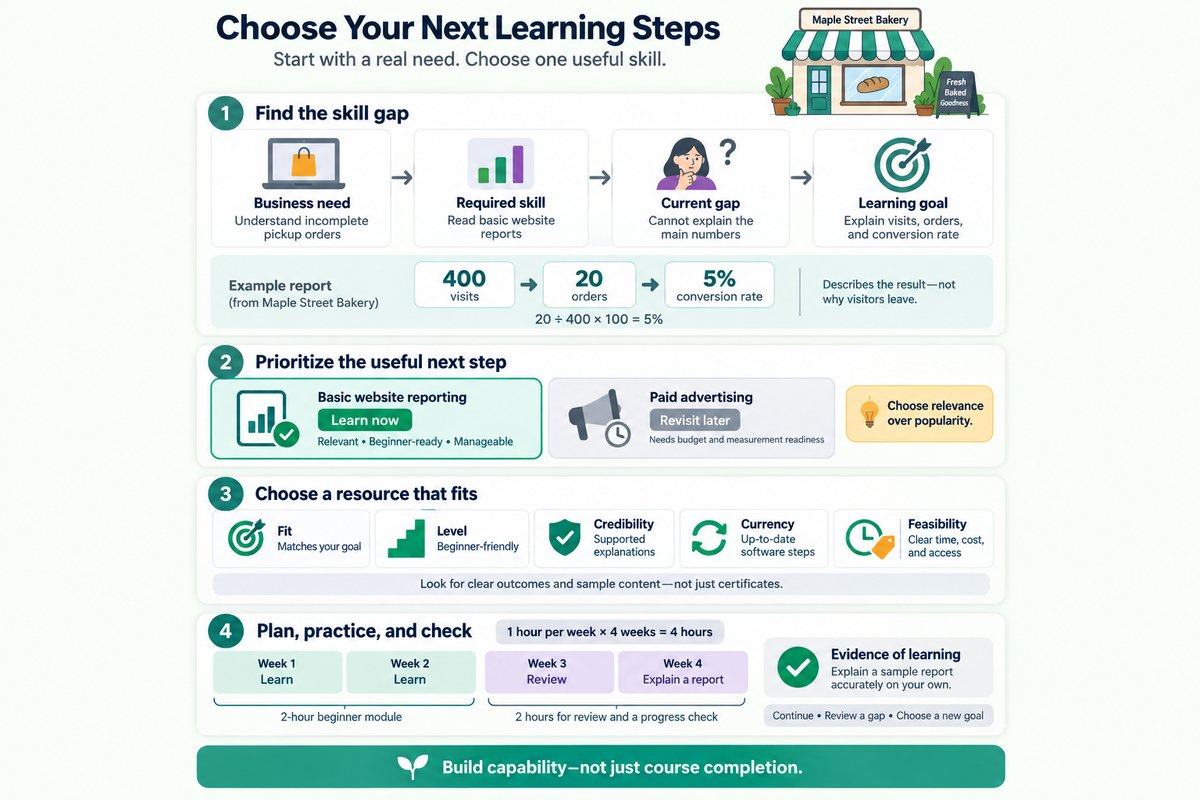
Choose the gap that deserves attention now
Not every missing skill deserves immediate attention. A beginner may need stronger writing, reporting, and advertising skills, but learning them all at once divides attention. Priority means choosing which need matters most at the moment. A useful choice connects to current work, has the necessary foundations in place, and fits the learner’s available time.
For the bakery assistant, a basic reporting course supports the current ordering question directly. An advertising course could be valuable later, but it does not resolve the assistant’s difficulty reading existing results. Advertising also requires decisions about spending and measuring outcomes. Starting there could add complexity before the assistant can judge whether the spending helps.
| Decision factor | Basic website reporting | Paid advertising |
|---|---|---|
| Current relevance | Helps explain existing ordering results. | Helps attract additional visitors. |
| Readiness | Matches the assistant’s immediate knowledge gap. | Requires confidence with budgets and measurement. |
| Access needed | A sample report or approved access to business data. | Approved account access and a spending budget for live use. |
| Decision for this case | Learn now. | Revisit when the business needs more traffic and can evaluate it. |
A common mistake is to choose a topic only because it is widely discussed. Another is to assume that a more advanced course creates more value. Difficulty is not the same as relevance: a short beginner resource may solve the immediate problem better. Choose the smallest useful learning step, while checking that any required foundations are already in place.
Judge a resource by what it helps you do
A course page may promise confidence, career growth, or expert knowledge. Those promises tell you less than a specific outcome such as “explain the main measures in a website report.” Learning outcomes are statements describing what a learner should be able to do after learning. They help connect a resource to the skill gap you have identified.
For the bakery assistant, a suitable resource explains basic reports with worked examples and clear definitions. Its level should match a beginner, and its examples should use a current interface if it teaches software steps. General principles may remain useful for years, while screenshots and menu instructions can become outdated. Checking both the content and its update information reduces wasted time.
| Selection factor | Useful evidence | Warning sign |
|---|---|---|
| Fit | Outcomes match reading and explaining reports. | A broad promise to “master marketing.” |
| Level | Required knowledge is clearly stated. | Unexplained terms appear immediately. |
| Credibility | The author’s relevant experience and examples are visible. | Strong claims without support. |
| Currency | Software instructions match the version being used. | Old menus with no update guidance. |
| Feasibility | Time, price, and access requirements are clear. | Important costs or requirements are hidden. |
A certificate can document completion, but it does not prove that someone can perform the skill independently. Similarly, a free resource is not automatically weak, and a paid resource is not automatically strong. The assistant’s best choice is the resource that teaches the needed capability clearly within the available time and budget. Reviews can support that choice, but the stated outcomes and sample content provide more direct evidence of fit.
Make the plan small enough to finish
A plan such as “learn analytics” leaves both the workload and the finish line unclear. Analytics means using data to understand performance and support decisions. A more useful plan names one capability, one main resource, a realistic schedule, and evidence of learning. This keeps the plan focused on progress rather than on collecting courses.
Suppose the assistant has one hour each week for four weeks. That creates a four-hour learning budget, so a twelve-hour course is not a realistic first commitment. A two-hour beginner module leaves time to revisit difficult explanations and check understanding. The plan should account for that extra time rather than treating the advertised video length as the full workload.
A progress check is evidence that a capability is improving. For this assistant, the check could be explaining a sample report accurately without following the course explanation line by line. This is more meaningful than counting completed videos alone. If the explanation remains unclear, the next choice is targeted review—not automatically another course.
The learning plan follows a simple sequence:
- Set the time limit. Input: one available hour per week. Output: a four-hour budget across four weeks.
- Select the main resource. Input: the report-reading goal. Output: one two-hour beginner module.
- Allow time for understanding. Input: two hours of remaining time. Output: room for review and a progress check.
- Define the review decision. Input: evidence of current ability. Output: continue, review a specific gap, or select a new goal.
Maple Street Bakery: choosing reporting before advertising
In this illustrative example, the bakery records 400 visits to its ordering page and 20 completed orders during one week. The assistant wants to learn advertising to bring in more visitors, but the owner first needs a clear explanation of the existing results. The learning decision therefore begins with understanding the available data, not increasing spending.
- Read the business question. Input: 400 visits and 20 orders. Output: a question about the relationship between visits and orders.
- Identify the learning need. Input: unfamiliar report measures. Output: a goal to explain the basic ordering results accurately.
- Choose a matching resource. Input: that narrow goal. Output: a beginner reporting module rather than a broad advertising course.
- Define evidence of learning. Input: a report with a consistent scope. Output: an explanation of the figures and their limits.
The assistant learns that 20 divided by 400, multiplied by 100, equals 5%. This is a conversion rate: the percentage of measured visits that lead to a desired action, here a completed order. It describes the recorded result, but it does not explain why visitors leave or whether 5% is good for this bakery. The benefit of this learning choice is a clearer discussion with the owner; its limit is that reporting alone cannot fix the ordering experience.
Maple Street Bakery: narrowing an email learning goal
Later, the bakery has a different need: its approved monthly email should make pickup instructions easier to understand. The assistant can send the email but struggles to write a clear message. The business does not need a full email marketing program for this task, so a focused writing resource is a better match than a broad course covering every email feature.
- Name the communication need. Input: an email announcing Saturday pickup. Output: a need for clear ordering instructions.
- Identify the capability. Input: a confusing draft. Output: a learning goal focused on clear promotional writing.
- Select the relevant content. Input: that goal. Output: a short resource on message structure and calls to action.
- Set the evidence standard. Input: the learning goal. Output: an email draft that clearly states the offer, deadline, and ordering step.
A call to action is a phrase that tells the reader what to do next, such as “Order by Friday at 3 p.m.” The owner can review the draft before it enters the bakery’s normal approval and sending process. A clearer draft provides evidence of improved writing, but it does not guarantee more sales. Offer quality, audience interest, and timing still affect the business result.
A learning path you can use
-
Connect learning to a real need. Start with the result, then identify the capability that supports it.
-
Choose a manageable priority. Relevance and readiness matter more than popularity or difficulty.
-
Evaluate resources carefully. Look for clear outcomes, suitable depth, credible explanations, and realistic requirements.
-
Measure capability, not just completion. Use evidence of understanding to guide the next decision.
A strong digital marketing learning path grows through focused choices. You do not need to master every channel before contributing useful work. Clear goals, well-matched resources, and honest progress checks help you build skills that matter in real marketing decisions.