

The Customer Journey and a Consistent Brand Message
- View
One offer, several moments of truth
A customer sees an Instagram post from a neighborhood bakery called Maple Street Bakery: “Fresh breakfast, ready when you are.” The customer visits its website but cannot find pickup times, then reaches checkout and discovers that the earliest pickup is noon. The post attracts attention, but the experience fails to support the promise.
Digital marketing connects these moments, not just the messages that appear in each one. Customers need different information as they move toward a purchase, yet they should recognize the same business and understand the same promise throughout. This lesson explains how to match messages to customer needs without changing what the brand stands for.
Maple Street Bakery is an illustrative business used throughout this lesson. Its offers and prices show how the ideas work, rather than report actual business results. By the end, you should be able to identify customer journey stages, recognize message gaps, and explain how a consistent brand message supports trust.
The journey follows the customer’s questions
Someone notices a bakery post, checks the menu, reads reviews, and places an order. After pickup, that person may return or recommend the bakery to a friend. The customer journey is the full experience a person has with a business, from first becoming aware of it to using its products and possibly returning.
A touchpoint is any moment when a person encounters the business, such as an advertisement, a website visit, or a pickup confirmation. A channel is the place or method through which that contact happens, such as Instagram or email. One channel can contain several touchpoints: an email offer and an order confirmation are separate contacts, even when both arrive in the same inbox.
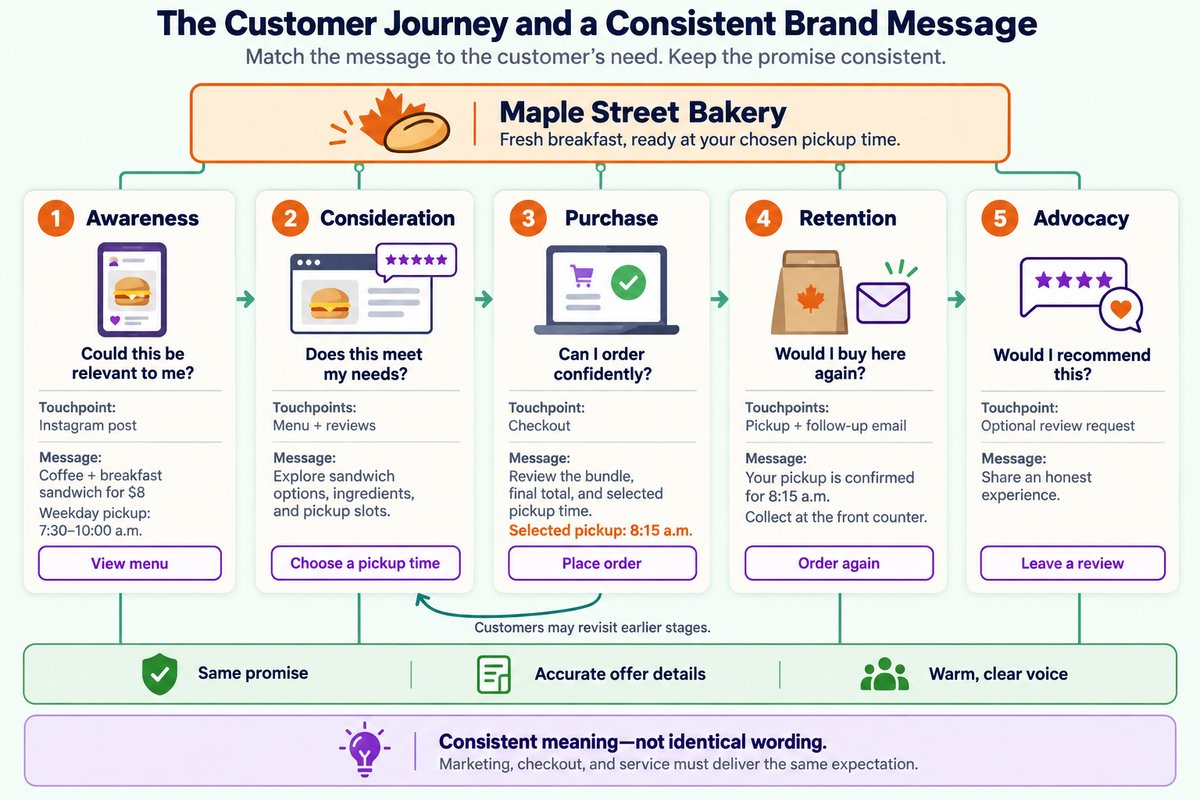
A useful beginner model groups the journey into five stages. These stages describe the customer’s changing needs, not a fixed schedule that everyone follows. A customer may return to research after reaching checkout, skip stages when buying something familiar, or leave without purchasing.
| Journey stage | Customer’s main question | Maple Street touchpoint | Helpful message |
|---|---|---|---|
| Awareness | Could this be relevant to me? | Instagram post | Fresh breakfast near your commute |
| Consideration | Does this meet my needs? | Menu and pickup page | Items, prices, ingredients, and available times |
| Purchase | Can I complete this confidently? | Checkout | Final cost and selected pickup time |
| Retention | Would I buy here again? | Pickup and follow-up email | Clear instructions and dependable service |
| Advocacy | Would I recommend this? | Review request | An optional invitation to share an honest experience |
Retention means encouraging customers to continue buying from a business. Advocacy happens when customers recommend or publicly support it. Neither is guaranteed by a successful first purchase; both depend on the experience that follows.
Match the message to the decision
A person who has just discovered Maple Street needs a reason to care, while someone at checkout needs clear details. Sending both people the same sales message ignores their different questions. Stage-based messaging means choosing information that helps a customer with the decision they face at that moment.
For Maple Street, an awareness post can introduce an $8 breakfast bundle, but the menu must explain what the bundle includes. The checkout page then needs to confirm the price, available pickup time, and any additional charges before payment. Each touchpoint adds useful detail instead of simply repeating the headline.
A common mistake is to treat the journey as a straight line controlled by the business. A customer may see the $8 offer, read reviews, return to Instagram, and only then visit the menu. Another misconception is that every touchpoint should push for an immediate purchase, even when the customer still needs basic information.
The best practice is to connect each message to one clear customer need and an appropriate call to action, meaning the next action the business invites someone to take. For the breakfast post, “View the breakfast menu” may be more useful than “Buy now” when customers have not yet seen the available items. The goal is to make the next decision easier, not to force everyone through the same path.
Keep the promise stable as details change
Maple Street’s Instagram post may be brief and friendly, while its checkout page needs precise instructions. These messages can sound different without contradicting each other. A consistent brand message keeps the business’s main promise, important facts, and recognizable style aligned across touchpoints.
The foundation is a brand promise: the value customers should reliably expect from the business. For Maple Street, a more accurate promise than “ready when you are” is “Fresh breakfast, ready at your chosen pickup time.” This promise gives the customer a clear expectation, and it gives the bakery a standard that its ordering and pickup processes must support.
Consistency does not mean copying one sentence everywhere. It means adapting the detail while preserving the meaning: a post introduces convenient pickup, the menu explains available times, and the confirmation repeats the selected time. Brand voice, the business’s recognizable communication style, also stays steady; Maple Street can remain warm and direct while using more exact language at checkout.
A common pitfall is to focus only on matching colors and logos while leaving conflicting claims untouched. Another is to promise “pickup anytime” in an advertisement when checkout offers only fixed time slots. Consistent wording cannot repair an unreliable service, so marketing and daily operations must agree on what the business can deliver.
| Message element | What stays consistent | What can adapt |
|---|---|---|
| Main promise | Fresh breakfast at a selected pickup time | The amount of explanation |
| Offer facts | The $8 bundle’s contents and conditions | Which facts receive emphasis |
| Voice | Warm, clear, and helpful | The level of formality |
| Next action | An accurate expectation of what follows | View menu, select time, or collect order |
The distinction is consistent meaning, not identical wording. Maple Street can use “Make your morning easier” in a social post and “Your pickup is confirmed for 8:15 a.m.” in an email. Both support the same promise, but each serves a different customer need.
Example: connect the breakfast post to pickup
Different Messages, One Breakfast Promise
Maple Street offers an $8 bundle containing one coffee and one breakfast sandwich, with weekday pickup slots from 7:30 to 10:00 a.m. Its first version of the post says only, “Breakfast for $8—ready anytime.” That wording hides the time limits and creates an expectation the bakery cannot reliably meet.
The improved journey connects the offer to information the customer needs at each decision. The social post does not need to contain every ordering detail, but it should not create a false impression. The following sequence shows the intended path; actual customers may pause or move backward.
- Start with the offer. Input: the $8 bundle and weekday pickup limits. Output: a post saying, “Coffee + breakfast sandwich for $8. Choose a weekday pickup time, 7:30–10:00 a.m.”
- Explain the choice. Input: a customer opening the post’s link. Output: a menu page showing the bundle, sandwich options, and available pickup slots.
- Confirm the commitment. Input: the customer selecting 8:15 a.m. Output: checkout showing the bundle, selected time, and final amount before payment.
- Support collection. Input: a completed order. Output: a confirmation stating, “Your breakfast pickup is confirmed for 8:15 a.m. Collect it at the front counter.”
This approach reduces uncertainty and gives the bakery’s staff a clear order to fulfill. It also connects marketing with the ordering system and pickup process, rather than treating the post as a separate activity. The limitation is operational: if staff cannot prepare the order on time, accurate messaging alone will not deliver the promised experience.
Example: carry the same promise into a larger order
The same bakery also sells a $36 meeting breakfast box containing six pastries and a 64-ounce coffee container. Orders must be placed by 3:00 p.m. on the previous business day, with pickup available from 8:00 a.m. This remains part of the same brand promise: customers receive fresh breakfast at an agreed time, even though the product and ordering conditions differ.
A meeting organizer needs more certainty about quantities and timing than a customer buying breakfast for one. Maple Street therefore gives those details greater attention without introducing a conflicting promise such as “large orders available instantly.” The sequence below shows how the bakery connects the offer to fulfillment.
- Present the suitable offer. Input: the meeting box’s contents and price. Output: a product page stating “Six pastries and a 64-ounce coffee container for $36.”
- Set the timing expectation. Input: the preparation deadline. Output: a clear notice beside the order button: “Order by 3:00 p.m. the previous business day; pickup from 8:00 a.m.”
- Confirm the order details. Input: an accepted order for an 8:30 a.m. pickup. Output: an email repeating the contents, pickup time, and collection location.
- Support a future visit. Input: a completed pickup. Output: an optional follow-up thanking the customer and linking to the same ordering information.
The benefit is a more dependable experience for someone organizing breakfast for several people. The stated deadline also helps bakery staff plan preparation, connecting the customer’s expectations with the work required to fulfill the order. However, the product page should describe the exact contents rather than guarantee that the box will satisfy six people, since appetites and meeting needs vary.
A clear promise at every step
-
Follow the customer’s questions. Awareness, consideration, purchase, retention, and advocacy describe different needs, not a rigid path.
-
Adapt the message, not the truth. Change the detail and next action while keeping the promise and offer facts aligned.
-
Connect communication with delivery. Posts, product pages, checkout, confirmations, and service should support the same expectations.
Effective digital marketing helps customers understand an offer, make a confident choice, and receive what they expect. The customer journey shows where that support is needed, while a consistent brand message connects the experience. Together, they provide a practical foundation for marketing that earns trust rather than only attracting attention.