

Digital Marketing’s Role and Marketing Objectives
- View
Online attention needs a business purpose
Oak Street Bakery posts photos of fresh bread, sends emails, and pays for a few online ads. Its owner sees more likes but cannot tell whether those activities bring in more orders. With limited time and money, the bakery needs a clear reason for each marketing activity.
This is a common challenge: being active online can feel like progress, even when business results do not change. Digital marketing becomes more useful when each activity supports a clear objective. In this lesson, you will learn how digital marketing supports a business, how to write useful objectives, and how to measure progress without confusing attention with success.
How digital marketing supports the business
A customer sees Oak Street Bakery in a search result, checks its website, and places a pickup order. Another customer receives an email and returns to buy again. These online interactions help connect what the business offers with people who may value it.
Digital marketing means using digital channels to communicate value, build customer relationships, and support business goals. A channel is a route for reaching people, such as search, email, or social media. Marketing is broader than promotion: it also involves understanding needs and shaping an offer that meets them. Digital marketing supports that work, but it cannot replace a good product, fair pricing, or reliable service.
Digital and offline activities often work together. A customer may discover the bakery online but buy at the counter, while a store receipt may encourage someone to join its email list. The useful question is not “Which channel is most popular?” but “What role should this channel play in helping the business succeed?”
| Dimension | Digital marketing | Offline marketing |
|---|---|---|
| Examples | Website, search results, email, social media | Flyers, local events, printed signs |
| Customer interaction | Can lead directly to an online action | Often leads to a visit, call, or later online action |
| Measurement | Can record many clicks and completed online actions | May use offer codes, customer questions, or sales records |
| Limitations | Tracking can be incomplete; attention does not guarantee sales | Responses can be difficult to connect to one activity |
Neither approach is automatically better. For Oak Street Bakery, an online ordering page and a sign outside the store may support the same sales objective. The right combination depends on the result the business needs and the resources it can use.
Give each activity a clear role
Someone who has never heard of Oak Street Bakery needs a different message from someone who already orders every Friday. The first person may need a reason to notice the bakery; the returning customer may need a helpful reminder. This difference explains why digital marketing supports several roles, rather than only immediate sales.
The customer journey is the set of interactions a person has with a business before, during, and after a purchase. A simple model includes awareness, consideration, conversion, and retention. People do not always follow these stages in order: they may compare options, leave, return, or buy immediately. The model helps clarify what an activity should achieve, not predict every customer’s behavior.
| Stage | Customer’s situation | Bakery activity | Intended result |
|---|---|---|---|
| Awareness | “I do not know this bakery.” | Show a short video of its bread-making process | More people recognize the bakery |
| Consideration | “Is this a good choice?” | Provide clear product information and pickup details | People feel ready to order |
| Conversion | “I want to place an order.” | Offer a simple ordering page | A customer completes an order |
| Retention | “Will I buy again?” | Send useful emails to customers who opted in | More customers return |
A conversion is a desired action, such as a purchase or a completed inquiry form. Retention means keeping customers and encouraging an ongoing relationship. A common mistake is expecting every post to create an immediate sale, even when its main purpose is awareness. The opposite mistake is treating awareness as enough when the business needs orders; each role still needs a relevant measure of progress.
Turn a business goal into a marketing objective
Give Marketing Activity a Business Purpose
Oak Street Bakery wants to grow profitably. That direction matters, but it does not yet tell the marketing team what result to pursue. “Post more often” is more specific about work, yet it still describes an activity rather than a business result.
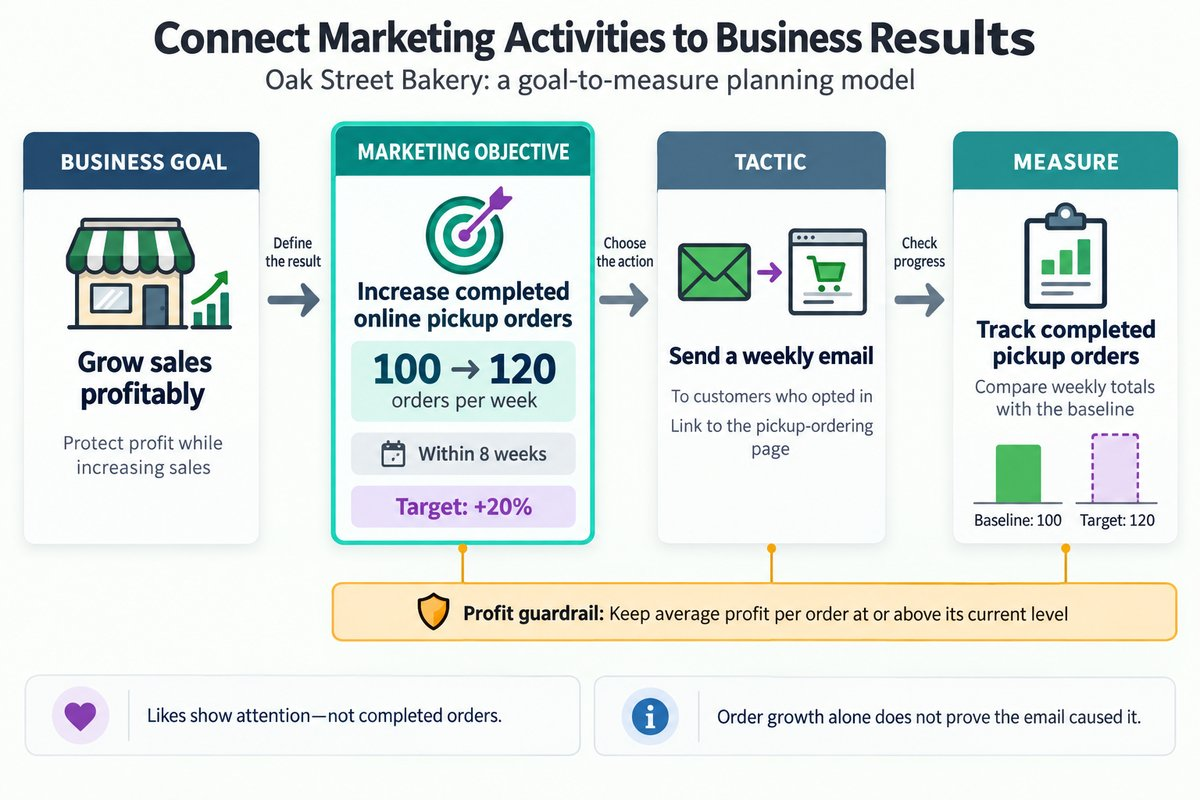
A business goal states a broad outcome for the organization. A marketing objective defines a specific result that marketing aims to support, while a tactic is an action used to pursue it. Keeping these separate prevents a busy schedule from becoming the definition of success. A bakery can publish every day and still fail to increase orders.
| Planning layer | Purpose | Oak Street Bakery example |
|---|---|---|
| Business goal | Set the overall direction | Grow sales without reducing profit |
| Marketing objective | Define a measurable marketing result | Increase completed online pickup orders from 100 to 120 per week within eight weeks |
| Tactic | Describe the planned action | Send a weekly email linking to the ordering page |
| Measure | Check progress | Count completed online pickup orders each week |
Strong planning starts with the desired result and works toward the activity, not the other way around. For the bakery, the order objective gives the email a purpose and provides a way to judge its contribution. Marketing still shares responsibility with other functions: stock availability, website reliability, and pickup service can all affect whether orders increase.
Make objectives specific enough to guide decisions
A useful objective tells people what should change, by how much, and by when. SMART is a common framework for checking this clarity: specific, measurable, achievable, relevant, and time-bound. It does not guarantee that an objective is good, but it helps reveal missing information.
For Oak Street Bakery, “Increase completed online pickup orders from 100 to 120 per week within eight weeks” provides a clear starting point and target. The starting value is the baseline, which gives the business something to compare results against. Moving from 100 to 120 orders is an increase of 20 orders, or 20%. That number is a planning target in this example, not an expected result for every bakery.
| SMART element | Question it answers | Application to the bakery |
|---|---|---|
| Specific | What exactly should change? | Completed online pickup orders |
| Measurable | How much change is needed? | From 100 to 120 per week |
| Achievable | Is the target reasonable? | Check past demand, budget, and production capacity |
| Relevant | Does it support the business? | More orders can support sales growth |
| Time-bound | When should the result happen? | Within eight weeks |
The achievable and relevant checks require judgment, not just careful wording. If the bakery can prepare only 110 pickup orders per week, a target of 120 requires a capacity change. If heavy discounts increase orders but remove profit, the target may undermine the business goal. A best practice is to add a guardrail, a limit that protects another important result—for example, keeping average profit per order at or above its current level.
Measure results, not just visible activity
Suppose a bakery post receives 500 likes while weekly pickup orders remain at 100. The likes show that people reacted, but they do not show that the sales objective was achieved. Measures become useful when the team understands what each one can—and cannot—prove.
A metric is a numerical measure of activity or results. A key performance indicator, or KPI, is a metric selected to track progress toward a particular objective. For the pickup-order objective, completed orders are a KPI; likes may provide supporting information. A metric becomes a vanity metric when people use an impressive-looking number as proof of success without connecting it to the intended outcome.
| Measure | What it tells the bakery | What it does not prove |
|---|---|---|
| Post likes | People reacted to the content | They placed orders |
| Ordering-page visits | People reached the ordering page | They completed a purchase |
| Completed pickup orders | How many orders were placed | Those orders were profitable |
| Profit per order | Whether each order meets the profit guardrail | Which marketing activity caused the purchase |
Digital measurement is useful, but it is not complete. Customers may use different devices, decline tracking, or see an online message before buying in-store. Attribution, the process of assigning credit to marketing interactions, therefore has limits. Compare results with the baseline and consider other changes, such as weather or store hours, before claiming that one activity caused an increase.
Example: increasing online pickup orders
In this illustrative example, Oak Street Bakery records an average of 100 completed online pickup orders per week over four recent, typical weeks. It chooses a target of 120 per week within eight weeks and confirms that staff can handle the extra orders. It also keeps average profit per order as a guardrail, so the team cannot reach the target simply by offering unprofitable discounts.
The bakery connects its marketing work to that objective through a short sequence:
- Set the baseline: Use four weeks of completed-order records to establish an average of 100 orders per week.
- Confirm the target: Check staffing and production capacity to approve a target of 120 orders per week.
- Choose the activity: Use an email to customers who opted in to direct readers to the pickup-ordering page.
- Review progress: Compare weekly completed orders with the baseline and check average profit per order.
At the end of eight weeks, suppose the weekly average reaches 118 orders and profit per order remains stable. The increase is 18%, which shows progress, but the bakery has not fully met its target. The team also checks whether holidays or changes in opening hours affected demand. This connects marketing reporting with sales and operations, while avoiding the unsupported claim that the email alone produced every additional order.
Example: encouraging customers to return
The same bakery also wants a more reliable flow of repeat business. Its order records show that 40 out of 200 first-time online customers place another order within 30 days, giving a repeat-purchase rate of 20%. For a new group of 200 first-time customers, the bakery sets a target of 25%, or 50 returning customers, while keeping average profit per order stable.
This objective measures customer behavior rather than the number of messages sent. The bakery plans a helpful follow-up email for customers who opted in and checks that the ordering system can identify repeat purchases. It measures each customer across a full 30-day period, so recent buyers do not appear to have failed to return before their measurement period ends.
- Define the group: Identify 200 first-time online customers whose purchases start during the selected period.
- Set the target: Apply a 25% repeat-purchase target to define a goal of 50 returning customers.
- Support the return visit: Send an opted-in follow-up email with useful ordering information.
- Measure the outcome: Count customers who buy again within 30 days and divide by 200.
Suppose 48 customers return, producing a repeat-purchase rate of 24%. The result improves on the 20% baseline but falls short of the 25% target. Order records provide the main outcome measure, while email clicks offer supporting evidence about the message. The bakery must still consider product quality and customer service, since marketing reminders cannot fix a disappointing customer experience.
Keep the result in view
Digital marketing works best when its activities have clear jobs. Channels help a business reach people, support decisions, encourage action, and maintain relationships. Objectives connect that work to results the business can evaluate.
-
Start with the business goal, then define the marketing result that supports it.
-
Separate objectives from tactics: sending an email is an action, not an outcome.
-
Use a baseline, target, and deadline to make progress visible.
-
Choose relevant KPIs and guardrails, and avoid treating every change as proof of marketing impact.
Next, we'll build on this by exploring Audience Segments, Customer Needs, and Research.