

Review the Coffee Shop’s Marketing Approach
- View
A busy social feed does not always mean a busy shop
A coffee shop can post attractive drink photos every day and still have empty tables in the morning. The owner sees likes and comments, but the business needs customers who visit and buy. A useful marketing review connects those online activities to the shop’s actual goals.
This lesson uses Maple Street Coffee, a fictional neighborhood coffee shop, to show how that review works. All figures are illustrative, not reported business results. You will examine whether its audience, message, channels, and results support the same goal—and see how to identify improvements without jumping to conclusions.
Start with the business goal
Maple Street Coffee wants more weekday breakfast customers between 7:00 and 10:00 a.m. Its marketing includes Instagram posts, a Google Business Profile, and a monthly email newsletter. Each activity may help, but being active online is not the same as having a clear direction.
A marketing approach is the overall way a business reaches people, communicates its value, and encourages action. A marketing audit is a structured review of those activities and their results. For a beginner, the central question is simple: Does the marketing help the right customer take an action that matters to the business?
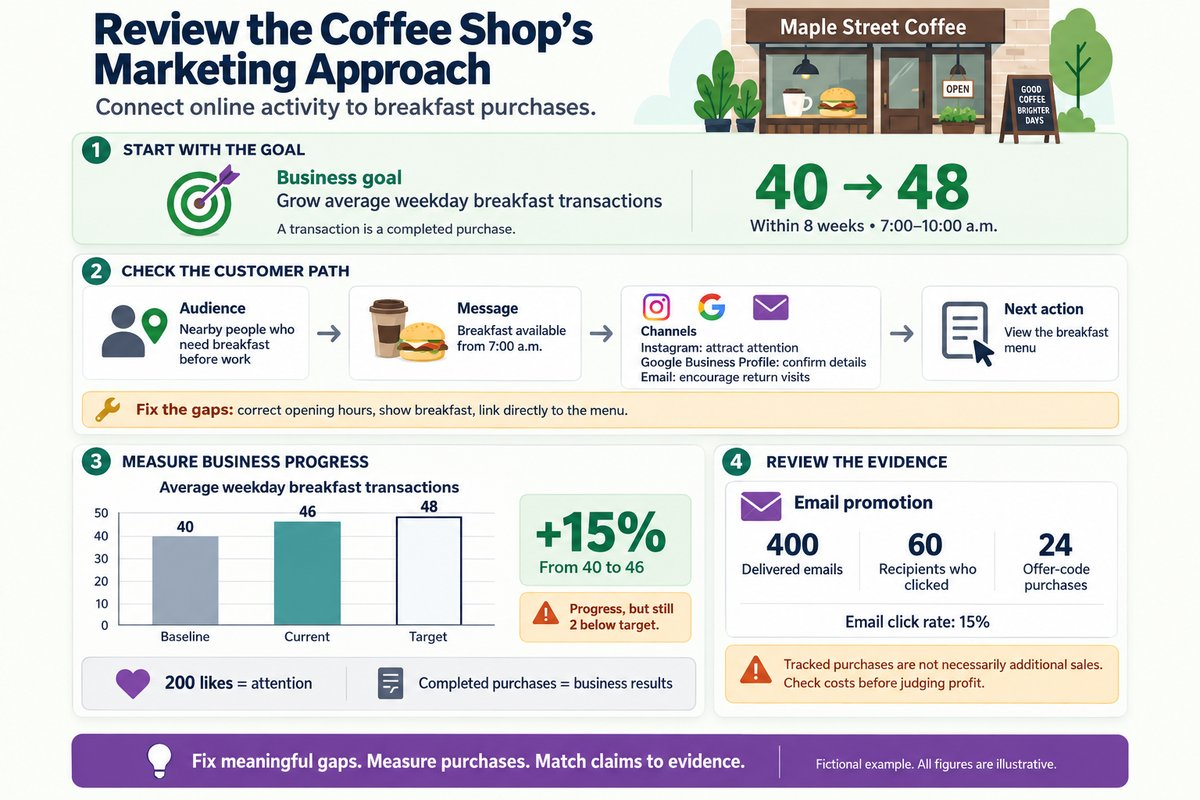
The shop sets an illustrative goal: increase average weekday breakfast transactions from 40 to 48 within eight weeks. A transaction is a completed purchase; it is not necessarily a unique customer. This goal gives the review a clear focus, rather than treating every increase in online activity as success.
| Review area | Maple Street Coffee’s direction | What the review checks |
|---|---|---|
| Goal | Increase breakfast transactions from 40 to 48 per weekday | Are activities designed to support morning purchases? |
| Audience | People living or working nearby who need breakfast | Do messages address their needs and location? |
| Value proposition | A quick breakfast stop with coffee and food | Is this useful reason to choose the shop clear? |
| Channels | Instagram, Google Business Profile, and email | Does each channel have a clear role? |
| Results | Completed breakfast purchases | Is the shop tracking business outcomes, not just attention? |
A value proposition explains why a customer should choose a business. A channel is a route used to reach customers, such as email or search. These parts should work together: a promise of a quick breakfast is more useful when customers can also find the opening hours, location, and available food.
Check whether the message fits the customer
A nearby office worker sees a coffee photo during a morning commute. The photo looks appealing, but it does not show whether the shop serves breakfast or opens before work. The content earns attention without answering the questions that could lead to a visit. This is a gap between the message and the target audience, the group the business aims to reach.
Reviewing audience fit means looking beyond broad labels such as “coffee lovers.” For Maple Street Coffee, a more useful description is “people nearby who need breakfast before work.” That description points toward specific information: morning hours, breakfast availability, location, and realistic service expectations. It does not assume that every nearby worker has the same budget or preferences.
The best practice is to connect a customer need with a truthful benefit. For example, “Coffee and a breakfast sandwich available from 7:00 a.m., two blocks from Central Station” gives a commuter a clear reason to consider visiting. “The best coffee in town” offers less practical information and makes a claim that may be difficult to support. A common misconception is that stronger marketing always needs more exciting language; often, it needs more useful detail.
The review must also check whether the shop can deliver the promise. Advertising “breakfast in five minutes” creates a problem if morning orders regularly take 15 minutes. Marketing and daily operations must agree, or a successful promotion may lead to disappointed customers. A persuasive message should make a relevant promise that the business can keep.
Give each channel a clear role
A customer may discover Maple Street Coffee on Instagram, check its hours on Google, and visit the next morning. These connected moments form a customer journey, the path from first awareness to purchase and possible return visits. Reviewing channels means checking how well they support that path, not simply counting how many accounts the shop uses.
Different channels serve different needs, although their roles can overlap. Instagram can make the breakfast offer noticeable, while a Google Business Profile can help someone confirm whether the shop is nearby and open. Email can remind subscribers about a reason to return. The best approach is not to force every channel to do everything, but to remove gaps between interest and action.
| Review dimension | Google Business Profile | Email newsletter | |
|---|---|---|---|
| Useful role | Show the breakfast offer and attract attention | Help nearby customers find and assess the shop | Encourage subscribers to return |
| Essential information | Food, opening time, and location | Accurate hours, address, and menu details | Relevant offer, timing, and clear action |
| Common weakness | Attractive photos without visit details | Outdated hours or missing information | Broad updates without a reason to visit |
| Measurement limit | Likes do not prove purchases | Direction requests do not prove arrivals | Clicks do not prove purchases |
A call to action, or CTA, tells the customer what to do next. For Maple Street Coffee, “View the breakfast menu” is clearer than “Find out more” when the purpose is to help someone choose breakfast. The linked page must then show the breakfast menu, not make the customer search through unrelated content. A frequent mistake is adding more channels while leaving these basic connections broken.
Separate attention from business results
Suppose Maple Street Coffee’s breakfast post receives 200 likes. That number shows a response to the content, but it does not reveal how many people visited or bought breakfast. A metric is a measurement used to assess activity or performance. Its value depends on the question the review needs to answer.
A conversion is a desired action, such as a purchase or signup. For the shop’s breakfast goal, a completed breakfast purchase is the most relevant conversion. Likes, menu visits, and direction requests can help explain customer interest, but they are not substitutes for sales. The misconception to avoid is that a large online number automatically means strong business performance.
The shop should compare results using the same definition and similar conditions. If breakfast transactions rise from 40 to 46 per weekday, the increase is 6 ÷ 40 × 100, or 15%. That is progress, but it remains below the target of 48. Weather, holidays, pricing, and changes in nearby office attendance may also affect the result.
Attribution means assigning credit for a result to a marketing activity. A customer may see several messages before buying, so giving all credit to one post can be misleading. The review should describe what the evidence supports and what remains uncertain. Useful measurement guides decisions without claiming more certainty than the data allows.
Example: Fix a missing link in the breakfast message
Fix the Path from Interest to Breakfast
During the review, the owner finds that recent Instagram posts mainly show latte art. The Google Business Profile lists an 8:00 a.m. opening time, although the shop now opens at 7:00 a.m. The breakfast menu on the website is accurate, but Instagram does not link directly to it.
The owner follows a short review sequence:
- Check the goal: Use the 7:00–10:00 a.m. breakfast goal to focus the review on morning visits.
- Inspect the customer-facing details: Compare published hours with actual hours and identify the incorrect 8:00 a.m. listing.
- Check the message: Compare latte-art posts with the breakfast offer and identify missing food and opening-time details.
- Check the next action: Follow the Instagram link and identify the extra search needed to find breakfast.
- Record the recommendation: Correct the hours and publish breakfast content that links directly to the menu.
These changes make the existing approach clearer without adding a new channel. Customers can see a relevant offer, confirm that the shop is open, and find the menu more easily. The owner must coordinate with staff to confirm hours and availability before publishing updates. The benefit is a smoother route to a visit; the limitation is that correcting information alone does not guarantee more purchases.
Example: Review a breakfast promotion without overstating success
Maple Street Coffee then runs an illustrative two-week email promotion for a $7 coffee-and-sandwich bundle. Of 400 delivered emails, 60 recipients click the menu link, and staff record 24 purchases using the email’s offer code. During the same period, average weekday breakfast transactions rise from 40 to 46. These figures describe different parts of the result, so the owner reviews them separately.
- Calculate email interest: Divide 60 clicking recipients by 400 delivered emails to get a 15% click rate.
- Count tracked purchases: Use the checkout records to identify 24 purchases connected to the offer code.
- Check overall progress: Compare 46 daily breakfast transactions with the baseline of 40 and the target of 48.
- Check financial impact: Review ingredient costs and any discount cost before deciding whether the promotion is worthwhile.
The code provides evidence that the email offer contributes to purchases, but it does not prove that all 24 purchases are additional sales. Some customers may have planned to visit anyway, and others may share the code. The overall increase also cannot be assigned entirely to email without stronger evidence. The review therefore connects marketing records with checkout and cost information, giving the owner a more useful picture than email clicks alone.
Turn the review into a clear judgment
A useful review ends with a focused judgment, not a long list of disconnected numbers. For Maple Street Coffee, the approach has a relevant breakfast offer, but inaccurate hours and unclear messages weaken its connection to the goal. The promotion shows encouraging results, while its full effect on additional sales and profit remains uncertain.
The most important takeaways are:
-
Start with a business goal: Judge activities against the result the shop needs.
-
Check the full customer path: Audience, message, channel, and next action should fit together.
-
Match claims to evidence: Attention suggests interest; purchases provide stronger business evidence.
-
Prioritize meaningful gaps: Fix inaccurate information and unclear actions before adding more activity.
In the next lesson, you'll take this further with Choose Your Next Learning Steps.