

Permission-Based Email and Repeat Visits
- View
Give visitors a reason to come back
A visitor checks Cedar Street Bakery’s website, reads about its weekend baking classes, and leaves without booking. The visit shows interest, but the bakery cannot assume that the visitor wants marketing emails. A clear invitation to receive useful updates creates a respectful way to continue the relationship.
Email can help a business stay useful after a first visit, especially when people need time before making a decision. The goal is not simply to send more messages; it is to give interested people a good reason to return. In this lesson, you’ll learn how to earn permission, design relevant emails, and connect those emails to useful return visits.
Permission starts with a clear choice
Cedar Street Bakery places a signup form beside its class schedule: “Get one monthly email with new baking classes and seasonal recipes.” A visitor enters an email address and chooses to subscribe. This is permission-based email marketing: sending marketing messages to people who have knowingly agreed to receive them.
An opt-in is the action a person takes to give that agreement, such as submitting a clearly labeled subscription form. Permission should describe who will send the emails and what subscribers can expect. Providing an address for a receipt, delivery update, or class booking does not automatically give permission for unrelated marketing.
| Dimension | Permission-based approach | Assumption-based approach |
|---|---|---|
| How an address is collected | A visitor chooses “Subscribe to monthly class updates.” | A business adds every customer’s checkout email. |
| What the person expects | Recipes and class announcements from the bakery. | A receipt or booking confirmation only. |
| Relationship with the audience | The business follows an agreed purpose. | The business risks surprising or frustrating people. |
| Recommended action | Keep evidence of the signup and honor the promise. | Ask for a clear marketing choice instead. |
A subscriber is someone who has signed up to receive your emails. That person has invited a specific kind of contact, not given unlimited access to their attention. Think of permission as an agreement that the business must continue to respect.
Build a signup promise you can keep
A visitor is more likely to subscribe when the benefit is clear before they share their address. Cedar Street Bakery’s promise names the content, the sender, and the frequency: one monthly email about classes and recipes. These details reduce uncertainty and help attract people who actually want the messages. A vague invitation such as “Join our list” gives visitors little reason to act.
Ask only for information needed to deliver the promised experience. For the bakery’s monthly update, an email address may be enough; a phone number and home address add effort without improving the email. Keep marketing choices separate from necessary purchase steps, and avoid preselected consent boxes. Record the signup date, the source of the signup, and the wording the person agreed to.
Some businesses use double opt-in, which asks a person to confirm their subscription through an email link. This can help verify control of the address and reduce incorrect signups, although it adds another step. It is not a universal legal requirement, and marketing rules vary by location. Treat clear consent as a relationship standard while checking the laws that apply to the business and its audience.
A simple signup sequence makes the agreement visible:
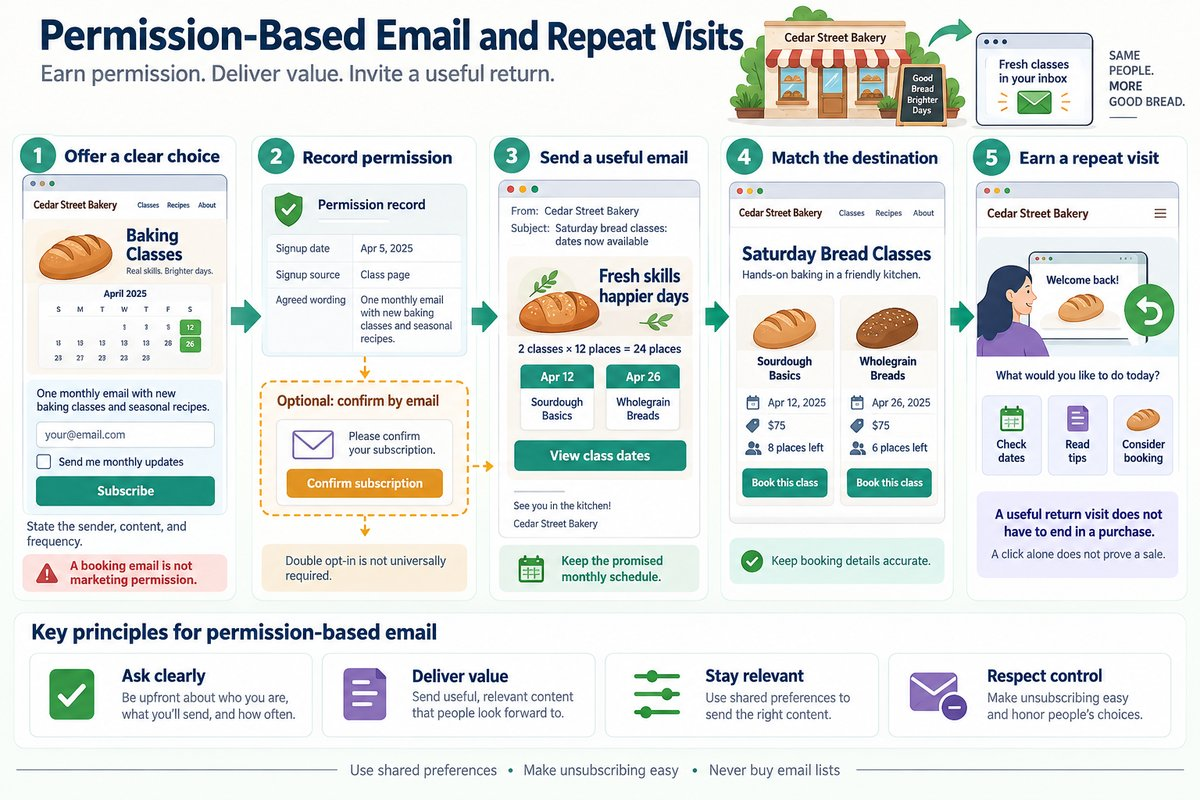
- Input: a visitor reading the class page. Show “Get one monthly email with new baking classes and seasonal recipes”; output: a clear subscription offer.
- Input: an email address and an active signup choice. Save the address and consent record; output: a subscription record.
- Input: an unconfirmed signup, if double opt-in is used. Send a confirmation link; output: a confirmed subscription when the person clicks.
- Input: an active subscription. Send a welcome email that repeats the promise; output: a subscriber who knows what to expect.
Turn each email into one useful next step
From Permission to a Useful Return Visit
A subscriber opens an email announcing a beginner bread class, reads a short description, and clicks “View Saturday classes.” The link opens the relevant class page rather than the bakery’s general homepage. This connected experience gives the reader a clear reason to return. A repeat visit is a later visit to the business’s website or another relevant destination.
The email needs a clear purpose before it needs clever writing. Its subject line, the text shown in the inbox, should accurately describe the message rather than create false urgency. Its call to action (CTA) is the instruction that invites the next step, such as “View Saturday classes.” One main CTA helps beginners build focused emails without competing requests.
The page after the click should continue the same promise. If an email offers a beginner bread class, the destination should show that class, its availability, and the information needed to decide. A return visit can still be valuable when the reader does not buy immediately; they might check a date or read preparation advice. However, a click alone does not prove that the email created a sale.
| Email element | Cedar Street Bakery example | Purpose |
|---|---|---|
| Recognizable sender | Cedar Street Bakery | Helps subscribers identify the business. |
| Accurate subject line | “April beginner bread classes are open” | Sets a clear expectation. |
| Useful message | Class dates, skill level, and what participants will make | Helps readers judge relevance. |
| Main CTA | “View beginner bread classes” | Makes the next step clear. |
| Matching destination | The beginner class schedule | Continues the promise after the click. |
Keep the relationship useful over time
Someone who signs up for monthly class updates may welcome a useful recipe but dislike daily sales messages. The original permission sets the starting point for cadence, the planned rhythm of your emails. Cedar Street Bakery should begin with the monthly schedule it promised rather than increase frequency just to gain more visits. There is no single sending schedule that works for every audience.
Relevance also depends on people’s interests. Segmentation means grouping subscribers using information they have shared or other appropriate data so messages better match their needs. For example, the bakery can offer an optional choice between “Baking classes” and “Seasonal recipes.” It should not promise personalized content unless it can reliably use those preferences.
Subscribers must also have an easy way to stop marketing emails. An unsubscribe link lets them withdraw from the list, and the business should honor that choice promptly within applicable legal requirements. Keep a record that prevents unsubscribed addresses from being added back by mistake, and do not buy lists as a shortcut to permission. A smaller interested audience is a stronger starting point than a large group that never asked to hear from you.
| Common misconception | Better principle | Concrete action |
|---|---|---|
| “A purchase means permission for every email.” | Purchase communication and marketing have different purposes. | Offer a separate signup choice during class booking. |
| “More emails always create more return visits.” | Frequency must match expectations and usefulness. | Keep the promised monthly schedule. |
| “Every subscriber needs every announcement.” | Relevant messages serve specific interests. | Send class announcements to people who chose class updates. |
| “An unsubscribe is something to prevent.” | Leaving should be simple and respectful. | Include a clear unsubscribe link in each marketing email. |
Example: welcome a new class subscriber
The following Cedar Street Bakery examples are illustrative, not reported business results. Maya visits the beginner bread class page but cannot attend the dates currently available. She signs up for the monthly class-and-recipe email so she can hear about future options.
- Input: Maya’s subscription. The bakery records the signup wording, date, and source; output: a documented marketing choice.
- Input: the new subscription record. A welcome email says, “You’re subscribed to one monthly email with new classes and seasonal recipes”; output: confirmed expectations.
- Input: Maya’s interest in beginner classes. The welcome email includes “Explore beginner baking tips”; output: a direct route to useful website content.
- Input: Maya’s click. A beginner tips page explains basic equipment and links to the class schedule; output: a useful return visit.
The welcome email delivers value without forcing an immediate booking. The bakery’s website content and email now support the same customer need: becoming more confident about attending a class. This approach depends on keeping the tips page accurate and useful, and it does not guarantee that Maya will return or book.
Example: invite a relevant return without over-sending
Cedar Street Bakery later opens two Saturday bread classes, each with 12 places. Its signup form allows subscribers to choose class updates, recipes, or both, so the business can identify people who requested class news. It includes the announcement in the promised monthly email rather than adding several unexpected reminders.
- Input: two confirmed classes with 12 places each. The bakery checks dates, prices, and availability; output: an accurate offer covering 24 places.
- Input: subscribers who selected class updates. The bakery prepares the relevant audience; output: a recipient list matched to expressed interest.
- Input: the confirmed class details. The email uses “Saturday bread classes: dates now available” and “View class dates”; output: one clear invitation.
- Input: a click on the CTA. The class page shows current availability and booking details; output: a return visit with a clear decision path.
The bakery’s email and booking process must stay aligned throughout the campaign. If both classes fill, the page should clearly show that status and offer a waitlist only if the bakery can manage one. Accurate availability protects trust, but even a relevant email may arrive when a subscriber has no time or budget to attend.
Earn the next visit
Permission-based email works when the signup promise, the message, and the destination fit together. A subscriber should understand why an email arrived and what useful action it offers. The business earns future attention by respecting that agreement each time it sends.
-
Ask clearly: Explain the content and expected frequency before signup.
-
Deliver useful value: Give each email a focused purpose and a matching destination.
-
Stay relevant: Use appropriate preferences and keep the promised sending rhythm.
-
Respect control: Make unsubscribing easy and honor the choice.
Next, we'll build on this by exploring Measuring Results and Understanding Attribution.