

Search Visibility, Social Media, and Paid Advertising
- View
Help the right customers find you
Maple Street Bakery has a useful website, fresh products, and room for more orders. Yet people searching for a nearby bakery do not always find it, and its social posts reach only a small audience. The owner needs more than attention: the business needs visits from people who may actually place an order.
This lesson follows Maple Street Bakery as it connects search visibility, social media, and paid advertising. These channels help a business appear at different moments in a customer’s decision. Understanding their roles helps you choose where to spend time and money without expecting one channel to do everything.
By the end of this lesson, you will be able to:
-
Explain how organic search, organic social media, and paid advertising attract visitors.
-
Match each channel to a clear customer need and business goal.
-
Recognize common mistakes that waste effort or advertising budget.
-
Connect visibility and clicks to useful business results.
Three routes to a customer’s attention
A customer types “birthday cake near me,” sees a cake-decorating video, or notices a sponsored cake offer. Each experience can lead to the same bakery, but the customer starts with a different level of interest. A marketing channel is a route through which a business reaches people.
Search visibility means how easily people can find a business in search results, including relevant local results. Organic visibility comes from unpaid placement, although creating and maintaining content still takes time and resources. Paid advertising involves paying a platform to display a message, which can appear in search results, social feeds, or other placements.
| Comparison dimension | Organic search | Organic social media | Paid advertising |
|---|---|---|---|
| How people discover you | They search for information, a product, or a service. | They encounter posts through feeds, shares, or profiles. | A platform displays an ad through selected placements and settings. |
| Typical role | Answer existing needs. | Build familiarity and interest. | Buy access to relevant audiences or searches. |
| Main investment | Useful website content and ongoing improvements. | Content creation and audience interaction. | Advertising budget plus creative work and management. |
| Main limitation | Visibility takes time and is not guaranteed. | Reach varies and depends partly on platform systems. | Delivery depends on budget, competition, and platform rules. |
These are connected routes, not separate customer worlds. Someone may discover Maple Street Bakery through a social video and later search for its name. A useful plan gives each route a job while keeping the offer, business details, and next action consistent.
Three Routes to Maple Street Bakery
Search visibility starts with a useful answer
When someone searches for “custom birthday cake pickup Saturday,” the search engine tries to show relevant, useful results. The bakery improves its chances by publishing a page that clearly explains its cake options, pickup location, and ordering deadline. Search engine optimization (SEO) is the work of improving a website so search engines can understand it and people can use it. SEO supports unpaid search visibility; it does not buy a particular position.
The starting point is search intent, or what a person wants to achieve through a search. A search for “how to store a cake” needs helpful advice, while “order birthday cake downtown” suggests a possible purchase. Maple Street Bakery should match each page to a clear need rather than repeat the same phrase throughout its website. A descriptive page title, clear headings, useful product details, and relevant internal links help visitors and search engines understand the page.
Local visibility also depends on accurate business information, such as the bakery’s address, hours, and phone number. For example, displaying an incorrect Saturday closing time can lose an order even when the business appears in results. Pages should also load reliably and work well on phones so visitors can complete their next step. A common misconception is that adding more keywords guarantees better rankings; keyword stuffing, or unnatural repetition of search terms, can make content less useful without improving visibility.
Social media turns products into familiar choices
A short video shows a baker adding fresh strawberries to a cake. Someone who was not shopping for cake stops to watch, visits the bakery’s profile, and remembers the business for a later celebration. Social media marketing uses content and interaction on social platforms to reach people and develop interest. Its value often begins before someone is ready to buy.
Good social content gives the intended audience a reason to pay attention. For Maple Street Bakery, useful themes include finished cakes, answers to ordering questions, and short views of the baking process. A post about a $35 celebration cake becomes more helpful when it includes its serving size and ordering deadline. A call to action (CTA) tells the viewer what to do next, such as “View cake options” or “Check pickup availability.”
Posting alone does not guarantee that followers will see the content. Platforms use ranking systems to decide what appears in a feed, and distribution can change over time. Engagement, such as comments, shares, and saves, can show that content interests people, but it does not prove that orders increased. A common mistake is chasing popular formats that attract unrelated viewers; a widely shared joke may bring less business value than a modestly viewed post that answers a local customer’s question.
Paid advertising buys opportunities, not guaranteed sales
When the bakery pays to show an offer, it gains access to advertising placements rather than a promise of orders. A paid search ad may appear beside relevant search results, while a paid social ad may introduce the offer in someone’s feed. Targeting means using available settings, such as location or search terms, to guide who may see an ad. Those settings narrow the opportunity, but they do not identify every future buyer with certainty.
A strong campaign connects one business goal to a suitable audience, message, and destination. The landing page, or page reached after an ad click, should deliver what the ad promises. If Maple Street Bakery advertises a $35 cake for local pickup, the destination should make that cake, price, and pickup process easy to find. Sending people to a general homepage adds extra work and can reduce completed orders.
Advertising costs depend on factors such as competition, audience, and platform systems. Pay-per-click (PPC) is a payment model in which the advertiser pays when someone clicks, although not every advertising campaign uses this model. A higher budget can create more opportunities for exposure, but it cannot repair an unclear offer or a confusing order page. Best practice is to set spending limits, check results, and improve weak points rather than assume that more spending will automatically produce profitable growth.
Measure progress beyond the click
A person can see an ad without clicking, click without ordering, or order after several visits. These actions describe different parts of the journey, so they should not be treated as equal results. A conversion is a valuable action defined by the business, such as a completed cake order.
| Measurement | What it tells you | Bakery example |
|---|---|---|
| Impressions | How many times content or an ad is displayed, not how many unique people see it. | An ad is displayed 5,000 times. |
| Clicks | How many times people click the measured link or ad. | The ad receives 100 clicks. |
| Click-through rate (CTR) | Clicks divided by impressions, multiplied by 100. | 100 ÷ 5,000 × 100 = 2%. |
| Cost per click (CPC) | Advertising spend divided by clicks. | $100 ÷ 100 = $1 per click. |
| Cost per conversion | Advertising spend divided by measured conversions. | $100 ÷ 5 orders = $20 per order. |
These figures are an illustration, not an expected result for every bakery. Five orders may sound promising, but their value depends on what the business earns after costs. If each order contributes only $12 before advertising costs, paying $20 to acquire it does not cover the ad spend on that purchase.
Measurement also has limits, since privacy choices, tracking setup, and visits across devices can affect recorded results. A platform may report an order under its own attribution rules, which determine how credit is assigned to marketing activity. Treat reports as useful evidence, and check them against actual orders and business costs.
Example: Make Saturday cake pickup easier to find
Maple Street Bakery wants more local cake orders for Saturday pickup. In this illustrative example, its website shows attractive photos but leaves customers unsure about deadlines and prices. The first improvement is not more promotion; it is a clear page that supports a real ordering decision.
- Start with the customer’s question: Use “birthday cake pickup Saturday” as the input. Identify the information needed: cake choices, prices, pickup location, and the order deadline.
- Create a focused page: Use those details to produce a page titled “Birthday Cakes for Saturday Pickup.” Show the $35 cake, its serving size, and the Thursday noon deadline.
- Check the local details: Compare the page with the bakery’s business listing. Correct the hours and address so customers receive consistent information.
- Publish a matching social post: Use a short cake-decorating video with the Thursday deadline. Link viewers to the cake page rather than asking them to search through the website.
- Review completed orders: Compare page visits with confirmed Saturday pickup orders. Use customer questions to identify missing information.
The search page answers a clear need, while the social post introduces the same offer to people browsing their feeds. Both routes lead to one destination, which keeps prices and deadlines consistent. This also helps the bakery’s staff avoid explaining different offers to different customers.
The benefit is a clearer path from interest to ordering, not a guaranteed search ranking or immediate sales increase. Organic search improvements may take time to affect visibility, and social reach remains uncertain. The bakery must also keep the page current when prices, availability, or pickup arrangements change.
Example: Test a local cake ad without losing control of costs
The same bakery now tests paid search for its $35 cake offer. It sets a $100 spending limit for an initial test and focuses on searches related to local cake orders. The figures below are illustrative results, not performance promises or industry benchmarks.
- Define the outcome: Use completed cake orders as the conversion. Confirm that the ordering system records those orders accurately.
- Set the campaign boundaries: Use the bakery’s actual service area and relevant cake-order searches. Apply a $100 test budget with suitable platform spending controls.
- Match the message: Create an ad that states “Birthday Cakes from $35” and the pickup deadline. Send clicks directly to the matching cake page.
- Read the results: Record $100 in spend, 100 clicks, and five measured orders. Calculate a $1 CPC and a $20 cost per order.
- Check the business value: Compare the $20 acquisition cost with the contribution from each order. Decide whether to improve the offer or page, adjust the campaign, or stop spending.
The campaign brings measurable visits quickly, but the results expose a financial problem if each cake contributes only $12 before advertising. In that case, five orders contribute $60 toward the $100 advertising expense, leaving a $40 shortfall. The owner should not describe the campaign as successful simply because it generated orders.
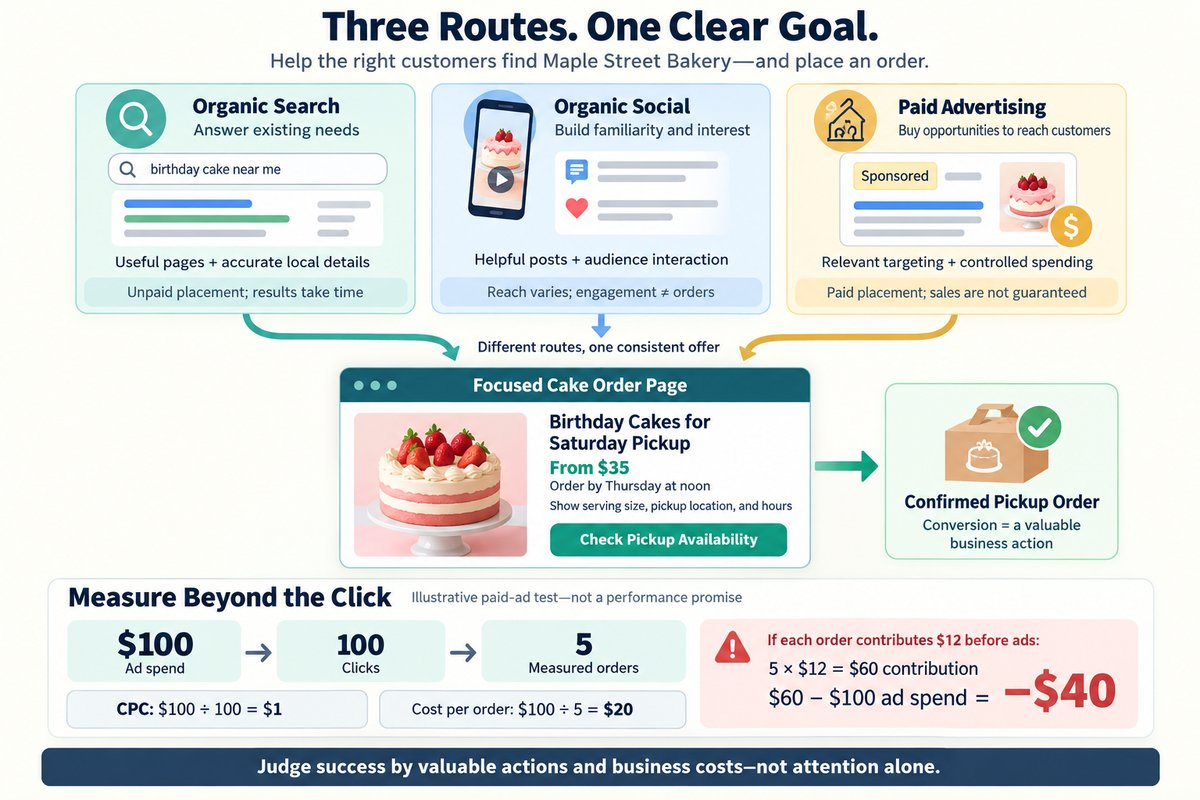
This test connects marketing decisions to the bakery’s pricing, production costs, and order capacity. If many visitors leave without ordering, the owner can check whether the page explains pickup clearly before increasing spending. One small test cannot establish a reliable long-term result, but it can reveal a costly weakness before the business commits more money.
Give each channel a clear job
Search visibility, social media, and paid advertising work best when each supports a specific customer need. A useful page helps people make decisions, social content gives them reasons to pay attention, and advertising creates paid opportunities to reach them. The shared goal is not maximum activity; it is valuable action at a cost the business can support.
-
Search: Match useful pages to what people are trying to find.
-
Social media: Build relevant interest with clear content and interaction.
-
Paid advertising: Connect a controlled budget to a focused offer and destination.
-
Measurement: Judge results through meaningful actions and business costs, not attention alone.
Next, we'll build on this by exploring Permission-Based Email and Repeat Visits.