

Audience Segments, Customer Needs, and Research
- View
One offer, different reasons to buy
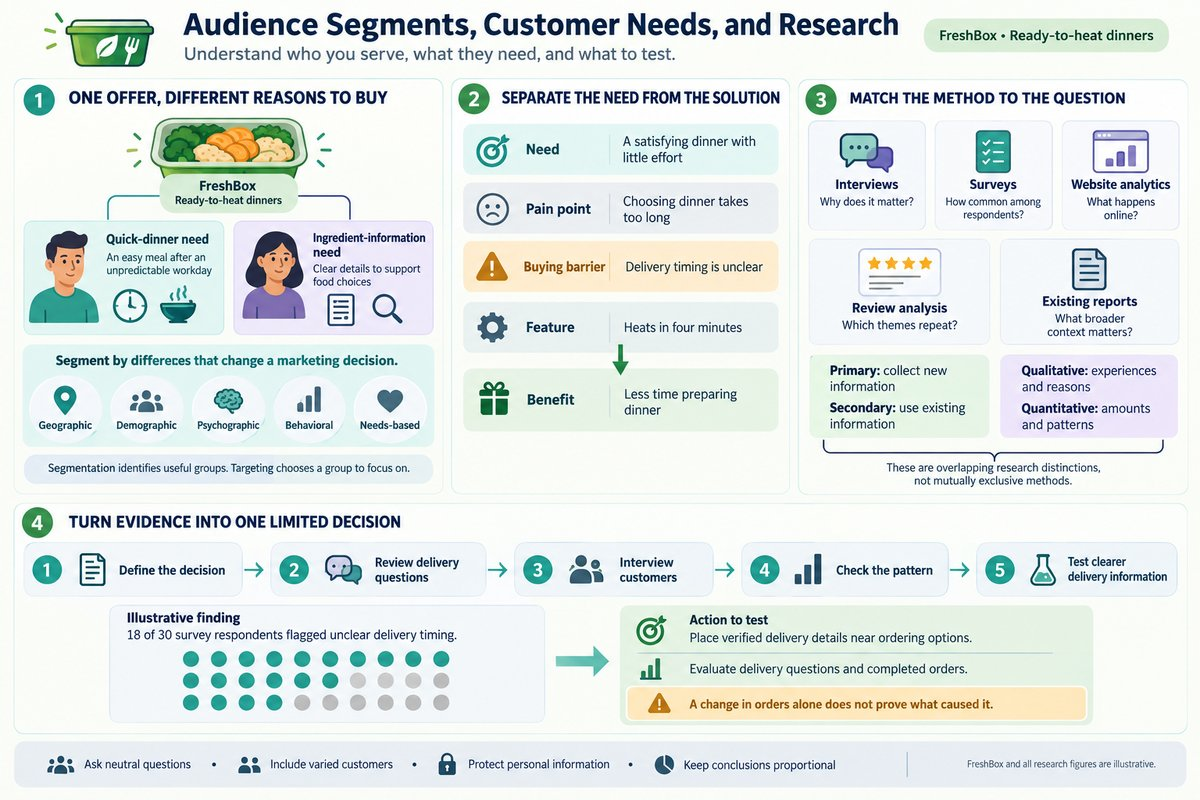
FreshBox is a local meal-prep business that sells ready-to-heat dinners online. Its owner plans to promote a weekly meal bundle with the message “Healthy meals for everyone.” Yet some customers want a quick dinner after work, while others want clear ingredient information to support their food choices. The same product may help both groups, but the same message may not answer both groups’ concerns.
Digital marketing becomes more useful when it starts with those differences. Before choosing what to say, a business needs to understand who it wants to reach, what those people need, and what evidence supports its decisions. This lesson follows FreshBox through that process; the business and all research figures are illustrative.
By the end, you will understand how to:
-
Identify useful audience segments rather than broad groups with little in common.
-
Separate customer needs from product features and buying barriers.
-
Choose research methods that answer different questions.
-
Turn research findings into clear, testable marketing decisions.
Find differences that change a marketing decision
Two FreshBox customers may live on the same street and have similar incomes, yet buy for different reasons. One orders whenever evening shifts make cooking difficult; the other orders only when the menu provides enough ingredient detail. Grouping them only by location or income would miss a difference that matters to the offer. Audience segmentation means dividing a broad audience into groups with shared characteristics, needs, or behaviors that matter for marketing.
A target audience is the group a business chooses to focus on for a particular offer or campaign. Segmentation describes useful groups; targeting selects which group to serve. A segment is valuable when the business can recognize it through evidence, reach it appropriately, and offer something relevant. For example, “customers who need dinner ready within ten minutes” gives FreshBox a clearer direction than “adults who like food.”
Segments are working models, not fixed labels for people. One customer may need fast dinners during a busy week and detailed nutrition information during another week. Start with differences that could change a real decision, such as which product information to highlight. Avoid creating many narrow groups when the business lacks enough evidence or resources to serve them differently.
| Segmentation basis | What it describes | FreshBox example | Main caution |
|---|---|---|---|
| Geographic | Where people live or work | Customers inside the delivery area | Location alone does not explain motivation. |
| Demographic | Characteristics such as age or household size | Households with one person | Shared characteristics do not guarantee shared needs. |
| Psychographic | Attitudes, interests, and values | Customers who value reducing food waste | Stated values may not match buying behavior. |
| Behavioral | Actions such as purchase frequency | Customers who reorder most weeks | Past actions do not fully explain why people act. |
| Needs-based | The outcome people want | A reliable dinner after a late shift | Needs require evidence, not guesses. |
These approaches can work together. FreshBox might focus on people within its delivery area who regularly need quick evening meals. The geographic limit makes the audience serviceable, while the need makes the offer relevant. Adding more personal details is useful only when those details improve a decision.
Look beneath the product request
A customer says, “I need something I can heat quickly.” FreshBox could treat that as a request for a microwave-friendly container, but the deeper goal may be to eat dinner with little effort after a long shift. A customer need is the outcome or problem a person wants to address. The product is one possible way to meet that need, not the need itself.
A useful framework is jobs to be done: understanding the progress someone wants to make in a particular situation. For FreshBox, the job might be, “When I get home late, help me eat a satisfying dinner without planning or cleaning up much.” This statement includes a situation, a desired outcome, and a difficulty to reduce. It is more useful than assuming that every busy customer wants the cheapest possible meal.
Needs can include practical and emotional concerns. A customer may want quick preparation and also want to feel confident that dinner is taken care of. A pain point is a specific frustration, while a buying barrier is something that prevents or delays a purchase. Separating these ideas helps a business address the actual problem rather than add features that customers may not value.
| Customer insight | Meaning | FreshBox example |
|---|---|---|
| Need | The outcome the customer wants | Eat a satisfying dinner with little effort |
| Pain point | A frustration in the current situation | Choosing dinner takes too long after work |
| Buying barrier | A reason not to purchase | Delivery timing is unclear |
| Feature | Something the product has or does | Meals heat in four minutes |
| Benefit | How a feature helps the customer | Less time preparing dinner |
A feature becomes meaningful when it supports an outcome the customer values. “Heats in four minutes” connects directly to a quick-dinner need, but it does not solve uncertainty about delivery. If delivery timing is the main barrier, repeating the preparation time will leave the concern unanswered. Good research helps FreshBox identify which problem requires attention first.
Match the research method to the question
FreshBox notices that customers leave its delivery-information page without ordering. That pattern shows where a possible problem occurs, but it does not reveal the reason. Customer research is the planned collection and interpretation of evidence about customers and their decisions. Its purpose is to reduce uncertainty, not simply confirm what the business already believes.
Primary research collects new information directly, such as customer interviews or surveys. Secondary research uses existing information, such as public industry reports or published local data. Another distinction concerns the evidence itself: qualitative research explores experiences and reasons, while quantitative research measures amounts or patterns. These categories overlap; a new survey can collect both numerical ratings and written explanations.
Choose a method by identifying the question first. Interviews can reveal why delivery feels uncertain, while website data can show how often visitors open the delivery page. Neither method gives a complete answer alone. A useful approach combines evidence about what people do with evidence about how they describe their decisions.
| Research method | Best question to answer | Useful evidence | Main limitation |
|---|---|---|---|
| Customer interviews | Why does this matter to customers? | Detailed experiences and customer language | A small group may miss other experiences. |
| Surveys | How common is an answer among respondents? | Counts, ratings, and stated preferences | Wording and respondent selection affect results. |
| Website analytics | What happens on the website? | Visits, page views, and completed actions | Behavior alone rarely explains motivation. |
| Review analysis | Which themes appear in customer comments? | Repeated praise, complaints, and concerns | Reviewers may differ from typical customers. |
| Existing reports | What broader conditions may matter? | Market trends and local context | Findings may not fit the business’s audience. |
Gather evidence without steering the answer
From Delivery Questions to a Testable Decision
A question such as “Would you enjoy our convenient weekly plan?” encourages agreement and assumes convenience matters. A more neutral question is “Tell me about the last time you bought a ready-made dinner.” The second question invites a real event rather than a favorable opinion. Follow-up questions about timing, alternatives, and difficulties help reveal what shaped that decision.
Strong research also depends on who participates. Sampling bias occurs when the people studied do not fairly reflect the audience the business wants to understand. Interviewing only loyal FreshBox customers could hide the concerns of people who stopped ordering. Including recent buyers, occasional buyers, and former customers can reveal a wider range of experiences.
Keep each finding separate from its interpretation. “Five interview participants mention uncertainty about delivery” is an observation; “delivery uncertainty is the main reason everyone leaves” goes beyond that evidence. Record uncertainty, look for repeated patterns, and check important conclusions with another source. Collect only necessary personal information, explain how responses will be used, and obtain appropriate consent.
A focused research process keeps the evidence tied to a decision:
- Define the decision. Input: FreshBox must choose which concern to address on its delivery page. Output: a question about what customers need to know before ordering.
- Review existing evidence. Input: delivery questions from customer support. Output: a list of repeated concerns about delivery days and arrival times.
- Collect direct evidence. Input: that concern list. Output: interview notes about customers’ recent ordering experiences.
- Check the pattern. Input: interview themes. Output: a survey or website-data check that tests how widely the concern appears.
- Make a limited decision. Input: evidence from the selected sources. Output: a clearer delivery explanation to test, rather than a claim that the problem is fully solved.
FreshBox example: identify a useful audience segment
FreshBox initially describes its audience as “working adults.” In an illustrative set of eight interviews, five participants describe buying prepared food after unpredictable workdays. Three of those five also mention avoiding weekly plans because their schedules change. These findings suggest a possible segment built around flexible, low-effort dinners, but eight interviews cannot establish how common that need is across the market.
The business turns this early evidence into a specific segment description. It then checks whether its delivery area, ordering options, and meal preparation times can genuinely support that group. This connects research with operations: marketing should not promise flexibility that the ordering system cannot provide. The result is a clearer audience choice and an offer worth testing, not proof that all working adults want the same thing.
- Start with interview evidence. Input: five accounts of difficult dinners after unpredictable workdays. Output: a possible shared need for low-effort evening meals.
- Identify a meaningful difference. Input: three concerns about fixed weekly plans. Output: a flexibility requirement to investigate further.
- Define the segment. Input: the need and the service area. Output: local customers who want quick dinners without a fixed weekly commitment.
- Check the business fit. Input: FreshBox’s actual ordering rules. Output: confirmation of whether customers can make one-time purchases.
- Choose a testable message. Input: a verified one-time purchase option. Output: “Four-minute dinners, with no weekly commitment.”
The benefit is relevance: the message answers a specific need and concern. Its limitation is the small, selected interview group, which may not reflect everyone FreshBox could serve. Further evidence should check whether enough reachable customers share this need. A precise segment description helps the business learn more efficiently without pretending the research is complete.
FreshBox example: separate a need from a buying barrier
FreshBox continues researching people considering its meals. In an illustrative survey, 18 of 30 respondents select unclear delivery timing as a concern. Several interview participants also explain that they cannot receive meals during their working hours. This supports investigating delivery information, but the survey result applies to those respondents and should not be presented as a market-wide percentage.
The customer need remains an easy dinner; the possible buying barrier is uncertainty about receiving it. FreshBox checks its actual delivery arrangements before changing the website. The marketing team works with the delivery team to confirm available days, delivery windows, and any limits on leaving food unattended. Clear information can reduce uncertainty, but it cannot make an unsuitable delivery service suitable.
- Identify the concern. Input: 18 of 30 survey responses flag delivery timing. Output: a reason to investigate the clarity and suitability of delivery options.
- Add context. Input: interview accounts about working hours. Output: an explanation of why delivery timing affects the purchase decision.
- Verify the service. Input: confirmed delivery arrangements. Output: accurate information that FreshBox can publish.
- Change one information element. Input: the verified details. Output: a clearly placed delivery explanation near the ordering options.
- Evaluate the result. Input: delivery questions and completed orders before and after the change. Output: evidence about whether the change may help.
FreshBox should avoid claiming that any later increase in orders proves the explanation caused it. Price changes, seasonal demand, or a different mix of visitors could also affect results. Comparing similar periods can improve interpretation, and a controlled test can provide stronger evidence when practical. Even without certainty, the business now has a reasoned decision, a clear limitation, and a defined way to learn more.
Let evidence guide relevance
Useful audience research connects a group of people, a meaningful need, and a decision the business can act on. It does not require a detailed personal profile for every customer. It requires enough reliable evidence to make the next choice more informed.
-
Segment around meaningful differences: choose characteristics that affect the offer, information, or service.
-
Separate needs from solutions: understand the desired outcome before promoting a feature.
-
Match methods to questions: combine reasons from customers with evidence of behavior.
-
Keep conclusions proportional: treat early findings as guidance to check, not universal facts.
Next, we'll build on this by exploring The Customer Journey and a Consistent Brand Message.