

Application Check and Future Learning Directions
- View
When a promising market is not yet a sound decision
A testing-equipment supplier is considering a portable avionics test set for military depots, flight-line maintenance teams, and commercial maintenance, repair, and overhaul organizations. Initial conversations sound encouraging: technicians dislike carrying multiple instruments, managers want shorter troubleshooting cycles, and acquisition teams are interested in commercially available solutions. Yet these signals do not automatically prove that the company has found an attractive, reachable market.
In aviation and defense, a market analysis must survive questions about technical performance, calibration, support, procurement, security, and operational risk. Federal acquisition guidance expects organizations to identify legitimate needs, evaluate trade-offs, and conduct market research appropriate to the circumstances before developing requirements or soliciting offers. The required depth varies with factors such as acquisition value, urgency, complexity, and previous experience. (login.acquisition.gov)
The final application check therefore asks a practical question: Is the analysis strong enough to support a real decision? Answering it requires more than reviewing market-size figures. You must test the connection among the customer’s problem, the operational requirement, the available evidence, the buying process, and the proposed business response.
What a decision-ready analysis contains
A market analysis evaluates the environment in which a testing-equipment supplier may compete. It considers demand, market structure, alternatives, competitors, barriers, trends, and the supplier’s ability to reach and serve the opportunity. Its purpose is not merely to describe an industry; it should help leaders choose where and how to compete.
A customer analysis examines the organizations and people involved in selecting, approving, purchasing, using, maintaining, and supporting the equipment. In aviation and defense, “the customer” is rarely one person. A technician may use the instrument, an engineering authority may approve it, a quality team may verify calibration controls, contracting personnel may purchase it, and a program manager may control the budget.
A decision-ready analysis connects these two views. It explains not only that demand appears to exist, but also which customer has which problem, under what operating conditions, with what evidence, and through what acquisition path. The analysis should distinguish confirmed facts from estimates and assumptions so that decision-makers understand both the opportunity and its uncertainty.
| Category | Descriptive analysis | Decision-ready analysis |
|---|---|---|
| Customer problem | States that customers need faster or more accurate testing. | Identifies the affected workflow, users, consequences, frequency, and required improvement. |
| Market opportunity | Presents a broad industry value or growth estimate. | Defines the reachable segment by platform, application, geography, procurement route, and supplier capability. |
| Evidence | Relies mainly on secondary reports or informal comments. | Triangulates customer evidence, technical requirements, procurement information, and market data. |
| Competition | Lists manufacturers and products. | Compares alternatives against customer decision criteria, including support and lifecycle considerations. |
| Recommendation | Suggests entering an attractive market. | Specifies a decision, assumptions, risks, evidence gaps, and conditions for proceeding. |
The distinction is similar to the difference between detecting a signal and verifying that the signal is valid. A market indication may attract attention, but it becomes useful only after its source, meaning, and reliability have been checked. Confidence should come from traceable evidence, not from the volume of information collected.
Checking the evidence chain
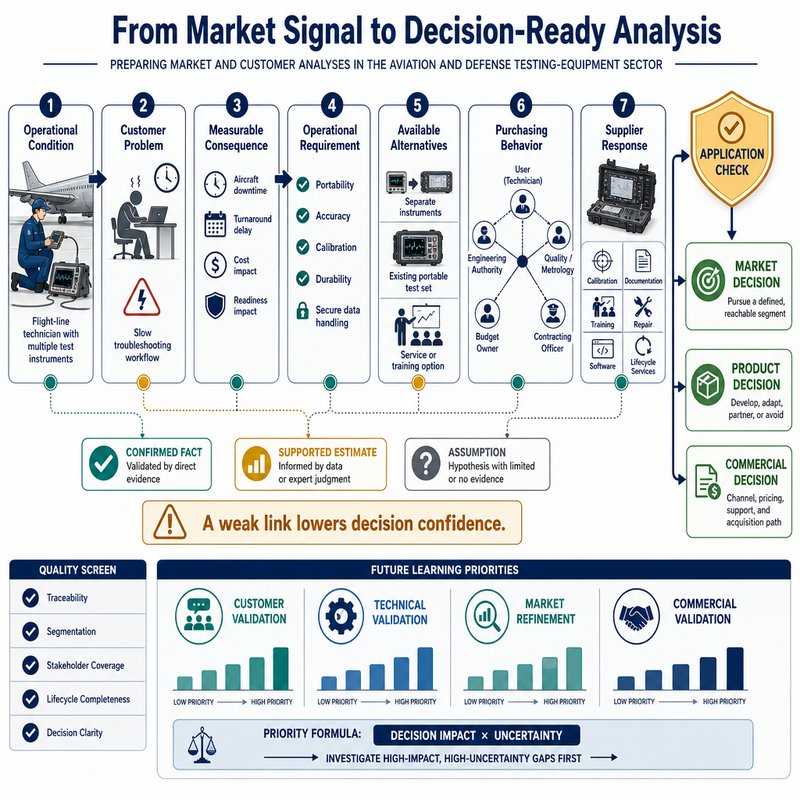
A strong application check begins with the evidence chain: the logical path from an observed customer condition to a recommended action. A basic chain follows this sequence: operational condition, customer problem, measurable consequence, requirement, available alternatives, purchasing behavior, and supplier response. If one link is weak, the recommendation may be premature even when the other parts appear convincing.
Suppose maintainers report that troubleshooting takes too long. That statement identifies dissatisfaction, but it does not yet establish a market requirement. The analyst must determine whether delays result from inadequate test equipment, inaccessible technical data, intermittent faults, insufficient training, approval procedures, or a shortage of calibrated instruments. Different causes lead to different solutions, and only some of those solutions create demand for new equipment.
The next step is to rate each claim by evidence strength. Confirmed facts may include published requirements, procurement records, documented maintenance procedures, or repeated findings from qualified stakeholders. Supported estimates combine relevant data with transparent calculations, while assumptions remain plausible but unverified. Recording these distinctions prevents an attractive narrative from being mistaken for a proven business case.
[[flowchart-placeholder]]
Best practice is to maintain traceability from every major conclusion back to its source. Government market research is expected to address matters such as commercial availability, customary modifications, warranty and support practices, applicable regulations, supplier capabilities, and potential small-business participation. Market research may include contact with knowledgeable government and industry personnel, but the results still need to be documented in a form appropriate to the acquisition’s size and complexity. (acquisition.gov)
A common pitfall is evidence stacking, in which several weak sources are treated as if they create one strong conclusion. Five informal opinions do not necessarily prove willingness to purchase, especially when all five come from users rather than budget owners. Another misconception is that proprietary or classified information is always necessary for useful analysis. In many cases, public requirements, approved technical documentation, customer interviews, contract notices, supplier literature, and carefully labeled assumptions provide enough evidence to make an initial decision.
Testing customer–market alignment
A market can be large while the reachable customer opportunity remains small. Customer–market alignment tests whether the identified customer need appears within a segment that the supplier can access, support, and serve profitably. This check prevents analysts from applying broad aviation or defense spending figures to a narrow category of specialized equipment.
Begin with the operating context. A portable flight-line test set and a laboratory-grade measurement system may address related signals but serve different workflows. They can face different expectations for environmental durability, measurement uncertainty, software control, transportability, calibration, operator skill, and data handling. Grouping them together can inflate the apparent market and conceal important customer differences.
Next, examine the buying system. Defense and government customers may use existing contracts, competitive solicitations, distributors, prime contractors, or program-specific procurement channels. Current federal guidance directs agencies to consider whether needs can be met by existing commercial products or services, commercially available solutions with modifications, or nondevelopmental items before concluding that a unique solution is necessary. (acquisition.gov)
Finally, compare the opportunity with the supplier’s ability to deliver the complete customer outcome. The instrument itself may meet the measurement need, but customers can also require calibration services, technical documentation, training, repair capacity, configuration control, software support, and long-term availability. In FAA flight-inspection operations, for example, equipment must meet original equipment manufacturer specifications, maintain traceability to National Institute of Standards and Technology standards, and have documented calibration procedures and intervals. Build states and equipment modifications must also be recorded and controlled. (faa.gov)
| Alignment question | Evidence of strong alignment | Warning sign |
|---|---|---|
| Is the problem operationally important? | The problem affects availability, safety, turnaround time, compliance, or lifecycle cost. | The issue is inconvenient but has little measurable consequence. |
| Does the segment share the need? | Similar users, platforms, or facilities report a repeated requirement. | Interest depends on one program, contact, or unusual configuration. |
| Can the supplier reach the buyer? | Procurement paths, influencers, and approval authorities are understood. | The analysis identifies users but not funding or contracting routes. |
| Can the offer meet the full requirement? | Product, calibration, support, documentation, and lifecycle needs are addressed. | The analysis considers only instrument specifications. |
| Can the opportunity be sustained? | Installed base, service demand, replacements, and upgrades support continuing value. | The forecast depends entirely on one initial equipment sale. |
The typical misconception is that superior technical specifications guarantee customer preference. Customers normally assess specifications within a larger system of constraints, including compatibility, training burden, support response, approval risk, and total ownership cost. A technically advanced product may therefore lose to an adequate product that fits the existing workflow and support structure more easily.
Turning findings into a bounded decision
An effective analysis ends with a bounded recommendation rather than a broad statement such as “enter the market.” A bounded recommendation specifies the customer segment, application, proposed response, confidence level, major dependencies, and conditions that would change the decision. This format allows leaders to act without pretending that uncertainty has disappeared.
The recommendation should also separate three decisions that are often confused. A market decision determines whether the segment is attractive enough for continued attention. A product decision determines whether the supplier should develop, adapt, partner for, or avoid a particular solution. A commercial decision determines how the offer will be priced, supported, distributed, and purchased.
| Decision level | Primary question | Typical output |
|---|---|---|
| Market | Is this customer segment important and reachable enough to pursue? | Prioritized segment with an opportunity range and evidence rating. |
| Product | What solution configuration best matches the operational requirement? | Product concept, modification scope, technical risks, and validation needs. |
| Commercial | How can the supplier deliver and capture value? | Route to market, support model, pricing logic, and acquisition approach. |
This separation improves cause-and-effect reasoning. A favorable market decision does not automatically justify immediate product development, because the required modifications or approvals may still be too costly. Similarly, a technically feasible product may not support a viable commercial decision if procurement cycles, service obligations, or customer concentration create unacceptable risk.
Best practice is to state decision triggers. For example, a supplier might continue only if customer evidence confirms that the problem affects a defined number of facilities, the required functions can be delivered within an approved modification range, and a workable calibration-support model exists. Triggers convert uncertainty into manageable checkpoints without turning an estimate into a false promise.
The main pitfall is false precision. A detailed spreadsheet can produce an exact-looking revenue forecast even when platform counts, replacement intervals, win rates, and unit prices remain uncertain. A more credible analysis uses ranges, identifies the assumptions that drive the result, and explains how the estimate would change under different conditions.
Example: A portable radio-navigation test set
Consider a supplier assessing a portable test set for VOR, instrument landing system, and related radio-navigation functions. The initial opportunity appears strong because the equipment can consolidate several tests into one field instrument. However, the application check must establish whether consolidation solves a significant customer problem and whether the claimed segment actually shares that problem.
The first step is to define the workflow. The analyst identifies who performs the tests, where they occur, how many instruments are currently required, how long setup takes, and what happens when equipment is unavailable or outside its calibration period. The FAA emphasizes the importance of periodic VOR receiver calibration because equipment can show acceptable performance under strong-signal conditions while producing out-of-tolerance readings at greater distances. (faa.gov)
The second step is to connect the workflow to customer requirements. For a flight-line team, portability, battery operation, setup time, environmental tolerance, and clear pass/fail indications may carry more weight than laboratory-level flexibility. A repair facility may place greater emphasis on accuracy, automated procedures, recorded results, calibration traceability, and integration with existing quality processes. The analysis should therefore divide the market by application rather than treating all avionics maintenance organizations as equivalent.
The final step is to test commercial reach. The analyst reviews whether customers purchase directly, use approved distributors, buy through broader support contracts, or depend on prime contractors. The resulting recommendation may favor one segment—such as depot and repair-facility use—while postponing another segment until environmental performance or field-support evidence improves.
The benefit of this approach is focus: development and sales resources are directed toward customers whose requirements match the proposed product. Its limitation is that public information may not reveal fleet-specific quantities, maintenance intervals, or funding priorities. Those uncertainties should reduce the confidence rating rather than disappear inside an overly precise forecast.
Example: Flight-inspection measurement equipment
A second supplier is considering measurement hardware and software used to inspect radio-navigation services from specialized aircraft. At first glance, the customer group appears small, but each installation may demand high-value equipment, integration, calibration, documentation, and long-term support. The opportunity therefore cannot be evaluated by unit volume alone.
The first analytical step is to identify the full system boundary. FAA Order 8200.48 establishes standards for equipment used by Flight Program Operations and connects those standards to the ground and flight testing of radio-navigation aids. The order covers measurement uncertainty, calibration traceability, documented procedures, configuration control, and software quality—not only the performance of an individual instrument. (faa.gov)
The second step is to map the stakeholder network. Flight crews, maintenance personnel, metrology specialists, systems engineers, quality organizations, safety authorities, contracting personnel, and program leadership may influence different parts of the decision. A product champion within engineering may confirm technical value, but that support does not prove that integration, airworthiness, funding, or contracting requirements can be satisfied.
The third step is to evaluate the complete offering. A supplier may need to provide calibration evidence, configuration records, controlled software updates, installation engineering, documentation, training, and support over a long operational life. These requirements can increase the value of the opportunity, but they also create barriers, costs, and delivery risks that must appear in the analysis.
The impact is a more realistic market conclusion. Instead of calling the segment “too small” based on annual unit demand, the analysis recognizes lifecycle services and high switching costs. At the same time, it avoids overstating the opportunity by acknowledging long procurement cycles, demanding assurance requirements, and dependence on a limited number of programs.
Recognizing the remaining learning gaps
Completing an application check does not mean that every uncertainty has been resolved. It means the remaining gaps are visible, prioritized, and connected to decisions. Future learning should concentrate on the uncertainties that could materially change the recommendation, rather than collecting additional information simply because it is available.
A useful learning agenda separates four kinds of gaps. Customer gaps concern problem severity, stakeholder priorities, and purchasing behavior. Technical gaps concern performance, integration, calibration, software, or environmental requirements. Market gaps concern segment size, competitors, alternatives, and replacement patterns, while commercial gaps concern pricing, contracting routes, support costs, and partner roles.
| Learning direction | Questions to resolve | Why it matters |
|---|---|---|
| Customer validation | Who experiences the problem, who approves the solution, and who controls funding? | Prevents user interest from being confused with purchase authority. |
| Technical validation | Which requirements are mandatory, negotiable, or application-specific? | Defines the actual product and modification scope. |
| Market refinement | How many reachable organizations share the requirement and when might they buy? | Improves the obtainable-market estimate and timing assumptions. |
| Commercial validation | What support model, channel, and acquisition path will customers accept? | Tests whether the opportunity can produce sustainable value. |
| Risk reduction | Which assumption could reverse the recommendation? | Directs attention toward the most consequential uncertainty. |
The priority should be determined by decision impact multiplied by uncertainty. A highly uncertain issue deserves immediate attention when it could reverse the business decision. A low-impact detail can remain approximate, even if more data would make the report look complete.
A final quality screen
Before leaders rely on the analysis, it should pass five checks:
-
Traceability: Major findings can be traced to identifiable evidence, calculations, or clearly labeled assumptions.
-
Segmentation: The opportunity is defined by customer, application, operating context, and acquisition route rather than by broad industry totals.
-
Stakeholder coverage: Users, technical authorities, quality functions, budget owners, buyers, and support organizations are distinguished.
-
Lifecycle completeness: The analysis covers equipment, calibration, documentation, training, repair, software, configuration, and obsolescence where relevant.
-
Decision clarity: The recommendation states what should happen, under which conditions, with what confidence, and what could change the decision.
A weak result does not necessarily mean that the opportunity should be rejected. It may indicate that the recommendation should be narrower, the confidence rating should be lower, or a critical assumption requires validation. The purpose of the check is not to eliminate uncertainty; it is to prevent hidden uncertainty from controlling the decision.
A reliable basis for action
-
Strong market and customer analyses connect operational problems, measurable consequences, customer requirements, acquisition behavior, and supplier capabilities.
-
Technical performance must be evaluated alongside calibration, support, documentation, configuration, procurement, and lifecycle needs.
-
Decision-ready recommendations use evidence ranges, confidence levels, assumptions, and explicit conditions rather than unsupported certainty.
-
Future learning should focus first on uncertain factors that could materially change the market, product, or commercial decision.
A disciplined analysis gives aviation and defense leaders a defensible basis for deciding where to invest, what to validate, and which opportunities to avoid. When evidence is traceable and uncertainty is visible, the analysis becomes more than a report—it becomes a practical instrument for making better market decisions.
Web Sources
-
Federal Acquisition Regulation, Part 10: Market Research. (acquisition.gov)
-
FAA Order 8200.48, Flight Inspection Equipment Requirements. (faa.gov)
-
FAA Aeronautical Information Manual, VOR accuracy and calibration guidance. (faa.gov)