

Building an Evidence-Based Market and Customer Analysis
- View
When a promising market is not enough
A testing-equipment manufacturer is considering a new modular avionics test platform. Civil maintenance organizations want faster fault isolation, while defense programs emphasize ruggedization, cybersecurity, calibration traceability, and long-term support. Both groups appear interested, but interest alone does not show how many systems they might buy, who can authorize the purchase, or whether the product can satisfy operational and procurement requirements.
This uncertainty matters because aviation and defense markets are changing across several dimensions at once. The FAA’s current aerospace forecast covers established segments such as airlines and general aviation alongside emerging areas including unmanned aircraft systems, advanced air mobility, and commercial space. Each segment creates different test workloads, certification environments, and customer priorities, so a broad claim such as “aviation testing is growing” is not specific enough to guide an investment. (faa.gov)
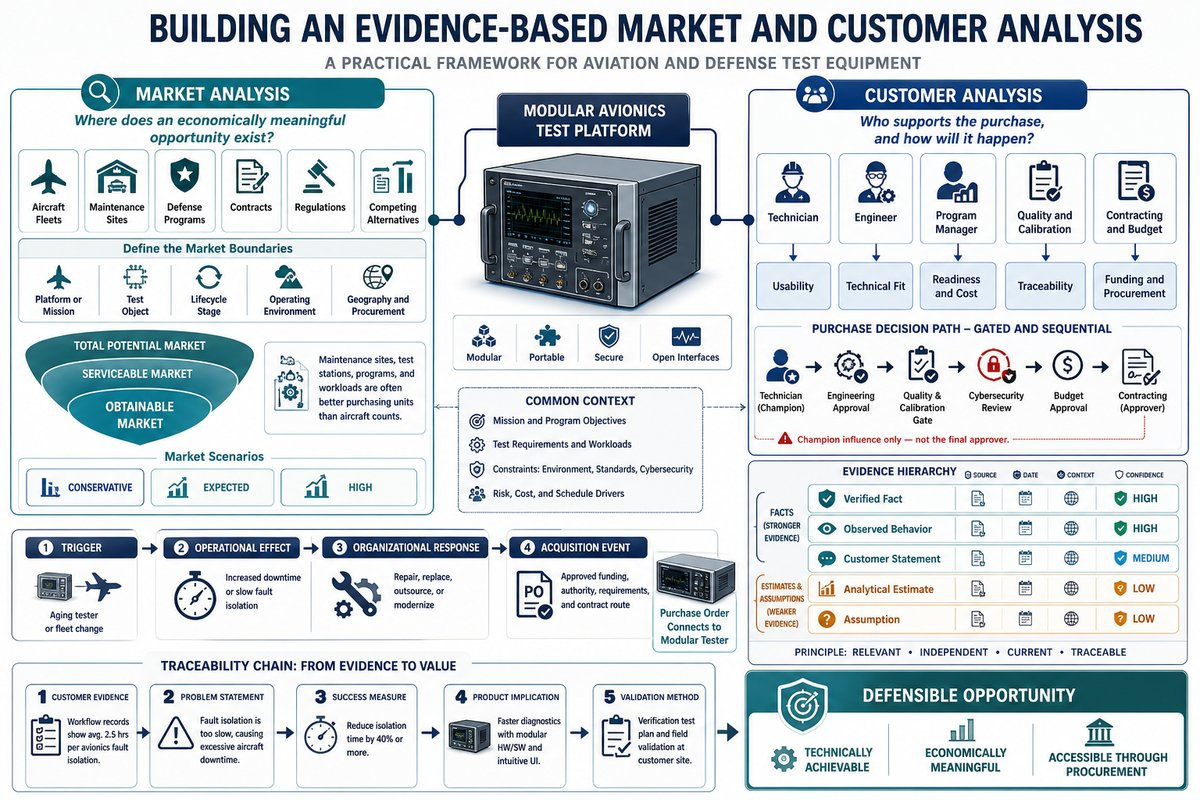
An evidence-based market and customer analysis converts this uncertainty into a defensible business view. It combines market indicators, technical requirements, customer evidence, procurement realities, and clearly stated assumptions. The goal is not to eliminate uncertainty; it is to show decision-makers what is known, what is inferred, and what still needs validation.
Market analysis and customer analysis answer different questions
A market analysis examines the commercial environment surrounding an opportunity. It defines the relevant market, identifies demand drivers, estimates reachable demand, evaluates alternatives, and considers barriers such as qualification requirements or long procurement cycles. Its central question is: Where does an economically meaningful opportunity exist?
A customer analysis focuses on the organizations and people involved in acquiring, using, approving, and supporting the equipment. It investigates operational problems, technical needs, buying processes, decision criteria, and organizational constraints. Its central question is: Who experiences enough value to support a purchase, and how will that purchase actually happen?
The two analyses must connect. A large population of aircraft does not automatically create a large market for a new tester, because some platforms may use existing equipment, centralized repair, built-in test functions, or long-term support contracts. Likewise, enthusiastic technicians do not constitute a viable customer opportunity if engineering, cybersecurity, contracting, or budget authorities reject the proposed solution.
| Category | Market analysis | Customer analysis |
|---|---|---|
| Primary focus | Measures the structure, size, direction, and accessibility of an opportunity. | Explains customer problems, priorities, roles, and purchasing behavior. |
| Typical unit of analysis | Aircraft fleets, installed systems, maintenance sites, programs, contracts, or test events. | Organizations, facilities, programs, buying groups, and individual stakeholders. |
| Key evidence | Fleet forecasts, program documents, contract history, competitor offerings, regulations, and maintenance models. | Interviews, observed workflows, requirements, failure data, procurement records, and stakeholder feedback. |
| Main risk | Overstating demand by treating the entire industry as reachable. | Mistaking one user’s opinion for an organization-wide commitment. |
| Decision supported | Whether and where to pursue the opportunity. | What solution and buying approach will gain acceptance. |
A useful analogy is an aircraft navigation system. Market analysis identifies the destination and possible routes, while customer analysis reveals the restrictions, fuel requirements, weather, and landing conditions. A destination can look attractive on a map while remaining unreachable under actual operating constraints.
What makes evidence decision-ready
Not all information has equal strength. A customer’s formal requirement, a documented fleet forecast, and a technician’s casual comment should not carry the same weight. A sound analysis uses an evidence hierarchy that distinguishes verified facts from estimates and assumptions.
Primary evidence comes directly from the customer, operating environment, or authoritative record. Examples include maintenance data, technical requirements, approved budgets, requests for information, solicitation documents, observed test procedures, and structured stakeholder interviews. Secondary evidence includes industry reports, public forecasts, competitor literature, conference presentations, and informed expert commentary.
Derived evidence is created by analyzing primary or secondary material. For example, an analyst may multiply the number of addressable maintenance locations by an estimated tester requirement per site. This calculation can be useful, but its result is only as reliable as the assumptions behind the number of locations, adoption rate, replacement cycle, and unit configuration.
| Evidence class | Testing-equipment example | How it should be used |
|---|---|---|
| Verified fact | A solicitation requires operation over a specified temperature range. | Treat it as a documented condition, while recording the source and date. |
| Observed behavior | Technicians repeatedly move units between flight-line locations. | Use it to identify mobility, setup-time, and durability needs. |
| Customer statement | A maintenance manager says current fault isolation takes too long. | Treat it as a problem indicator until supported by workflow or performance data. |
| Analytical estimate | Each regional depot may require three configured systems. | Show the calculation and test the estimate under multiple scenarios. |
| Assumption | Forty percent of eligible sites will adopt within five years. | Label it clearly and explain what evidence would confirm or change it. |
A strong evidence record also includes source, date, context, and confidence level. Aviation and defense programs may change configuration, funding, schedule, or acquisition strategy, making an older statement technically accurate but commercially misleading. Federal acquisition guidance similarly treats market research as proportional to urgency, value, complexity, and prior experience, and it emphasizes information that remains current, accurate, and relevant. (acquisition.gov)
A common misconception is that more data automatically produces better analysis. In reality, ten repeated claims copied from supplier websites may be weaker than one customer maintenance record. Evidence quality depends on relevance, independence, recency, and traceability—not merely volume.
Define the market around the test need
The phrase aviation and defense testing-equipment market is too broad for useful analysis. It could include production test systems, depot-level automatic test equipment, portable flight-line testers, calibration equipment, environmental test chambers, telemetry systems, and software-based simulation environments. These categories serve different customers, budgets, technical architectures, and acquisition pathways.
A practical market definition uses five boundaries:
-
Platform or mission: Commercial aircraft, military aircraft, missiles, unmanned systems, ground support, or space systems.
-
Test object: Avionics line-replaceable units, wiring, sensors, communications equipment, power systems, or complete vehicles.
-
Lifecycle stage: Development, production, qualification, maintenance, overhaul, or modernization.
-
Operating environment: Laboratory, production line, depot, hangar, flight line, shipboard location, or deployed site.
-
Geographic and procurement scope: Domestic commercial operators, U.S. government customers, allied governments, or international maintenance providers.
These boundaries create a meaningful addressable unit. Depending on the opportunity, that unit might be a maintenance facility, production line, test station, supported aircraft type, or annual test workload. Counting aircraft alone is often misleading because ten aircraft at one base may share a tester, while one production facility may need several stations to avoid creating a bottleneck.
Market sizing should therefore move through three levels. The total potential market includes all entities with a theoretically relevant need. The serviceable market removes entities that cannot be served because of technical, geographic, security, qualification, or channel limitations. The obtainable market then estimates the portion the supplier could realistically win within a defined period, given competition, production capacity, contract access, and adoption risk.
[[flowchart-placeholder]]
A defensible model presents a range rather than a single impressive number. The conservative case may assume slow adoption, extensive qualification, and replacement only at end of life. The expected case may include normal replacement and selected modernization, while the high case may assume accelerated fleet growth or broader platform compatibility.
Connect demand drivers to actual purchases
A demand driver is a condition that increases the need for testing capability. Common examples include fleet growth, aging equipment, new platform introductions, higher utilization, electronic-system complexity, obsolescence, and new test or reporting requirements. However, a demand driver creates market potential only when it leads to an identifiable purchasing mechanism.
Consider aging automatic test equipment. Obsolete components may increase maintenance effort, reduce tester availability, and threaten mission readiness, but the customer may respond by repairing the existing equipment, consolidating workloads, buying used spares, or funding a modernization program. The analyst must follow the complete chain from operational condition to funded acquisition rather than assuming that pain guarantees a purchase.
This distinction is particularly important in defense environments. GAO has reported that common automatic test equipment can support multiple aircraft or weapon systems and that open architectures and joint-service applications may improve commonality. These factors may favor adaptable, modular solutions, but they can also increase integration, governance, and compatibility requirements. (gao.gov)
A reliable demand chain has four links:
- Trigger: A fleet change, obsolescence issue, readiness gap, or new requirement creates pressure.
- Operational effect: The condition affects test time, throughput, availability, cost, safety, or mission performance.
- Organizational response: The customer considers repair, replacement, outsourcing, redesign, or modernization.
- Acquisition event: Funding, authority, requirements, and a procurement route converge around a purchase.
The most common pitfall is stopping at the first link. “The installed testers are old” is an indicator, not a sales forecast. The analysis becomes actionable only after determining when replacement decisions occur, who controls them, what alternatives exist, and how money becomes available.
Analyze the whole buying group
Testing equipment is rarely purchased by a single decision-maker. The user who experiences the problem may not control the technical baseline, security approval, contract, or budget. Customer analysis must therefore map the buying group, meaning the stakeholders whose combined support is required for adoption.
The operational user cares about practical matters such as setup time, portability, interface clarity, and fault-isolation speed. Engineering stakeholders examine accuracy, repeatability, interfaces, software, environmental performance, and configuration control. Quality, calibration, safety, cybersecurity, logistics, contracting, and finance functions apply additional criteria that can block a technically attractive product.
| Stakeholder | Primary concern | Evidence that matters | Possible rejection reason |
|---|---|---|---|
| Technician or operator | Usability, speed, portability, and reliable results. | Workflow observations, demonstration results, and time-to-test data. | The system adds steps or performs poorly in field conditions. |
| Test or systems engineer | Measurement integrity, interfaces, coverage, and maintainability. | Technical specifications, uncertainty analysis, architecture, and verification results. | The tester cannot support required signals, loads, or configurations. |
| Program or maintenance manager | Readiness, capacity, schedule, and lifecycle cost. | Availability data, throughput estimates, support plans, and cost models. | The business case does not improve operational performance. |
| Quality or calibration authority | Traceability, repeatability, documentation, and process control. | Calibration procedures, records, standards compliance, and audit evidence. | Measurement control is inadequate or difficult to audit. |
| Contracting or budget authority | Competition, price reasonableness, funding, and acquisition compliance. | Market research, quotations, contract history, and funding documentation. | No valid procurement path or approved funding exists. |
Government customers formalize many of these considerations through acquisition planning. Current FAR Part 10 requires market research to identify legitimate needs, evaluate trade-offs, and determine whether commercial or nondevelopmental solutions can satisfy those needs. Defense-specific guidance also connects market research to small-business decisions and, where appropriate, assessments of price reasonableness. (acquisition.gov)
A typical misconception is that the “customer” means the person who attends the product demonstration. That person may be a valuable champion, but a champion is not necessarily an approver. Evidence-based analysis documents each stakeholder’s influence, success criteria, concerns, and role in the decision sequence.
Translate customer language into measurable requirements
Customers often describe needs in broad operational language: “We need faster testing,” “The current system is difficult to support,” or “The equipment must work across several platforms.” These statements reveal direction, but they are not yet sufficient for product planning or market qualification. The analyst must translate them into measurable outcomes without prematurely designing the solution.
A useful chain begins with the job to be done, moves to the operational problem, and ends with a measurable requirement. For example, the job may be to confirm the serviceability of an avionics unit before an aircraft returns to operation. The problem may be that setup and fault isolation take too long, while the measurable requirement could involve maximum setup time, test duration, coverage, false-failure rate, or operator workload.
This translation prevents two errors. The first is accepting the customer’s preferred solution without confirming the underlying problem, such as assuming that a new tester is necessary when a software update or interface adapter may be sufficient. The second is defining a technical requirement that has no measurable operational benefit.
Testing and acquisition practices increasingly emphasize early involvement, testability, automation, and usable test data. A recent GAO review of weapon-system testing identified the importance of early tester participation, testability requirements, automation, distributed test capability, and data environments that support analysis and reporting. (files.gao.gov)
Best practice is to maintain a traceable line from evidence to requirement:
-
Customer evidence: A documented workflow, failure record, interview, or contract requirement.
-
Problem statement: The operational effect described without embedding a favored solution.
-
Success measure: A quantifiable improvement in time, coverage, availability, cost, or quality.
-
Product implication: The capability the proposed equipment must provide.
-
Validation method: The demonstration, analysis, inspection, or test used to prove performance.
Example: a portable avionics tester for regional maintenance sites
A supplier is evaluating a portable tester for communication and navigation line-replaceable units used by regional aviation maintenance organizations. Its first estimate multiplies the number of aircraft in the target category by the proposed tester price. That approach produces an attractive figure, but it ignores how maintenance is organized.
The team redefines the addressable unit as the maintenance site, not the aircraft. It then separates line-maintenance locations from component repair shops, because many line locations remove suspected units but do not conduct complete bench tests. This segmentation immediately reduces the serviceable market while making the remaining opportunity more credible.
The analysis proceeds in five steps:
- Map the workflow: Identify where removal, verification, repair, calibration, and return-to-service activities occur.
- Locate the delay: Determine whether time is lost during testing, shipment to a central shop, troubleshooting, or approval.
- Identify stakeholders: Include technicians, avionics engineers, quality personnel, calibration managers, procurement, and finance.
- Define measurable value: Estimate avoided shipments, reduced no-fault-found removals, faster fault isolation, and increased shop capacity.
- Apply commercial filters: Remove sites that lack sufficient workload, budget, technical authority, or an acceptable return on investment.
The result is smaller than the original aircraft-based estimate but substantially more useful. The company can now prioritize high-volume facilities where portable testing solves a documented workflow problem. Its primary limitation is data access: maintenance organizations may not share detailed failure rates, labor costs, or internal approval thresholds, so the model must show ranges and confidence levels.
This analysis also connects to product and service planning. Portability affects enclosure design, calibration stability, accessories, training, and shipping, while multi-site deployment affects software licensing and support capacity. Market evidence therefore influences not only the revenue estimate but the complete operating model.
Example: modernizing defense automatic test equipment
A defense depot relies on aging automatic test equipment to diagnose electronic assemblies used across several aircraft configurations. Replacement parts are becoming harder to obtain, test program sets are platform-specific, and technicians maintain multiple legacy interfaces. A supplier sees an opportunity for a modular open-architecture replacement.
The market cannot be sized by counting obsolete testers alone. Some units may remain serviceable for years, some workloads may be consolidated, and others may migrate to different maintenance levels. The supplier must instead identify funded modernization windows, supported configurations, workload concentration, interface requirements, and the authority responsible for the common-test strategy.
The evidence trail develops step by step. Maintenance records establish downtime and support burden, while program documents identify required platforms and lifecycle horizons. Technical engagement reveals whether the customer values one-for-one replacement, cross-platform commonality, or a staged migration that preserves existing test program assets.
GAO’s examination of defense automatic test equipment highlighted the operational importance of tester commonality and the potential role of open system architecture. Those considerations support a modular approach, but they do not prove that a specific product will win; the supplier still needs evidence of compatibility, test coverage, cybersecurity acceptance, calibration performance, and procurement feasibility. (gao.gov)
The potential benefits include fewer tester types, improved supportability, shared training, and easier insertion of new instrumentation. The limitations include migration cost, legacy interface complexity, qualification effort, and the risk that common hardware may still require different software or adapters. A credible analysis treats those limitations as cost and schedule factors rather than hiding them behind a broad modernization claim.
This example shows why market and customer analysis must remain linked to engineering and acquisition workflows. Customer evidence shapes architecture and verification plans, while market evidence determines whether commonality produces enough recurring demand to justify development. The strongest business case connects readiness improvement, technical feasibility, lifecycle economics, and a realistic contract route.
Common errors that weaken the analysis
Several mistakes repeatedly produce unsupported conclusions:
-
Starting with a market percentage: Claiming that the company will capture one or two percent of a broad industry avoids the harder work of defining actual purchasing units.
-
Confusing users with buyers: User enthusiasm is valuable evidence, but it does not replace technical approval, funding, or contracting authority.
-
Treating requirements as equally important: Some requirements are mandatory gates, while others are preferences or tradeable performance goals.
-
Mixing facts and assumptions: An unlabeled adoption estimate can appear more certain than the evidence justifies.
-
Ignoring the current alternative: The real competitor may be continued repair, shared equipment, outsourcing, or accepting the existing delay.
The remedy is disciplined traceability. Every major claim should point to an evidence source, calculation, or explicit assumption. Every estimate should state its unit, time period, boundary, and uncertainty.
A reusable structure for the final analysis
A decision-ready analysis can be organized into six connected parts. This structure keeps the narrative concise while making the evidence easy to audit.
- Opportunity statement: Define the customer problem, affected application, and business decision.
- Market boundary: State the platform, test object, lifecycle stage, environment, geography, and procurement scope.
- Demand model: Identify addressable units, demand drivers, replacement or purchase triggers, scenarios, and exclusions.
- Customer map: Document users, influencers, approvers, buyers, blockers, and their decision criteria.
- Evidence register: Separate verified facts, observations, estimates, assumptions, confidence levels, and unresolved gaps.
- Implications: Explain what the findings mean for product scope, qualification, pricing, support, partnerships, and pursuit priority.
The final result should allow a reader to challenge an assumption without losing the entire argument. If the expected adoption rate falls, the model should show the effect. If a mandatory environmental requirement changes, the customer analysis should reveal which segment remains addressable.
From broad opportunity to defensible focus
-
Market analysis defines where demand exists, but customer analysis determines whether that demand can become an approved purchase.
-
Evidence must be classified and traceable, with facts, estimates, and assumptions presented separately.
-
Market size should be built from meaningful purchasing units, not broad industry totals or unsupported market-share percentages.
-
Aviation and defense purchases depend on buying groups, measurable requirements, technical acceptance, funding, and a workable procurement path.
An evidence-based analysis may produce a smaller opportunity than an optimistic top-down estimate, but it creates a far stronger basis for action. It helps commercial, engineering, and leadership teams focus on opportunities that are technically achievable, economically meaningful, and genuinely accessible. That discipline turns market enthusiasm into a decision the organization can defend.
Web Sources
-
Federal Aviation Administration, FAA Aerospace Forecasts, FY 2026–2046. (faa.gov)
-
Acquisition.gov, Federal Acquisition Regulation Part 10—Market Research. (acquisition.gov)
-
Acquisition.gov, FAR Companion: Part 10 Market Research. (acquisition.gov)
-
Acquisition.gov, Defense FAR Supplement Part 210—Market Research. (acquisition.gov)
-
U.S. Government Accountability Office, Military Readiness: DOD Needs to Better Manage Automatic Test Equipment Modernization. (gao.gov)
-
U.S. Government Accountability Office, Weapon Systems Testing: DOD Needs to Update Policies to Better Support Modernization Efforts. (files.gao.gov)