

Customer Needs and Purchasing Influences
- View
When technical performance is only part of the sale
A defense maintenance organization needs new automated test equipment for an avionics repair depot. The engineering team favors the system with the widest measurement range, while technicians want simpler workflows and fewer manual connections. Cybersecurity specialists question how the equipment stores test data, and procurement personnel focus on price, delivery risk, and contract terms.
Each group is discussing the same purchase, but each defines value differently. In aviation and defense markets, a technically impressive product can still lose if it creates calibration problems, requires costly integration, introduces security risks, or fails to satisfy formal evaluation criteria. Preparing a useful customer analysis therefore requires more than identifying what equipment a customer uses; it requires understanding what outcomes the organization needs, who influences the decision, and how those influences become purchasing criteria.
Turning customer requests into underlying needs
A customer need is an outcome, capability, or condition that enables a customer to perform its mission. A stated requirement is the customer’s documented expression of that need, such as a minimum frequency range, measurement accuracy, environmental rating, or delivery date. A purchasing influence is any technical, financial, operational, regulatory, or organizational factor that affects whether and how the customer buys.
These terms are related, but they are not interchangeable. A technician may request a larger display, yet the underlying need may be to reduce setup errors while wearing protective equipment. A specification may require a particular interface, while the broader operational need is compatibility with an existing test program set. Strong analysis moves from the visible request to the mission outcome behind it without dismissing the written requirement.
Customer needs in this sector usually exist at several levels:
-
Mission need: Maintain readiness, improve safety, accelerate aircraft return to service, or support a new platform.
-
Operational need: Reduce test time, simplify troubleshooting, improve portability, or operate in harsh environments.
-
Technical need: Meet measurement ranges, tolerances, interfaces, data formats, or electromagnetic compatibility requirements.
-
Support need: Secure calibration, repair, training, software updates, spare parts, and technical documentation.
-
Acquisition need: Obtain acceptable performance within budget, schedule, contractual, security, and sourcing constraints.
The levels form a chain. If an aircraft remains unavailable because a test bench cannot isolate an intermittent fault, the mission need is readiness, the operational need is faster fault isolation, and the technical need may involve synchronized data capture or higher sampling performance. The customer does not ultimately value the specification for its own sake; the specification matters because it supports an operational and mission result.
Separating needs, requirements, and preferences
Beginners often treat every customer statement as equally important. In practice, some conditions are mandatory, some affect competitive scoring, and others merely improve usability. A useful customer analysis distinguishes among thresholds, objectives, and preferences.
| Category | Meaning | Testing-equipment example | Purchasing effect |
|---|---|---|---|
| Threshold need | A minimum condition that must be satisfied. Falling below it can make an offer technically unacceptable. | The tester must operate from the facility’s available power supply and cover the required signal range. | Usually a pass-or-fail gate rather than a source of extra value. |
| Objective need | Performance beyond the minimum that creates measurable operational value. | Automated diagnostics reduce average fault-isolation time or support additional line-replaceable units. | May justify a higher price when the acquisition permits technical tradeoffs. |
| Preference | A desirable characteristic that is not central to mission success or formal evaluation. | Engineers prefer a familiar graphical interface or a particular enclosure layout. | Influences internal support but may have little formal weight. |
| Constraint | A boundary imposed by budget, schedule, security, infrastructure, or policy. | The equipment must fit an existing rack, avoid facility modifications, and meet an installation deadline. | Limits the acceptable solution space even when another design performs better. |
Misclassifying these categories can distort the analysis. A supplier may invest heavily in exceeding an accuracy threshold even though the customer receives no additional operational benefit from the improvement. At the same time, the supplier may overlook a less visible constraint, such as calibration turnaround time, that directly affects equipment availability.
The best practice is to ask what happens if a condition is not met. If the product becomes ineligible, the condition is probably a threshold. If exceeding it produces a quantifiable improvement in readiness, labor, reliability, or risk, it may be an objective. If the customer simply likes it but cannot connect it to an operational or evaluation outcome, it is more likely a preference.
A typical misconception is that the written specification reveals the customer’s complete need. Specifications are essential, but they may not explain why a requirement exists or how users experience the current problem. They may also lag behind operating changes, new threats, updated platform configurations, or lessons learned from existing equipment. Customer analysis should respect the specification while investigating the operational context surrounding it.
The buying center behind the customer name
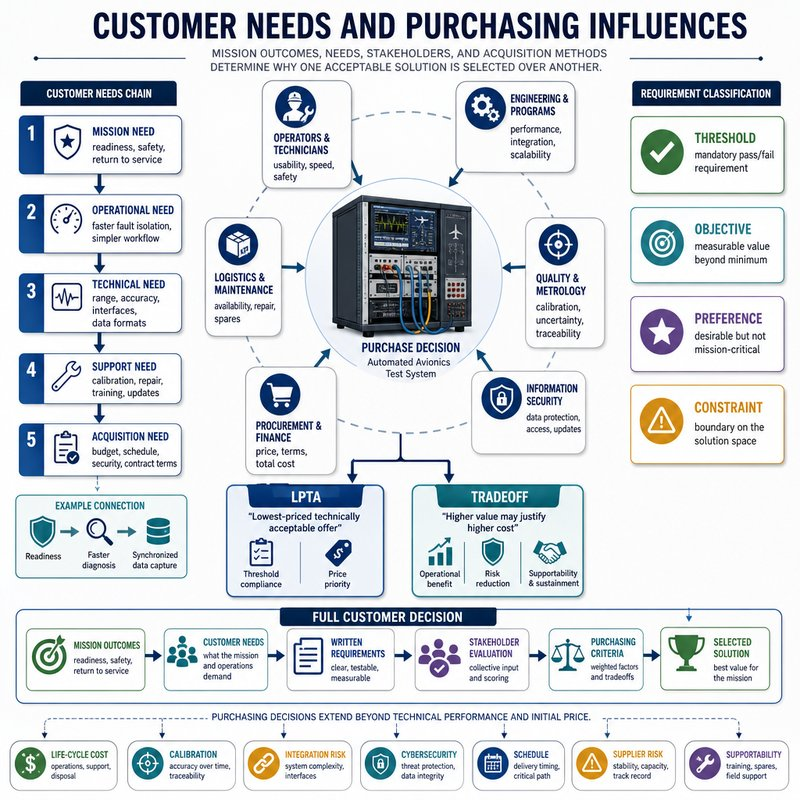
An aviation manufacturer, military organization, airline, maintenance provider, or government agency does not make a complex purchase as a single person. Decisions emerge from a buying center: the collection of stakeholders who define, evaluate, approve, use, secure, fund, and support the solution. These stakeholders may agree on the overall mission while disagreeing about the best equipment.
The user typically emphasizes workflow, speed, ergonomics, and reliability. Engineering personnel focus on technical performance, interfaces, verification, and configuration control. Quality and metrology personnel examine calibration methods, uncertainty, records, and traceability. Procurement and contracting personnel must follow the acquisition strategy and evaluate offers only against the stated factors.
Government source-selection teams may include contracting, legal, logistics, technical, and other specialists, and evaluation factors must reflect the acquisition’s important areas. This structure explains why winning one engineer’s support does not guarantee an award: the solution must survive a coordinated organizational evaluation. (login.acquisition.gov)
| Stakeholder | Primary concern | Questions likely to influence purchasing |
|---|---|---|
| Operators and technicians | Usability, test speed, safety, and diagnostic clarity | How quickly can a technician configure a test? Does the system reduce manual steps and interpretation errors? |
| Engineering and program teams | Technical compliance, integration, scalability, and configuration control | Will it interface with current assets? Can it support future test requirements without major redesign? |
| Quality and metrology | Measurement confidence, calibration, uncertainty, and auditability | Are measurement results supported by a documented calibration chain? How are out-of-tolerance conditions handled? |
| Information security | Protection of systems, software, and sensitive data | What data does the equipment process or store? How are access, updates, removable media, and remote support controlled? |
| Procurement and finance | Competition, price, terms, supplier risk, and total cost | Is the offer compliant and fairly priced? What costs arise after installation? |
| Logistics and maintenance | Availability, supportability, spares, and obsolescence | How long will repairs and calibration take? Are critical parts and technical support available throughout the expected service life? |
Influence does not always follow seniority. A technician may lack formal approval authority but can reveal that a proposed interface will double setup time. A cybersecurity specialist may enter the process late yet identify a condition that blocks network connection. A contracting officer may not select the technical architecture but controls how supplier communications and proposal evaluation occur.
A strong analysis therefore identifies both formal authority and practical influence. It records who defines the requirement, who evaluates compliance, who controls funds, who can stop approval, and who lives with the equipment after award. Treating the most visible contact as “the customer” is a common pitfall because that contact usually represents only one part of the decision.
[[plantuml-mindmap-placeholder]]
How operational value becomes purchasing criteria
Customers convert needs into evaluation criteria so they can compare possible solutions. In government acquisition, the relative importance of price may change with requirement clarity and performance risk. Clearly defined, low-risk requirements may place greater weight on price, while less definitive or more developmental requirements may emphasize technical capability and past performance. (origin-www.acquisition.gov)
Two important approaches are lowest price technically acceptable, commonly abbreviated as LPTA, and the tradeoff process. Under LPTA, offers are judged against minimum acceptability standards, and the lowest evaluated price among acceptable offers wins. Under a tradeoff process, the customer may accept a higher-priced offer when its non-price benefits justify the additional cost. (origin-www.acquisition.gov)
| Category | LPTA approach | Tradeoff approach |
|---|---|---|
| Best fit | Stable, clearly defined requirements with low performance risk and little value from exceeding the minimum. | Complex, developmental, or risk-sensitive requirements where performance differences matter. |
| Technical treatment | Evaluated as acceptable or unacceptable against stated thresholds. | Compared for strengths, weaknesses, risks, and meaningful performance differences. |
| Role of price | Lowest evaluated price wins among acceptable offers. | Price is balanced against technical and other non-price benefits. |
| Supplier implication | Extra capability may increase cost without improving the evaluation result. | Extra capability must be connected to a credible customer benefit worth its added cost. |
| Common mistake | Assuming every technically superior feature earns credit. | Claiming broad superiority without showing measurable operational value. |
This distinction changes how customer needs should be analyzed. If the customer uses LPTA, the analyst must determine exactly what establishes acceptability and where unnecessary capability could make the offer less price-competitive. If the customer uses a tradeoff, the analyst must identify which improvements reduce risk, shorten timelines, increase readiness, or lower support costs strongly enough to justify a premium.
However, “best value” does not mean “most features.” A capability has value only when it affects an outcome the customer recognizes and is allowed to evaluate. A faster processor, additional software module, or broader measurement range may sound impressive but remain irrelevant if it does not improve the required mission or evaluation criteria.
The purchasing influences that extend beyond price
Purchase price is visible, but it is rarely the only economic influence. Customers also consider installation, adapters, training, calibration, repairs, software maintenance, infrastructure changes, spares, and eventual replacement or disposal. Together, these factors form the equipment’s life-cycle cost or total cost of ownership.
For example, one test set may cost less initially but require annual shipment to a distant calibration laboratory. Another may support local calibration, have modular field-replaceable components, and provide better diagnostic coverage. The second system’s higher acquisition price may be offset by reduced downtime, shipping, technician labor, and substitute-equipment needs.
Measurement confidence is especially important in testing equipment. NIST defines traceability as a property of a measurement result connected to a reference through a documented, unbroken calibration chain, with each link contributing to measurement uncertainty. Simply describing an instrument as “NIST traceable” does not establish that every result produced by the customer will be traceable. (nist.gov)
This distinction matters because calibration is not merely a certificate attached to a product. Customers may examine the calibration procedure, applicable measurement ranges, reported uncertainty, environmental conditions, interval management, and handling of out-of-tolerance results. FAA guidance for instrument shops also recognizes calibration of test equipment as part of maintaining an effective technical environment. (faa.gov)
Additional purchasing influences include:
-
Integration risk: Compatibility with test program sets, networks, fixtures, data formats, facilities, and existing procedures.
-
Schedule risk: Lead time, installation timing, qualification activities, training availability, and dependence on scarce components.
-
Supplier risk: The likelihood of performance failure, supply-chain disruption, safety impact, mission degradation, or financial loss. (acquisition.gov)
-
Security and data handling: Protection of software, controlled information, maintenance data, and network connections.
-
Supportability: Calibration capacity, repair turnaround, technical assistance, documentation, spares, and obsolescence planning.
A frequent misconception is that compliance is separate from customer value. In aviation and defense, compliance often enables value because noncompliant equipment may be unusable, unconnectable, or ineligible for purchase. Yet compliance alone does not guarantee preference; several suppliers may meet the same threshold, leaving support, risk, delivery, usability, and cost to shape the final decision.
Example 1: Replacing an aging avionics test station
The maintenance depot in the opening scenario operates an aging station used to troubleshoot aircraft communication and navigation components. Failures are becoming more frequent, replacement parts are difficult to obtain, and technicians maintain several manual workarounds. Management initially describes the need as “replace the old tester,” but that statement does not reveal the complete customer problem.
The first analytical step is to connect the replacement request to operational outcomes. The depot needs to preserve repair capacity, shorten fault isolation, reduce false removals, and avoid an extended transition that would interrupt production. Those outcomes generate technical needs for signal coverage, repeatable measurements, interface compatibility, automated procedures, and reliable data capture.
The second step is to map the buying center. Technicians want fewer cable changes and clearer fault messages, while engineering wants controlled test software and compatibility with approved maintenance data. Metrology needs achievable calibration intervals and documented uncertainty, and logistics wants replaceable modules, repair support, and a credible obsolescence plan.
The third step is to identify the likely purchasing logic. If the requirement defines only minimum capabilities and treats acceptable equipment equally, adding unsupported features may simply increase the price. If the solicitation permits tradeoffs, the supplier can demonstrate how automated sequencing reduces technician touch time, how modular repair limits downtime, and how backward-compatible interfaces reduce transition risk.
The benefit of this analysis is a more precise value proposition: not “our tester has more functions,” but “our system sustains the depot’s repair mission while reducing transition, support, and diagnostic risk.” Its limitation is that the analysis cannot replace the solicitation. Even a highly valuable feature may receive no formal credit if it falls outside the stated evaluation criteria.
Example 2: Selecting portable flight-line equipment
A military aviation unit also needs portable equipment for testing an aircraft subsystem at the flight line. The most obvious needs are measurement capability and environmental durability, but field conditions introduce additional influences. Technicians may work in limited space, in poor weather, under time pressure, and while wearing gloves or other protective equipment.
The analysis begins with the mission effect: each minute spent diagnosing a fault can delay aircraft availability. That leads to operational needs for rapid startup, simple connections, readable results, and reliable operation under expected temperature, vibration, moisture, and electromagnetic conditions. The technical specification should express these needs through measurable limits rather than general claims such as “rugged” or “easy to use.”
Next, the analyst traces organizational consequences. A lighter enclosure may improve portability but offer less protection, while a heavier system may require two-person handling or additional transport equipment. Wireless data transfer may simplify reporting but introduce cybersecurity and authorization concerns, especially if the device processes or stores controlled information.
Defense acquisitions may require specific cybersecurity conditions when contractor systems process, store, or transmit covered information. CMMC requirements can therefore influence supplier eligibility and the design of software updates, remote diagnostics, data storage, and support processes rather than functioning as an afterthought. (acquisition.gov)
The preferred solution will depend on the purchasing method and priorities. Under an LPTA approach, the winning offer may be the lowest-priced unit that satisfies the defined technical, environmental, security, and support thresholds. Under a tradeoff approach, lower weight, faster diagnostics, stronger battery performance, or reduced support burden may justify additional cost if the customer can connect those advantages to operational value.
The benefit is a decision aligned with real flight-line use rather than laboratory performance alone. The limitation is that stakeholder priorities may conflict: portability, protection, battery capacity, processing power, and price cannot always be maximized simultaneously. Effective analysis makes these tradeoffs visible instead of pretending one feature set is universally best.
Reading the full customer decision
Customer analysis in aviation and defense testing-equipment markets must connect mission outcomes, operational needs, technical requirements, stakeholder influence, and acquisition criteria. The strongest analysis distinguishes mandatory thresholds from valuable objectives and informal preferences. It also recognizes that the buyer is an organization composed of users, engineers, quality personnel, security specialists, logisticians, financial authorities, and contracting professionals.
Keep these principles in view:
-
Start with the mission effect, not the equipment feature.
-
Map the complete buying center, including stakeholders who can block or reshape the purchase.
-
Separate thresholds, objectives, preferences, and constraints before evaluating product fit.
-
Look beyond purchase price to calibration, integration, support, security, schedule, and supplier risk.
-
Align value claims with the purchasing method, especially the difference between minimum acceptability and evaluated tradeoffs.
A sound customer analysis explains not only what the customer might buy, but also why the organization would select one acceptable solution over another. This understanding prevents feature-driven assumptions and creates a more realistic view of customer value.
Next, we'll build on this by exploring Building an Evidence-Based Market and Customer Analysis.
Web Sources
-
Federal Acquisition Regulation, Subpart 15.1 — Source Selection Processes and Techniques (origin-www.acquisition.gov)
-
Federal Acquisition Regulation, Part 15 — Contracting by Negotiation (login.acquisition.gov)
-
Army Federal Acquisition Regulation Supplement — Developing a Source Selection Plan (acquisition.gov)
-
NIST — Measurements, Standards, and Metrological Traceability (nist.gov)
-
Defense Federal Acquisition Regulation Supplement — Supplier Risk and CMMC Requirements (acquisition.gov)