

Metacognitive calibration and human oversight
- View
When confidence exceeds the evidence
A laboratory robot selects a hook to retrieve a component beyond its gripper’s reach. Its interface reports a confidence score of 90%, and the supervising researcher authorises the movement without examining the camera image. The hook slips: an unfamiliar reflective surface has obscured the component’s orientation. In this illustrative scenario, the critical failure is not simply an unsuccessful action; it is the acceptance of confidence without establishing what that confidence warrants.
This problem connects robotics with human metacognition: both the machine’s assessment and the researcher’s judgement require scrutiny. METATOOL makes this connection explicit through its investigation of computational models of synthetic awareness informed by human metacognition and validated through robotic experiments. Its research programme concerns tool invention, making tool-mediated manipulation a particularly relevant setting for examining self-evaluation and oversight. The laboratory scenario developed here is illustrative, rather than a reported METATOOL experiment. (metatool-project.eu)
The central question is therefore precise: when should a confidence judgement influence action, and what must a human supervisor verify before accepting it? This lesson develops three connected ideas: monitoring the quality of a decision, calibrating confidence against outcomes, and establishing oversight with genuine intervention authority.
Monitoring a decision is not making it
The robot’s first judgement concerns the task: whether the hook can retrieve the component. A second judgement concerns the first: how likely that proposed action is to succeed. Metacognition concerns this evaluation of one’s own cognitive performance; confidence provides one observable expression of it. Human metacognitive research distinguishes successful task performance from the ability to recognise when that performance is likely to be correct. (hub.hku.hk)
Metacognitive monitoring supplies an assessment, whereas metacognitive control, as used here, denotes the subsequent regulation of behaviour. For the laboratory robot, monitoring might produce an uncertain assessment of the component’s orientation; control might then request another observation rather than execute the retrieval. This operational distinction expresses the relationship between self-evaluation and adaptation described in METATOOL’s research objectives. A numerical report alone does not complete that relationship: the assessment must have consequences for the decision process. (cordis.europa.eu)
The human supervisor also makes a second-order judgement: “How adequate is my own basis for authorising this action?” Confidence is not an unmediated read-out of correctness; it depends on models of the world and of one’s own cognitive capacities, which can themselves be inaccurate. Accordingly, the researcher’s familiarity with successful demonstrations does not settle whether the present observation is adequate. Both judgements require an evidential basis, not merely a convincing presentation. (discovery.ucl.ac.uk)
| Dimension | Task-level judgement | Metacognitive judgement |
|---|---|---|
| Robot’s question | Will this hook retrieve the component? | How well supported is that prediction? |
| Researcher’s question | Should this retrieval proceed? | Have I adequately assessed the evidence? |
| Illustrative output | Select the hook. | Request another observation before authorisation. |
Calibration asks whether confidence is deserved
Suppose the researcher records 80% confidence before each of 100 comparable judgements about retrieval feasibility. If 80 judgements prove correct, the aggregate confidence matches observed accuracy in that batch. Calibration concerns this correspondence between stated confidence and empirical correctness. It does not mean that any individual judgement expressed with 80% confidence must be correct. (hub.hku.hk)
Metacognitive sensitivity asks a different question: does confidence distinguish correct judgements from incorrect ones? Someone who always reports 80% confidence could match an overall accuracy of 80% while providing no indication of which judgements are mistaken. Fleming and Lau distinguish this discriminative ability from confidence bias and from metacognitive efficiency, which evaluates sensitivity relative to task performance. Treating these measures as interchangeable conceals materially different limitations. (hub.hku.hk)
For this lesson, calibration therefore means checking confidence against outcomes, rather than merely encouraging greater confidence or greater caution. The operational recommendation is to specify the proposition being assessed, record confidence before feedback, and preserve the conditions under which the judgement occurs. This recommendation follows from the research distinction between confidence level, correctness and sensitivity, together with NIST’s requirement to evaluate performance under conditions resembling deployment. A favourable average is useful evidence, but it is not unrestricted permission to generalise. (discovery.ucl.ac.uk)
| Assessment dimension | Question answered | Illustrative interpretation |
|---|---|---|
| Task accuracy | How often is the judgement correct? | 80 of 100 feasibility judgements are correct. |
| Calibration | Does confidence correspond to correctness? | Mean confidence is 80%, matching aggregate accuracy. |
| Sensitivity | Does confidence identify likely errors? | Incorrect judgements receive lower confidence than correct judgements. |
The numerical examples throughout the lesson are constructed teaching examples, not empirical findings or recommended acceptance thresholds.
Oversight requires authority, evidence and time
An approval button does not, by itself, establish effective oversight. NIST’s AI Risk Management Framework distinguishes human roles and responsibilities and recognises that human–AI configurations can allocate decisions in different ways. It also cautions that combining human and machine judgement does not automatically improve performance: under some conditions, their interaction can amplify bias. Human involvement must therefore be designed as a substantive contribution rather than a ceremonial endorsement. (airc.nist.gov)
A practical interpretation is that the researcher needs relevant evidence, competence to interpret it, authority to withhold approval, and sufficient opportunity to intervene. These are design implications of NIST’s emphasis on differentiated responsibilities, empowered personnel and explicit oversight arrangements. In the laboratory scenario, reviewing a frozen image after movement begins is not equivalent to reviewing the current scene before authorisation. The useful question is not merely “Is someone watching?” but “What consequential decision can that person still change?” (airc.nist.gov)
The corresponding misconception is that responsibility transfers entirely to the supervisor whenever a human approves an action. NIST instead locates governance across organisational roles, including executive responsibility and documented lines of communication. A supervisor cannot compensate indefinitely for missing validation, inaccessible evidence or ambiguous escalation arrangements. The recommendation is therefore to define the reviewer’s decision and the organisation’s obligations separately, then evaluate whether their interaction actually improves outcomes. (airc.nist.gov)
| Oversight dimension | Nominal oversight | Substantive oversight |
|---|---|---|
| Evidence | A confidence score appears alone. | The reviewer receives the relevant observation and validation context. |
| Authority | Approval is expected routinely. | The reviewer can withhold approval and escalate uncertainty. |
| Timing | Review occurs after the consequential action. | Review occurs while the relevant decision remains reversible. |
| Accountability | “The operator approved it.” | Reviewer duties and organisational responsibilities are documented. |
Worked example: detecting a misleading average
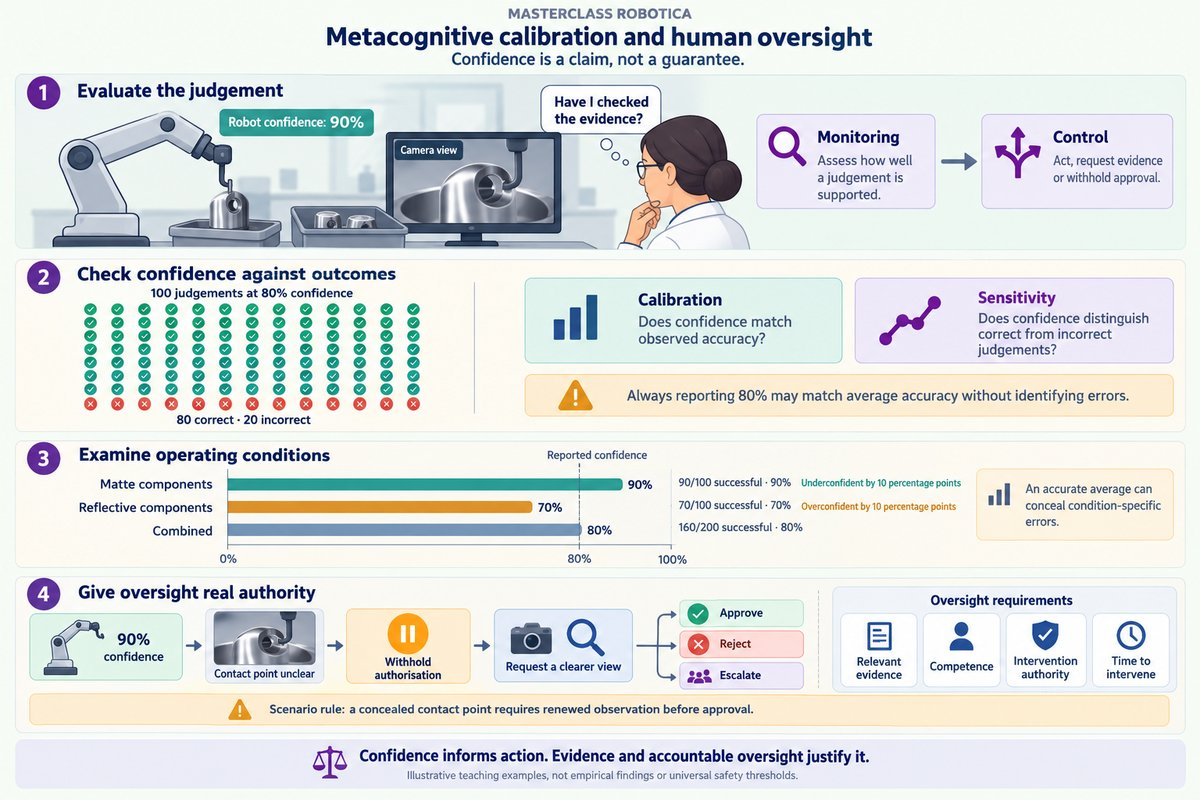
The laboratory team evaluates the researcher’s judgements before permitting routine tool-assisted retrieval. On each trial, the researcher predicts whether the proposed retrieval will succeed and reports confidence before seeing the outcome. For this example, success means retrieving the component into the designated tray without dropping it. The team records surface conditions as well as outcomes, allowing the same confidence claim to be examined within different operating contexts.
| Recorded condition | Trials | Reported confidence on every trial | Successful retrievals | Observed success rate |
|---|---|---|---|---|
| Matte components | 100 | 80% | 90 | 90% |
| Reflective components | 100 | 80% | 70 | 70% |
| Combined batch | 200 | 80% | 160 | 80% |
The combined batch appears perfectly calibrated at this confidence level, yet that aggregate conceals opposing discrepancies. Judgements concerning matte components are underconfident by 10 percentage points; those concerning reflective components are overconfident by 10 percentage points. Moreover, confidence never varies, so it cannot distinguish successful from unsuccessful trials within this batch. The example demonstrates why aggregate agreement and useful error discrimination must be examined separately.
- Define the claim: Input: “80% confidence.” Output: “80% confidence that retrieval into the tray will succeed without a drop.”
- Pair prediction with outcome: Input: the recorded confidence and observed retrieval result. Output: one evaluable record for each trial.
- Examine operating conditions: Input: 200 records labelled by surface type. Output: separate success rates of 90% and 70%.
- Revise the interpretation: Input: the combined and condition-specific results. Output: a restriction against treating the overall 80% figure as equally informative for both surfaces.
The benefit is diagnostic: the team identifies a context in which confidence overstates performance rather than dismissing the researcher as uniformly unreliable. The limitation is equally important: these observations do not establish future performance, nor do they justify automatically replacing every reflective-surface estimate with 70%. Additional evaluation must establish whether the pattern persists under relevant conditions. This interpretation accords with NIST’s emphasis on deployment-relevant measurement and documented limits to generalisation. (airc.nist.gov)
Worked example: withholding approval despite 90% confidence
When 90% confidence is not enough
The same robot subsequently proposes a retrieval involving a reflective component and displays 90% confidence. The camera image partially obscures the hook’s contact point, and the researcher initially feels confident about approving the familiar-looking trajectory. Here, the robot’s score and the researcher’s confidence concern related but distinct propositions. Neither resolves the missing observation, and the earlier validation batch does not establish the reliability of this new 90% score.
The laboratory adopts an illustrative authorisation rule: a concealed contact point requires renewed observation before approval, irrespective of the displayed score. This is a scenario-specific workflow rule, not a universal robotics safety standard. It makes uncertainty consequential by identifying the missing evidence and assigning a reviewer authority to withhold authorisation. Its rationale reflects NIST’s broader emphasis on contextual interpretation, explicit responsibilities and documented risk management. (airc.nist.gov)
- Identify the evidential gap: Input: the partially occluded camera image. Output: a recorded finding that the contact point is not adequately visible.
- Withhold authorisation: Input: that finding and the laboratory’s review rule. Output: no approval for the proposed retrieval.
- Obtain renewed observation: Input: the request for a clearer view. Output: an image that either resolves the uncertainty or leaves the proposal unresolved.
- Reassess the proposal: Input: the renewed observation and relevant validation records. Output: a documented approval, rejection or escalation.
- Preserve the outcome: Input: the eventual decision and any executed retrieval result. Output: a record available for subsequent evaluation.
The immediate benefit is not a guaranteed successful retrieval; it is a defensible decision boundary that prevents an unsupported score from substituting for required evidence. The organisational benefit is traceability: reviewers can distinguish a rejected proposal from an executed failure and investigate each appropriately. A limitation remains that obtaining another image may not resolve the underlying ambiguity, so escalation must remain a legitimate outcome. NIST’s account of human–AI interaction supports this qualified stance: collaboration can improve performance, but its effectiveness requires evaluation rather than assumption. (airc.nist.gov)
Confidence that earns its authority
-
Metacognitive monitoring evaluates a judgement; control determines what follows from that evaluation.
-
Calibration and sensitivity answer different questions: matching average accuracy does not establish an ability to identify likely errors.
-
Human oversight requires a consequential role: relevant evidence, explicit responsibilities and genuine intervention authority.
-
Responsible robotics connects judgement to accountable action: confidence informs decisions without superseding validation or contextual constraints.
The unifying discipline is to treat confidence as a claim whose authority must be earned. In robotic workflows, that discipline connects technical evaluation with the supervisor’s assessment of their own judgement. A well-founded decision may authorise action, request further evidence or withhold approval; its strength lies in the adequacy of its justification, not its apparent certainty.