

Decision-making under uncertainty
- View
Decision-making under uncertainty [15 minutes]
When the robot cannot establish the facts
A laboratory robot must retrieve a sample container from behind a protective screen. A narrow gripper can reach it quickly, but the camera cannot establish whether its rim is intact; a cradle attachment offers a slower alternative. The robot therefore faces two distinct questions: what is probably true, and which action is defensible if that judgement is wrong?
This lesson follows that retrieval scenario from uncertain perception to action selection. The connection between tool use and cognition has a concrete research counterpart: the MetaTool project investigates computational models informed by human metacognition and validates them through robotic experiments involving tool invention. The scenario below is an illustrative teaching model, not a reported MetaTool experiment. (metatool-project.eu)
The central objective is to distinguish uncertainty about the world from preferences about its consequences. By the end of the lesson, you should be able to interpret a probabilistic belief, compare actions through expected loss, and explain when additional observation warrants its cost. These distinctions provide a precise vocabulary for analysing the robot’s retrieval decision.
Representing possibilities without prematurely choosing one
Suppose the robot assigns a probability of 0.70 to an intact rim and 0.30 to a damaged rim. Retaining both possibilities preserves information that the categorical judgement “the rim is intact” would discard. A belief state is a probability distribution over possible states, rather than a declaration that one state is certainly correct. In a finite, exhaustive set of mutually exclusive states, its probabilities sum to one. (roboticsbook.org)
The following distinctions separate the physical situation from the robot’s representation of it. They also separate evidence about the container from the consequences of acting upon it. Probabilistic robotics uses this separation to represent uncertain states and revise their probabilities when observations arrive. (roboticsbook.org)
| Dimension | Meaning | Retrieval scenario |
|---|---|---|
| State | A relevant condition of the world | The rim is intact or damaged |
| Observation | Evidence generated through sensing | A camera image contains a visible discontinuity |
| Belief | A distribution over possible states | Intact: 0.70; damaged: 0.30 |
| Action | An available intervention | Use the gripper, deploy the cradle, or inspect |
| Loss | A numerical representation of an undesirable consequence | Delay, failed retrieval, or container damage |
For the worked examples, assume that the rim has exactly two possible conditions, that its condition remains unchanged during inspection, and that both retrieval tools are available. These assumptions deliberately restrict the model. All probabilities, loss values and inspection costs introduced below are illustrative inputs, not empirical performance figures.
Updating a belief when evidence arrives
A camera report should alter the robot’s belief according to how diagnostic that report is. An apparent crack is stronger evidence when such an appearance is common on damaged rims and uncommon on intact ones. The likelihood, written (P(o\mid s)), expresses the probability of observation (o) under state (s); it is not the probability of that state given the observation. Bayesian updating combines this likelihood with the prior belief to obtain a posterior belief. (zoo.cs.yale.edu)
For this stationary, two-state example, the update takes the following form. The denominator accounts for the observation arising under either possible condition. This normalisation ensures that the revised probabilities remain a valid distribution. (zoo.cs.yale.edu)
[ P(\text{damaged}\mid o)= \frac{P(o\mid\text{damaged})P(\text{damaged})} {P(o\mid\text{damaged})P(\text{damaged}) +P(o\mid\text{intact})P(\text{intact})}. ]
Assume that a close inspection produces a “crack detected” report with probability 0.90 for damaged rims and 0.20 for intact rims. Starting from a damage probability of 0.30, that report raises the probability to approximately 0.659, not 0.90. The distinction prevents a consequential misconception: sensor sensitivity is not posterior certainty.
- Weight the damaged hypothesis: (0.90\times0.30=0.27).
- Weight the intact hypothesis: (0.20\times0.70=0.14).
- Normalise the evidence: (0.27/(0.27+0.14)\approx0.659).
- Retain the alternative: the revised probability of an intact rim is approximately (0.341).
For this example, the appropriate interpretation is “damage has become more plausible”, not “damage has been established”. The posterior still assigns substantial probability to an intact rim. Keeping that alternative explicit matters when the next decision depends on both the probability of damage and the consequences of using each tool.
Choosing an action by its consequences
Knowing which state is most probable does not, by itself, determine which action is preferable. A decision rule must also specify what each action entails under each possible state. Sequential decision models formalise this relationship through states, actions, transition probabilities and rewards; an optimal policy selects actions to maximise expected utility under the specified model. (zoo.cs.yale.edu)
For the retrieval example, use expected loss: the probability-weighted sum of the losses associated with an action. Lower values are preferable, and every entry uses the same illustrative loss scale. The cradle incurs a fixed loss of 4 units for deployment time, while the gripper incurs no loss on an intact rim and 20 units on a damaged rim.
| Rim condition | Narrow gripper loss | Cradle attachment loss |
|---|---|---|
| Intact | 0 units | 4 units |
| Damaged | 20 units | 4 units |
At the initial damage probability of 0.30, the gripper’s expected loss is (0.70(0)+0.30(20)=6) units. The cradle’s expected loss is (0.70(4)+0.30(4)=4) units. The cradle therefore wins under this model, even though an intact rim remains the most probable state; selecting the most probable state first and optimising only for that state would produce a different decision.
The same values reveal a decision threshold rather than an arbitrary confidence requirement. If (p) denotes the probability of damage, the gripper’s expected loss is (20p), while the cradle’s remains 4. The gripper is preferable when (p<0.20), the cradle when (p>0.20), and they are equivalent at (p=0.20).
Example one: committing to the cradle
Why the less likely outcome can decide the action
The robot initially favours the intact-rim hypothesis, with probability 0.70. Nevertheless, the specified consequences make the cradle preferable before any further observation. This example demonstrates a decision in which uncertainty remains unresolved but action is already justified within the illustrative model.
- Represent the evidence: the input belief is intact 0.70 and damaged 0.30.
- Evaluate the gripper: the belief and loss table produce an expected loss of 6 units.
- Evaluate the cradle: the same belief produces an expected loss of 4 units.
- Select the action: the lower expected loss produces a cradle deployment decision.
The immediate benefit is a decision that accounts for the less probable but more consequential condition. Its limitation is equally important: the result depends on the assigned loss of 20 for gripper use on a damaged rim and the assumed fixed cradle loss of 4. Within this scenario’s workflow, the decision record should therefore retain the belief, loss table and selected action, rather than recording only “cradle chosen”.
A sensitivity check makes the dependence visible. If the gripper’s damaged-rim loss were 10 rather than 20, its expected loss would fall from 6 to 3, reversing the preferred action. The numerical result is thus an argument conditional on explicit assumptions, not an intrinsic property of the tool.
Paying for information only when it changes the decision
The robot can also act upon its uncertainty by inspecting the rim before choosing a retrieval tool. Planning in belief space makes room for such information-gathering actions: the decision concerns not only the physical state reached, but also the evidence available for subsequent choices. MIT’s treatment of partially observable planning explicitly distinguishes this approach from policies that assume direct access to the true state. (underactuated.csail.mit.edu)
For the present scenario, the value of inspection is the reduction in expected retrieval loss obtained by choosing a tool after seeing its result. Inspection should be evaluated across all possible reports, not only the reassuring one. Its cost must then be deducted from that expected improvement.
This produces a precise stopping criterion for the illustrative model. Information is worth purchasing when the expected reduction in loss exceeds its acquisition cost. Conversely, a more detailed image has no decision value here if it cannot improve the eventual tool choice sufficiently to recover that cost.
| Quantity in the scenario | Without inspection | With inspection |
|---|---|---|
| Available evidence | Initial belief only | Initial belief plus inspection report |
| Tool-selection rule | Choose the cradle | Choose the tool conditional on the report |
| Retrieval loss | 4 units | Calculated across both reports |
| Additional cost | 0 units | Assumed inspection cost of 0.50 units |
Example two: inspecting before committing
Continue with the same container, tools and initial belief, but now permit the close inspection. Assume that its only possible reports are “crack detected” and “no crack detected”, with the likelihoods already specified. Inspection costs 0.50 loss units and does not alter the rim.
- Predict a crack report: (0.30(0.90)+0.70(0.20)=0.41).
- Update after a crack report: damage probability becomes approximately 0.659, so the cradle remains preferable.
- Update after no crack report: damage probability becomes (0.30(0.10)/0.59\approx0.051), so the gripper becomes preferable.
- Average the conditional retrieval losses: (0.41(4)+0.59(20\times0.03/0.59)=2.24) units.
- Include inspection cost: (2.24+0.50=2.74) units, compared with 4 units without inspection.
The inspection reduces total expected loss by 1.26 units under these assumptions. Its benefit comes from selectively authorising the gripper after a reassuring report, rather than improving the outcome on every branch. The robot would still use the cradle after a crack report, so that branch contributes no change in tool selection.
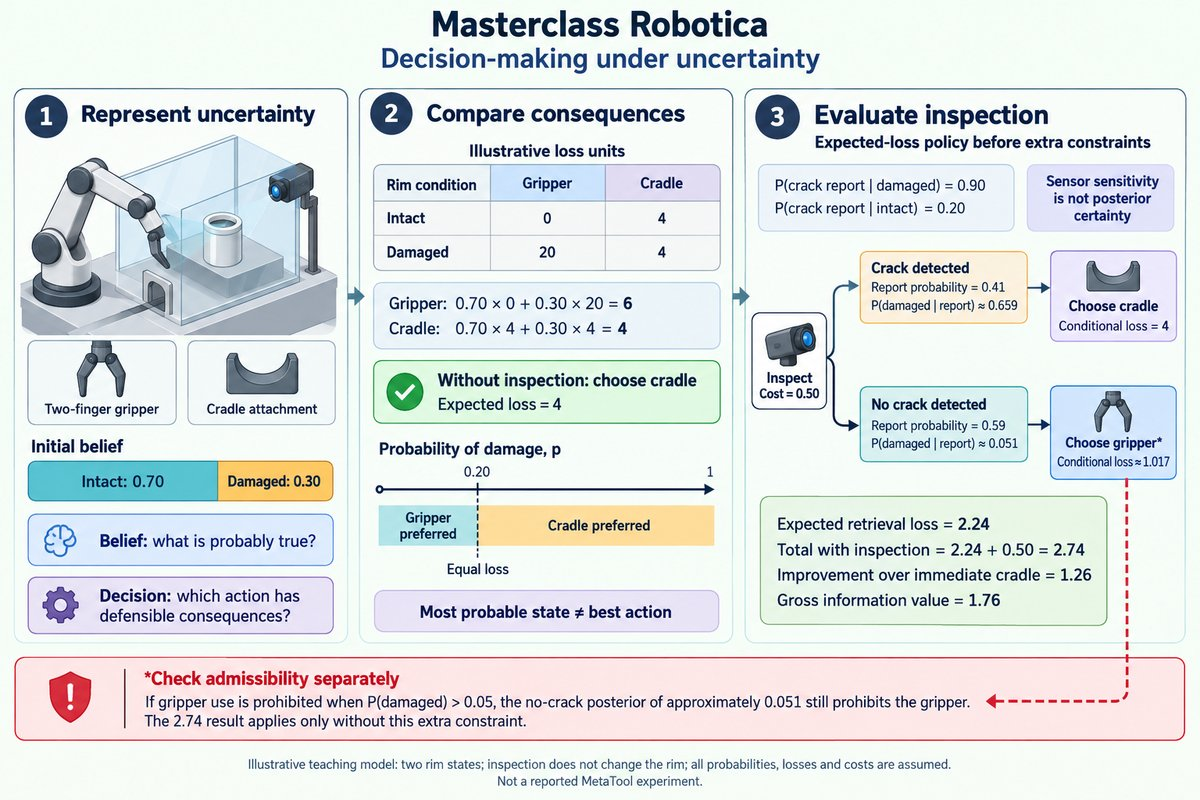
The gross value of the information is (4-2.24=1.76) units. An inspection costing more than 1.76 units would not be worthwhile within this model, even though it would still provide evidence. This limitation connects sensing to the wider retrieval workflow: observation is a resource-consuming action whose justification depends on its consequences for later decisions.
From a single choice to a conditional policy
The inspection example contains a compact policy: inspect, then select the cradle after a crack report or the gripper after no crack report. A policy specifies an action conditional on the information available, rather than prescribing an inflexible sequence regardless of what happens. This distinction becomes essential in stochastic environments, where the same attempted action need not always produce the same subsequent state. (zoo.cs.yale.edu)
A partially observable Markov decision process, or POMDP, provides a formal framework for sequential choices involving hidden states, uncertain transitions, observations and rewards. Its belief state summarises the relevant action–observation history under the model’s assumptions. The policy consequently operates on that belief rather than on an inaccessible true state. (underactuated.csail.mit.edu)
Our retrieval calculation is deliberately narrower than a full robot controller. It assumes that inspection leaves the container unchanged and that each tool’s loss already summarises the relevant retrieval consequences. Extending this teaching model would require explicit probabilities for events such as failed grasping or container displacement, rather than silently treating those outcomes as certain.
Where apparently rigorous decisions go wrong
The worked examples expose several ways in which a plausible calculation can answer the wrong question. Some errors concern inference, while others concern the objective or the scope of the model. The corrections below remain within the same retrieval scenario.
| Pitfall | Misleading interpretation | Correction in this scenario |
|---|---|---|
| Confusing likelihood with posterior | “The detector has sensitivity 0.90, so damage is 90% certain.” | Combine the likelihoods with the prior; the crack-report posterior is approximately 0.659. |
| Choosing the most probable state first | “Intact is more likely, so use the gripper.” | Evaluate both states; expected losses are 6 for the gripper and 4 for the cradle. |
| Valuing only favourable evidence | “Inspection is useful because a clear report permits gripping.” | Include both report branches; expected retrieval loss is 2.24 units. |
| Ignoring acquisition cost | “Any informative inspection is worthwhile.” | Compare its cost with the gross information value of 1.76 units. |
| Treating the objective as a safety guarantee | “The lowest expected loss must be acceptable.” | Check admissibility separately; the numerical model alone does not establish it. |
For this teaching scenario, suppose an operating requirement prohibits gripper use whenever the modelled damage probability exceeds 0.05. The no-crack posterior of approximately 0.051 narrowly fails that requirement, despite favouring the gripper under expected loss. The constraint therefore changes the admissible policy: the calculated average benefit cannot override the stated prohibition.
This distinction identifies a boundary of the calculation rather than a defect in arithmetic. Expected loss answers which admissible option performs best according to the specified probabilities and consequences. It does not establish that the probabilities are reliable, that the loss scale is adequate, or that all relevant operating requirements have been represented.
A defensible decision preserves its assumptions
The retrieval scenario yields a reusable distinction between estimating the world and deciding how to intervene. The former produces beliefs; the latter combines those beliefs with consequences, costs and admissibility conditions. A defensible result keeps those ingredients visible.
-
Retain alternatives: an intact-rim probability of 0.70 does not eliminate the damaged-rim possibility.
-
Separate evidence from consequences: a posterior probability is not an action recommendation.
-
Evaluate information prospectively: include every possible observation and the cost of obtaining it.
-
Keep the model’s boundary explicit: a favourable expected loss does not, by itself, establish acceptable operation.
Next, we’ll build on this by exploring Metacognitive calibration and human oversight.