

Purpose and Market Segmentation
- View
One market, several very different buyers
A testing-equipment manufacturer receives three inquiries in the same week. An aircraft original equipment manufacturer needs a high-channel-count data acquisition system for structural qualification testing. A military depot wants rugged, maintainable equipment for troubleshooting avionics assemblies, while an FAA-certificated repair station needs a calibrated bench tester that its technicians can use repeatedly under approved procedures.
All three organizations operate in aviation and defense, but they do not represent the same opportunity. Their missions, technical requirements, purchasing processes, risk tolerance, and definitions of value differ substantially. Treating them as one broad “aerospace market” would produce weak estimates, generic messaging, and poorly targeted product decisions.
This is why a strong market and customer analysis begins with two questions: What decision must the analysis support? and How should the market be divided into meaningful groups? The first establishes purpose; the second creates useful market segments.
What a market analysis is designed to accomplish
A market analysis is a structured assessment of the environment in which an organization offers, purchases, or supports a product or service. It examines factors such as market boundaries, customer groups, applications, demand drivers, alternatives, competitors, purchasing conditions, and barriers to adoption. A customer analysis looks more closely at the organizations and people within the market who use, specify, approve, influence, or purchase the solution.
Market analysis is not simply the collection of industry facts. Its purpose is to reduce uncertainty around a specific business or acquisition decision. In federal procurement, market research supports the identification of legitimate needs, evaluation of trade-offs, and selection of a suitable approach for acquiring and supporting supplies or services. It is expected before agencies develop many new requirements or solicit offers above applicable acquisition thresholds. (origin-www.acquisition.gov)
For a testing-equipment supplier, the decision might involve whether to develop a new product, adapt an existing platform, enter a geographic market, pursue a defense program, or prioritize a particular customer group. For a buyer, the analysis might support make-or-buy decisions, requirements development, supplier identification, or acquisition planning. In either case, the analysis should be designed backward from the decision it must inform.
A clear purpose prevents a common problem: gathering a large amount of information that does not change any decision. The analyst should define the decision, the intended user of the analysis, the relevant time horizon, and the acceptable level of uncertainty. A five-year product investment requires broader and deeper analysis than a short-term decision about which customer accounts to contact.
| Category | Market analysis | Customer analysis |
|---|---|---|
| Primary question | Where and under what conditions does an opportunity exist? | Who experiences the need, and how does the organization respond to it? |
| Typical focus | Market boundaries, segments, applications, demand conditions, competitors, alternatives, and entry barriers. | Customer missions, operating problems, use environments, roles, priorities, and purchasing behavior. |
| Typical output | A view of market attractiveness and the segments worth examining further. | A view of customer requirements, value drivers, stakeholders, and likely adoption conditions. |
| Relationship | Identifies the groups and environments that deserve attention. | Explains the organizations and people inside those groups. |
The two forms of analysis are complementary rather than interchangeable. Market analysis may show that military maintenance depots represent a promising segment, but it does not automatically explain which depot personnel define requirements or why they prefer one testing approach. Customer analysis supplies that closer view.
Defining the market before measuring it
A market boundary states what is included in the analysis and what is excluded. In aviation and defense testing equipment, boundaries can be established by product type, test application, platform, customer class, geography, program phase, regulatory environment, or a combination of these factors. Without an explicit boundary, market estimates often combine opportunities that cannot be served with the same product or commercial approach.
Consider the phrase “avionics test equipment market.” It could include automated test equipment used in production, portable flight-line testers, laboratory instruments, built-in test functions, software-only diagnostic tools, calibration services, and customized integration projects. It might cover commercial airlines, aircraft manufacturers, military units, repair stations, laboratories, and government agencies worldwide. Before estimating its size, the analyst must decide which of these categories belong in the analysis.
The boundary should match the decision. A company evaluating a portable radio-frequency tester might define its relevant market as organizations that perform on-aircraft or near-aircraft diagnosis of specified avionics systems. General-purpose laboratory instruments could be treated as alternatives, while structural test rigs and engine test cells would fall outside the boundary. This produces a serviceable market, not merely a large industry total.
A useful boundary also recognizes the aviation product life cycle. FAA aircraft certification can involve design review, ground and flight tests, and evaluation of maintenance and operational suitability before service entry. Continued airworthiness then creates additional inspection, maintenance, and testing activity throughout the aircraft’s operational life. (faa.gov) A supplier serving certification laboratories faces different requirements from one serving maintenance organizations, even when both test the same aircraft subsystem.
Segmentation turns a broad market into usable groups
Market segmentation is the process of dividing a broad market into groups whose members share characteristics relevant to demand, product fit, or purchasing behavior. A useful segment is not merely a label. It should help the organization make different decisions about product configuration, evidence, pricing, sales channels, support, or account priorities.
In consumer markets, segmentation often relies heavily on demographic or behavioral variables. Aviation and defense testing equipment is primarily an organizational market, so segmentation begins with characteristics of the customer organization and the work it performs. The most practical dimensions usually include customer type, test application, product life-cycle phase, technical environment, and acquisition context.
Segmentation works progressively. The analyst first divides the market into broad groups, such as civil and defense customers. Each broad group can then be divided into operationally meaningful subsegments, such as manufacturers, operators, maintenance organizations, government laboratories, and training organizations. Technical and purchasing variables are added only when they meaningfully change the opportunity.
The result should resemble a decision tree rather than a list of unrelated industry terms. An opportunity may be classified first by customer environment, then by test purpose, followed by platform and technical constraints. This structure makes it easier to compare similar opportunities without assuming that every customer needs the same configuration.
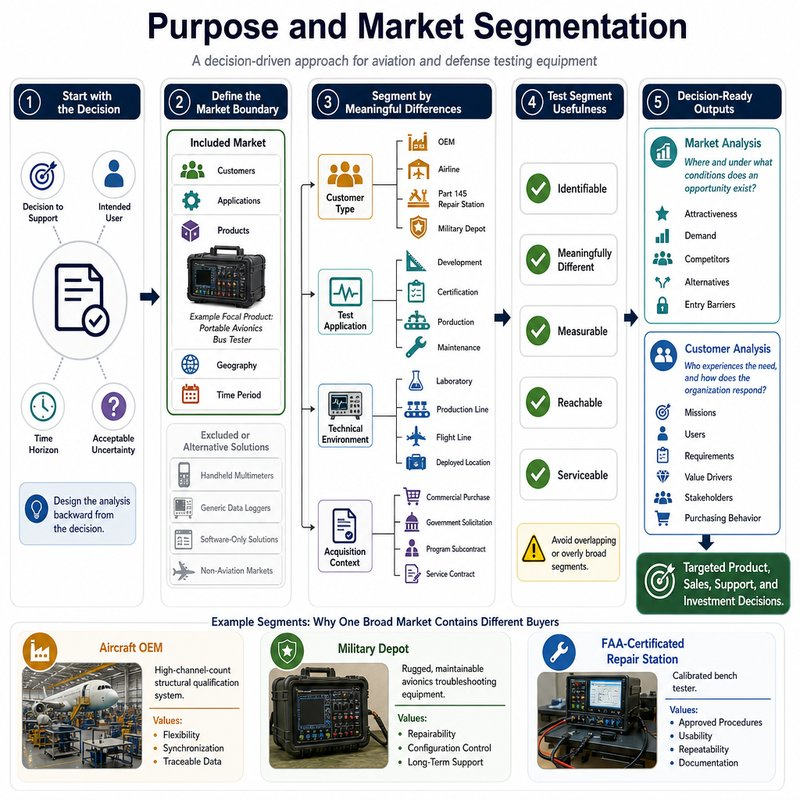
[[flowchart-placeholder]]
Four segmentation dimensions that matter
Customer type identifies the kind of organization that owns the problem, uses the equipment, or controls the purchase. Relevant groups may include original equipment manufacturers, subsystem suppliers, commercial operators, defense program offices, military depots, test ranges, government laboratories, and certificated repair stations. FAA Part 145 repair stations, for example, are authorized to perform maintenance, inspection, and alteration only within the scope of their approved ratings and capabilities. (faa.gov)
Customer type matters because organizational mission affects purchasing logic. An original equipment manufacturer may value measurement flexibility and integration with engineering software. A repair station may emphasize approved procedures, calibration status, technician usability, turnaround time, and documentation. A defense program office may place greater weight on configuration control, cybersecurity, ruggedization, long-term support, and contractual compliance.
Test application and life-cycle phase describe why testing occurs. Applications include research and development, design verification, certification, production acceptance, installation checks, operational evaluation, troubleshooting, maintenance, calibration, and overhaul. The same underlying measurement technology can require different packaging, accuracy, throughput, automation, and evidence depending on the application.
Defense programs make these distinctions especially important. Department of Defense test and evaluation includes developmental, operational, and live-fire activities, with integrated planning intended to use data and resources efficiently. (dau.edu) Equipment intended for developmental testing may need extensive instrumentation access, while operational testing may demand representative field conditions and realistic operator interaction.
Technical environment captures the conditions that determine whether equipment can perform effectively. Relevant variables include measurement range, accuracy, channel count, interfaces, signal types, environmental exposure, portability, automation, safety classification, and information-security constraints. Platform characteristics also matter because fixed-wing aircraft, rotorcraft, unmanned aircraft, missiles, and ground-based support systems create different physical and operational demands.
Acquisition context describes how the customer can purchase and sustain the solution. A commercial laboratory may make a capital-equipment purchase after technical evaluation, while a government customer may use a formal solicitation, contract vehicle, prime contractor, or program-funded integration effort. Contracting rules, approved supplier status, data rights, export controls, security requirements, and funding timing can all affect market accessibility.
| Dimension | Example segments | Why it changes the opportunity |
|---|---|---|
| Customer type | OEM, airline, repair station, military depot, test range, government laboratory. | Changes the mission, responsible stakeholders, purchasing authority, and support expectations. |
| Test application | Development, certification, production, maintenance, calibration, operational evaluation. | Changes required accuracy, automation, evidence, throughput, and operating conditions. |
| Technical environment | Laboratory, production line, flight line, depot, environmental chamber, deployed location. | Changes portability, ruggedness, interfaces, safety controls, and usability requirements. |
| Acquisition context | Commercial purchase, government solicitation, program subcontract, service contract. | Changes lead time, compliance burden, sales route, competition, and contract terms. |
What makes a segment useful
A practical segment should be identifiable. The analyst must be able to determine which organizations or opportunities belong to it. “Customers that value quality” is not useful because nearly every aviation customer claims to value quality, and the phrase does not provide an observable membership rule.
A segment should also be meaningfully different from neighboring segments. The difference must affect demand, technical fit, buying behavior, or service requirements. Dividing customers by company size may be useful if large organizations centralize procurement while smaller firms allow engineers to purchase directly, but size alone is not automatically meaningful.
The segment must be measurable enough for the decision. Perfect data are rare in specialized aviation and defense markets, particularly when programs are classified, quantities are low, or custom integration represents a large portion of value. Measurement can therefore combine installed platforms, facility counts, likely equipment positions, replacement cycles, program budgets, and qualified expert judgment.
Finally, the segment must be reachable and serviceable. A technically attractive group may not be commercially accessible because of security restrictions, existing program relationships, certification costs, contract requirements, or an entrenched installed base. Segmentation should reveal these constraints rather than hide them behind a large top-down market estimate.
Best practices and recurring analytical errors
The best segmentation starts with customer work rather than the supplier’s catalog. Asking where an existing product might be sold encourages analysts to create segments that mirror internal product lines. Starting with the test activity—what must be measured, demonstrated, diagnosed, or approved—creates a clearer view of demand.
Analysts should use more than one segmentation dimension, but they should avoid unnecessary complexity. “U.S. military organizations” is usually too broad, while a segment defined by service branch, platform, subsystem, test phase, facility, contract type, budget source, and equipment age may become impossible to measure. The goal is the smallest number of dimensions that produces meaningfully different decisions.
Segments should also remain separate from named accounts. A military depot is an account or facility; “military depot-level avionics maintenance” is a segment. Several accounts may belong to the same segment, while one large organization may participate in several segments through its engineering, production, and maintenance operations.
Common errors include:
-
Starting with market size: A large headline number can distract from whether the supplier can serve or reach the market.
-
Using only industry labels: Terms such as “aerospace” or “defense” hide major differences in missions and purchasing conditions.
-
Confusing platforms with needs: Two aircraft types may share a test requirement, while identical platforms may be tested differently in production and maintenance.
-
Creating overlapping segments: Categories without clear membership rules lead to double counting.
-
Assuming segmentation is permanent: New programs, regulations, technologies, and maintenance strategies can change which distinctions matter.
One typical misconception is that segmentation simply supports marketing communications. In technical business-to-business markets, it also informs product architecture, qualification strategy, service capacity, channel selection, and investment priorities. A segment that requires deployed operation may justify a rugged enclosure and simplified interface, whereas a laboratory segment may justify higher channel density and advanced data access.
Another misconception is that every organization belongs to one segment. An aircraft manufacturer may conduct development testing, operate production acceptance stations, and maintain a flight-test fleet. Each activity can represent a different segment because it involves different users, requirements, budgets, and purchasing events.
Example: segmenting an avionics bus tester opportunity
A testing-equipment company is considering a portable tester for diagnosing digital communication faults on aircraft. The initial market description—“commercial and military avionics”—is too broad to guide product development. The company first defines the application as near-aircraft troubleshooting of installed avionics data buses, excluding general laboratory analyzers, production test systems, and permanently installed onboard diagnostics.
The team then segments the opportunity by customer type and operating environment. Commercial airline maintenance, Part 145 repair stations, military flight-line units, and depot-level maintenance organizations become four candidate segments. Each performs diagnosis, but the working conditions differ: an airline may prioritize rapid return to service, a repair station may require compatibility across several customer platforms, and a military unit may need operation in harsh or controlled environments.
Next, the company compares technical and acquisition implications. A flight-line configuration may require battery operation, a readable outdoor display, protective connectors, and guided diagnostics. A depot configuration may favor deeper data access, external automation, repairable modules, and long-term configuration control. The analysis shows that one core measurement platform may serve multiple segments, but only if its accessories, software permissions, documentation, and support model are modular.
The benefit of segmentation is a clearer product decision: develop a common technical core while treating commercial line maintenance and military depot maintenance as separate offers. The limitation is that segment membership does not guarantee demand. The company still needs to determine installed-system counts, fault frequency, current diagnostic methods, available budgets, and barriers to replacing existing equipment.
Example: separating structural development from production testing
An equipment supplier also sees demand for systems that measure strain, load, displacement, and vibration on aircraft structures. A simple platform-based segmentation would divide the market into fixed-wing aircraft, rotorcraft, and unmanned aircraft. That division is relevant, but it does not explain why customers purchase different test-system configurations.
The supplier instead begins with life-cycle phase. Development and certification testing becomes one segment, while production acceptance testing becomes another. Development programs may involve changing sensor layouts, high channel counts, synchronization with other instruments, detailed raw data, and engineering-led configuration. FAA certification activities can include ground and flight testing to demonstrate safe operation, making test evidence and traceability especially important. (faa.gov)
Production testing serves a different purpose. The test method is usually more stable, operators repeat defined sequences, and the organization values cycle time, consistency, pass/fail control, and integration with manufacturing records. The measurement may be less exploratory but more dependent on repeatability and operational availability.
The segmentation leads to two distinct value propositions. Development customers receive flexible configuration, broad data access, and engineering analysis capability; production customers receive controlled workflows, automation, and repeatable reporting. The same sensors or acquisition modules may appear in both systems, but the complete solutions differ because the customer’s work differs.
This approach benefits engineering, sales, and operations simultaneously. Engineering can design reusable modules, sales can present application-specific value, and service teams can plan different support levels. Its limitation is that program transitions can blur the boundary, particularly when a development system is adapted for low-rate production, so opportunities must be classified according to their current decision criteria rather than product history alone.
A disciplined starting point
-
Begin with the decision the analysis must support, not with a collection of industry statistics.
-
Define the market boundary by stating which customers, applications, products, geographies, and time periods are included.
-
Segment by meaningful differences in customer mission, test application, technical environment, and acquisition context.
-
Test each segment for identifiability, difference, measurability, accessibility, and serviceability.
-
Treat segmentation as a decision framework, not a permanent description of the industry.
Good segmentation makes a complex aviation and defense market understandable without pretending that it is simple. It shows where similar technical needs exist, where customer conditions diverge, and where a supplier can realistically create and deliver value.
Next, we'll build on this by exploring Customer Needs and Purchasing Influences.