

Role of Securities in Financial Markets and Key Players
- View
Understanding the Role of Securities in Financial Markets
Imagine you're in a bustling financial district filled with towering skyscrapers, each housing numerous financial firms. Amidst this vibrant setting, securities play a crucial role, akin to the bustling commerce on the streets below. Securities such as stocks, bonds, and funds facilitate the flow of capital across markets, serving as pivotal instruments in trading and investing.
Why Securities Matter Now
In today's globalized financial environment, securities are not just passive assets. They actively shape economies by enabling capital allocation, risk management, and investment strategies. Understanding their role is critical for anyone involved in banking, broking, or asset management, where decisions impact portfolios and balance sheets.
Defining Securities and Their Purpose
-
Securities: These are financial instruments that represent ownership positions (stocks), creditor relationships (bonds), or rights to ownership (funds). They are essential for raising capital in public and private markets.
-
Core Function: The primary role of securities is to mobilize financial resources and manage risk. They provide liquidity in financial markets, enabling quick buying or selling, critical for maintaining market efficiency.
Unpacking Financial Markets and Key Players
Financial markets are platforms where securities are issued and traded. They serve as the backbone of the global financial system. Let's delve into the components and participants crucial to this ecosystem.
Key Components of Financial Markets
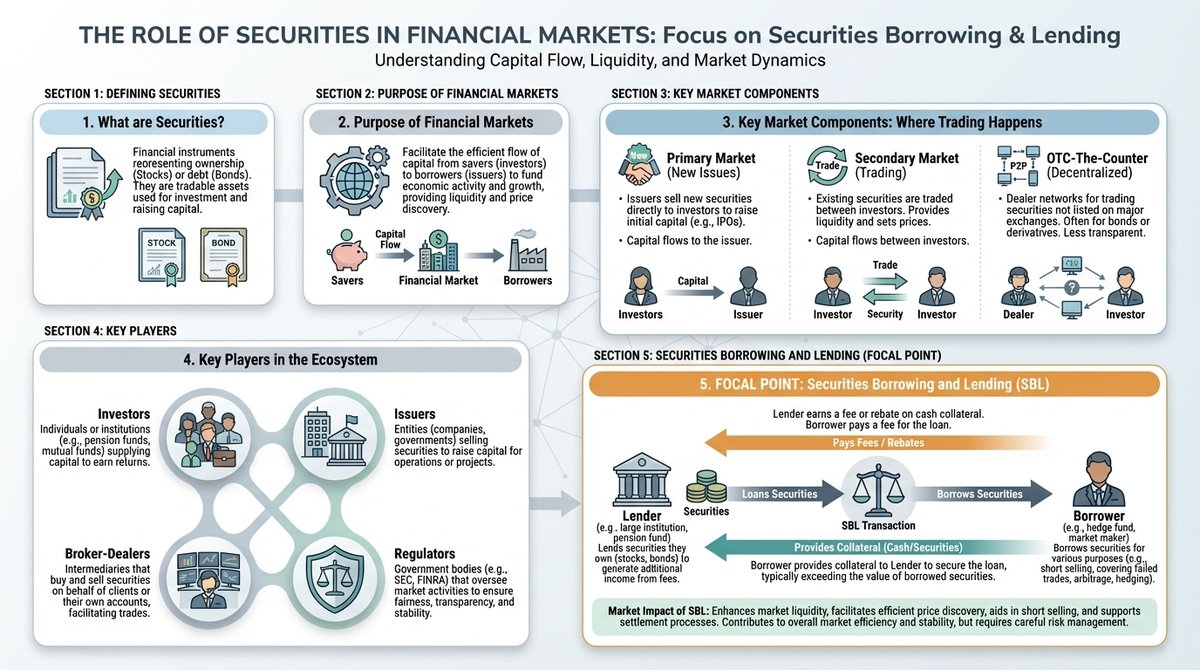
- Primary Markets: Here, new securities are issued to investors, often through initial public offerings (IPOs). Companies raise capital directly from investors, providing a fresh influx of resources.
- Secondary Markets: After initial issuance, securities are traded among investors. This liquidity is vital for investors seeking to enter or exit positions without affecting the asset's underlying value.
- Over-the-Counter (OTC) Markets: Securities traded in decentralized settings directly between parties. These markets accommodate bespoke agreements and derivatives not listed on formal exchanges.
Key Players in the Market
-
Investors: Ranging from individuals to institutional investors like pension funds, who provide the capital flowing into markets.
-
Issuers: Entities such as corporations and governments that create and sell securities to raise funds.
-
Broker-Dealers: Facilitate the buying and selling of securities, often acting as intermediaries between buyers and sellers.
-
Regulators: Organizations like the SEC enforce rules to ensure market integrity and protect investors.
Exploring Securities Markets and Their Functions
Understanding securities within financial markets requires analyzing best practices, common pitfalls, and misconceptions. Let's explore these aspects:
Best Practices in Securities Markets
-
Due Diligence: Thorough research and analysis before trading or investing to mitigate risks.
-
Diversification: Spreading investments across different securities to manage risk and stabilize returns.
-
Liquidity Management: Ensuring sufficient levels of liquidity for seamless transactions without drastic market impact.
Common Pitfalls to Avoid
-
Emotional Bias: Allowing emotions to drive decisions can lead to poor trading outcomes.
-
Over-Leveraging: Using too much borrowed capital can amplify losses beyond recoverable positions.
-
Ignoring Market Signals: Failing to heed market trends and signals can result in missed opportunities or adverse positions.
Misunderstandings About Securities
-
Risk Perception: Securities are not inherently risky; risk is influenced by market conditions and investment decisions.
-
Value Metrics Misinterpretation: Misunderstanding valuation metrics, such as P/E ratios or yield curves, can lead to poor analysis.
| Aspect | Best Practices | Common Pitfalls | Misconceptions |
|---|---|---|---|
| Trading Strategy | Research and diversify | Emotional decision-making | Securities are inherently risky |
| Market Entry | Evaluate market conditions | Over-reliance on leverage | Misinterpretation of value metrics |
| Liquidity Management | Maintain liquidity | Ignoring market trends | Misunderstanding market dynamics |
Real-World Applications of Securities
Consider how banks use securities to meet regulatory liquidity requirements, acting as a reserve to manage unexpected cash flow needs. Brokers, on the other hand, leverage securities lending to optimize portfolio returns and offer more diverse client services. This interchange of securities exemplifies their integral function in financial management and investment.
Real-World Example 1: Banking Sector
A major bank, needing to maintain liquidity reserves per regulatory standards, engages in securities lending. By lending out securities, the bank earns a small return while still meeting its liquidity requirements. This dual role of securities enhances both operational flexibility and income potential.
Real-World Example 2: Asset Management
An asset management firm, aiming to enhance portfolio performance, might utilize securities lending. By lending stocks to other financial entities for short selling, they generate additional income. This strategy, however, requires precise management to avoid conflicts during stock recall or market volatility situations.
Wrap-Up: Building a Financial Market Foundation
-
Core Understanding: Securities are foundational to capital market operations, providing essential functions and liquidity.
-
Marketplace Dynamics: Recognizing best practices and pitfalls empowers better decision-making and strategy formulation.
-
Practical Application: Real-world scenarios showcase securities' multi-faceted utility in financial operations.
Gaining command over the role of securities and recognizing key players allows you to navigate and influence the financial landscape effectively. With this knowledge, you're equipped to engage with the financial markets more strategically and responsibly.