

Understanding User Experience (UX) Design
- View
User Experience (UX) Design in e-Commerce [20 Minutes]
Discovering the Impact of UX Design in Online Shopping
Imagine you're browsing an e-commerce website to buy a new pair of sneakers. You easily find the category, sort by your favorite brands, and quickly locate various options in your size. The process is smooth, intuitive, and almost enjoyable, guiding you seamlessly from browsing to purchase. This pleasant journey is a result of effective User Experience (UX) design.
Defining the Essence of UX Design
User Experience (UX) Design is all about creating products that offer meaningful and relevant experiences to users. It involves designing the entire process of acquiring and integrating a product, including aspects of branding, design, usability, and function. But why does it matter in e-commerce?
In the competitive world of e-commerce, UX design can make or break a user's journey. A well-designed UX can lead to higher conversion rates, repeat purchases, and customer loyalty. Conversely, a poorly designed UX often results in frustration and abandoned carts.
Unpacking UX Design Principles
Key Terms in UX Design
-
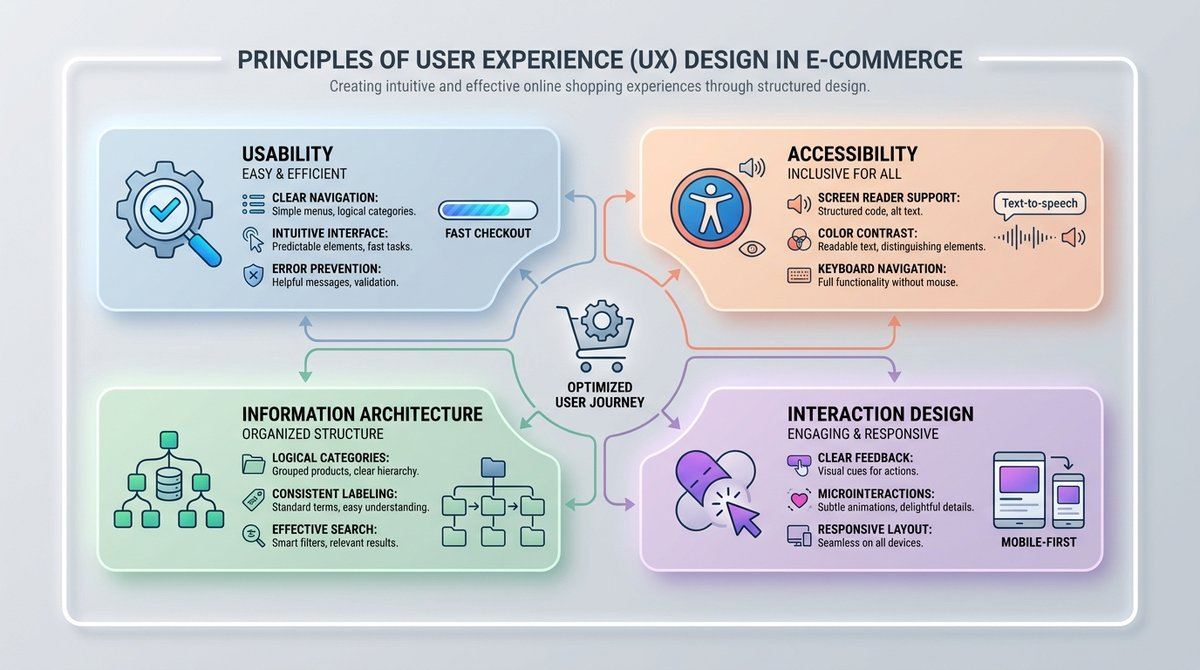
Usability: This refers to how easily users can navigate and utilize the interface of a product or website. It’s a fundamental aspect of UX as it ensures a user's interaction with a website is efficient and satisfying.
-
Accessibility: Making products usable by people with a wide range of abilities. In e-commerce, this means designing websites that everyone, regardless of disability, can access and make purchases from.
-
Information Architecture: Organizing and structuring content on a site so that users can find information easily. Imagine a grocery store where everything is well-labeled and logically placed — that's effective information architecture.
-
Interaction Design: Focuses on creating engaging interfaces with well-thought-out behaviors. It deals with the way users interact with the websites and products.
Best Practices in UX Design
-
Simplicity is Key: Keep interfaces uncluttered. Every element should serve a purpose.
-
Consistency: Consistent design regarding colors, fonts, and spacing helps users build familiarity and trust.
-
Feedback and Responsiveness: Providing users with feedback during their interactions helps them understand the results of their actions.
-
Mobile Optimization: With a significant number of users shopping on their phones, it’s crucial to ensure that websites are mobile-friendly.
Common Pitfalls to Avoid
-
Ignoring User Feedback: Users often provide valuable insights into what's working and what's not. Overlooking this feedback can lead to reduced usability.
-
Neglecting Load Time: Slow loading websites cause users to leave. Optimize images and code to ensure fast loading times.
-
Overcomplicating Navigation: A complex navigation structure can confuse users, making it hard for them to find what they’re looking for.
Examination of UX Design's Multifaceted Approach
The effectiveness of UX design in e-commerce lies in integrating various facets seamlessly. Let’s delve deeper into these foundational principles with an e-commerce focus:
The Role of Usability in e-Commerce
A critical aspect of usability is ensuring that the site is easy to navigate and understand. This involves clear categories, visible search functions, and straightforward checkout processes. Imagine a website where filters and sorting options allow you to effortlessly narrow down choices, aligning exactly with user needs. This direct approach saves time and enhances user satisfaction.
Accessibility: An Inclusive Approach
Consider the necessity to include all user demographics. Accessibility ensures that your site can be used by everyone — including those with visual impairments or who rely on screen readers. Features like alt texts for images, high-contrast modes, and keyboard navigability open the door to a broader audience, enhancing both usability and empathy.
Applied Examples in UX Design for e-Commerce
To better understand the impact of effective UX, let's examine a couple of real-world scenarios in the e-commerce landscape.
Case Study: Amazon’s One-Click Purchase
Amazon's one-click purchase is a prime example of streamlined UX. By storing user shipping and payment details, Amazon saves users the hassle of entering information multiple times. This convenience significantly reduces cart abandonment, increasing the conversion rate.
Impact: Simplifies the purchasing process, enhancing the user experience, and leading to increased sales.
Limitations: Requires user consent to store payment information, which might raise privacy concerns for some users.
Example: Apple Store Mobile Optimization
Apple's e-commerce website is a benchmark for mobile optimization. Its mobile site retains the design and features of its desktop counterpart, ensuring consistency. The interface is optimized for touch, and navigation remains intuitive, adapting seamlessly to smaller screens.
Impact: Users enjoy a consistent experience across all devices, boosting satisfaction and likelihood of purchase.
Limitations: High-quality design demands significant investment, which not all companies can afford.
Bringing it All Together
To summarize, understanding and applying UX design principles are essential in creating successful e-commerce platforms. Key takeaways include:
-
Focus on Usability and Accessibility: Design with the user in mind to ensure a smooth and inclusive experience.
-
Emphasize Simplicity and Consistency: Keep interfaces simple and maintain consistency throughout the platform.
-
Leverage Mobile Optimization and Fast Load Times: With increasing mobile shoppers, ensure websites are optimized for mobile devices and load quickly.
Understanding these elements of UX design is crucial in creating a successful e-commerce website that not only attracts but also retains users. Next, we'll build on this by exploring Importance of UX in e-Commerce.