

Overview of Borrowing Strategies
- View
Introduction to Securities Borrowing Strategies
In the world of finance, particularly across banking, brokering, and asset management, understanding the mechanisms of securities borrowing can be incredibly valuable. Imagine a scenario where a brokerage firm seeks to optimize its trading returns. One of the tools at its disposal is securities borrowing, a practice that involves borrowing stocks, bonds, or other financial instruments to enhance investment strategies. This lesson aims to introduce you to the foundational concepts of securities borrowing strategies, setting the stage for more advanced topics in subsequent lessons.
Key Concepts in Securities Borrowing
Securities borrowing involves the temporary acquisition of a security by one party (the borrower) from another (the lender). The borrower must eventually return the securities, typically with an additional fee or interest. Here are some key terms and principles to understand:
-
Collateral: Borrowers provide collateral, often cash or other securities, to secure the transaction, mitigating risk for the lender.
-
Reinvestment of Collateral: The lender can reinvest the collateral, potentially generating additional income.
-
Borrowing Fee: The borrower pays a fee for the security, which can vary based on the demand for the securities and other market conditions.
This process is crucial because it allows market participants to execute strategies such as short selling, hedging, and facilitating market liquidity.
Understanding Securities Lending
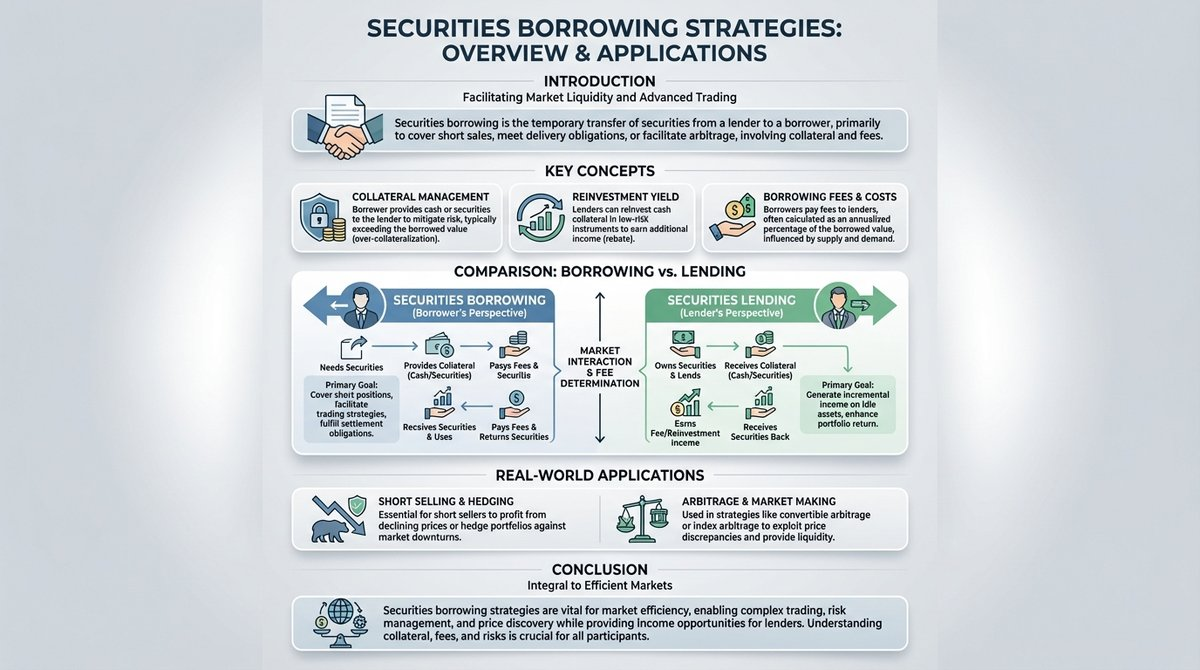
To appreciate securities borrowing, one must also understand securities lending. Here's a comparison of borrowing and lending:
| Aspect | Securities Borrowing | Securities Lending |
|---|---|---|
| Purpose | Acquire securities for specific strategies like shorting | Earn income through lending fees |
| Risk Management | Utilize collateral to safeguard transactions | Ensure borrower meets collateral requirements |
| Income Generation | Borrow to exploit price differences or dividends | Lend securities to earn fees and reinvest proceeds |
| Operational Role | Active borrower seeking strategic advantage | Passive or strategic lender managing investments |
Securities lending plays a pivotal role in providing liquidity and efficiency to the financial markets.
Real-World Applications
Example 1: Brokerages
A brokerage firm might borrow securities to facilitate clients' short-selling strategies. By borrowing shares that are expected to decline in value, the firm can sell them at the current price and aim to buy them back at a lower price, thus profiting from the price difference. This strategy necessitates precise timing and analysis to mitigate the risk of price movements going against predictions.
Example 2: Institutional Investors
Institutional investors, such as pension funds, often engage in securities lending to generate additional income streams. By lending out their portfolios of stocks or bonds, they earn fees while maintaining ownership. For instance, a pension fund might lend out equities during a period when the demand for short selling increases, thereby optimizing returns without directly affecting the fund's principal investments.
Conclusion and Looking Forward
This introductory lesson has laid the groundwork for understanding the strategies behind securities borrowing. We've discussed the mechanics of borrowing and lending securities, the roles they play in market operations, and some tangible examples of their application. In essence, these concepts are the building blocks for more intricate financial strategies. Next, we'll build on this by exploring Short Selling - Objectives and Methods. This upcoming discussion will deepen your understanding of how borrowing securities can be strategically employed to enhance investment returns.