

The Lending Process Explained
- View
Unveiling the Lending Process in Banking
Imagine a scenario where a hedge fund manager wants to short sell a stock. To do this, they need to borrow the necessary shares from a holder willing to lend them. This forms the backbone of securities lending—a process pivotal in driving liquidity and flexibility within financial markets today. Understanding this transaction is crucial for professionals working in banking, broking, or asset management sectors as it facilitates various strategies, such as hedging, arbitrage, and speculative trades. Transitioning into this topic, we'll explore the intricacies of the lending process, giving you a clear perspective on how this essential financial mechanism works.
Understanding the Basics of Securities Lending
Before diving into the lending process, let's establish some core concepts. Securities lending is a transaction where securities are temporarily transferred from a lender to a borrower, usually involving financial institutions such as banks or brokerage firms. In return, the borrower provides collateral and agrees to return the securities at a future date, plus a fee for borrowing.
Key Terminologies
-
Securities: Financial instruments representing ownership (stocks) or creditor relationship (bonds).
-
Collateral: Assets pledged by the borrower to secure the loan and mitigate risks for the lender, typically cash or equivalent securities.
-
Borrow Fee: The cost incurred by the borrower for the privilege of borrowing the securities.
-
Recall: The lender's ability to demand the return of securities at any time, ensuring flexibility and control over their assets.
These foundations reveal the inherent complexity and mutual dependencies in this financial system, setting the stage for a deeper dive into the lending mechanism.
Delving Deeper into the Lending Dynamics
The lending process is defined by a series of steps that involve various stakeholders, each playing a specific role in ensuring the transaction's efficiency and security. Here's a structured breakdown of this process:
The Securities Lending Process: A Step-By-Step Exploration
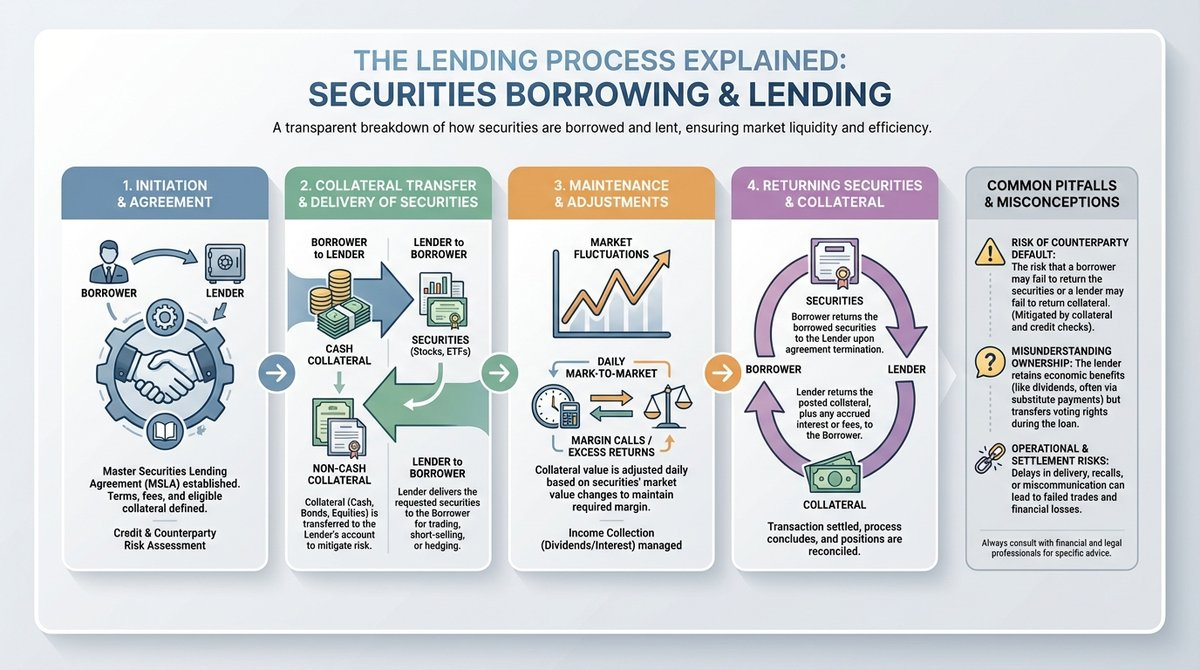
- Initiation and Agreement: The borrower identifies the need to borrow specific securities. After selection, the borrower approaches a lender—often a brokerage firm or bank. Both parties agree upon the terms, including the type of collateral, loan duration, and borrowing fee.
- Collateral Transfer and Delivery of Securities: Once terms are settled, the borrower transfers the collateral to the lender's account. This preconditional safeguard ensures the lender's assets are protected. Subsequently, securities are delivered to the borrower's account, allowing them to execute their strategy—be it short selling or other investment purposes.
- Maintenance and Adjustments: Throughout the loan period, the value of the collateral is monitored and adjusted to reflect market fluctuations. This dynamic feature ensures the lender remains protected against volatility, a critical component in maintaining confidence in the lending market.
- Returning Securities and Collateral: Upon reaching the loan's end date or through a recall, the borrower returns the securities. Following verification, the lender releases the collateral, concluding the transaction. The mutual exchange of securities and collateral marks the fulfillment of obligations by both parties.
Common Pitfalls and Misconceptions
- Misjudging Market Rates: An error can occur in estimating borrowing fees or interest rates, significantly impacting cost efficiency.
- Collateral Management Errors: Insufficient or poorly managed collateral can lead to financial vulnerabilities and legal complications.
- Ignoring Recall Potential: Overlooking the possibility of a lender-initiated recall can disrupt borrowing strategies, particularly in volatile markets.
[[flowchart-placeholder]]
Real-World Cases: Securities Lending in Action
Consider a hedge fund manager aiming to capitalize on an anticipated market decline through short selling. The manager borrows shares of Company XYZ, using cash as collateral. They sell the borrowed shares at the current market price, intending to repurchase them at a lower price post-market drop. As the market moves according to the fund's prediction, they buy back the shares at reduced pricing, return them to the lender, and retrieve their collateral. The profit made from this maneuver exemplifies the strategic leverage securities lending offers.
In another scenario, an insurance company with substantial stock holdings optimizes its portfolio returns by lending stocks it intends to hold long-term. Through lending, it earns additional income via borrowing fees, effectively increasing portfolio yield without altering its investment strategy.
These examples highlight the flexibility and opportunities within the securities lending framework, benefiting both borrowers aiming for strategic trades and lenders seeking passive income.
Recapping Essential Points
The intricacies of securities lending serve as a linchpin for various financial strategies across banking, broking, and asset management landscapes. Here's a concise reminder of the critical insights:
-
Securities lending enhances market liquidity and allows for diverse investment strategies by enabling assets to be temporarily transferred while still generating returns through fees.
-
Collateral management is crucial to safeguard both parties against market risks, ensuring the lender's assets remain protected, and the borrower can proceed with strategic operations.
-
Market awareness and understanding of the recall potential can mitigate common pitfalls associated with securities lending.
Understanding securities lending empowers you to leverage strategic financial opportunities effectively. Now that the foundation is in place, we'll move into Roles of Lenders, Borrowers, and Intermediaries to further demystify the intricate dance of securities lending.