

Types of Securities: Bonds, Stocks, and Others
- View
Understanding Different Types of Securities
Securities play a crucial role in the financial landscape, influencing decisions made by banks, brokers, and asset managers. Imagine a scenario where you're working at an asset management firm tasked with diversifying an investment portfolio. You need to decide how much to allocate to various types of securities, such as bonds, stocks, and others. This decision is vital for balancing risks and potential profits. Understanding the types of securities available is essential for anyone involved in financial services, as these choices impact investment strategies and financial stability.
Breaking Down Securities: Bonds, Stocks, and Others
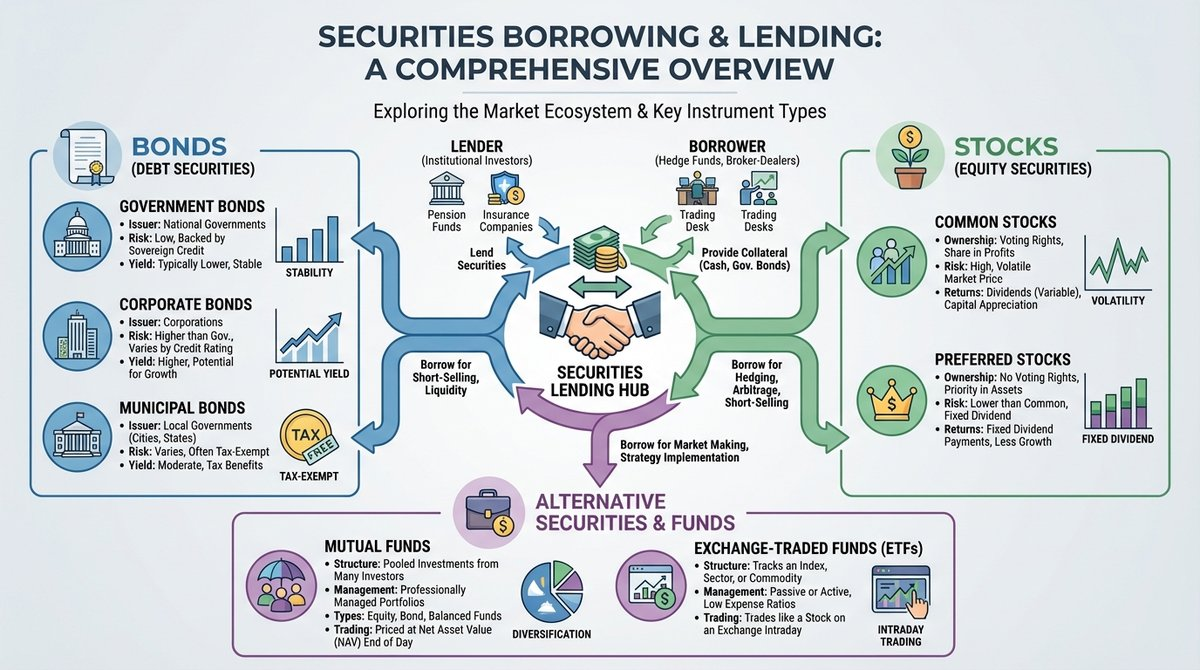
When we talk about securities, we refer to financial instruments that hold some monetary value. Let's break down the fundamental categories:
-
Stocks: These represent ownership in a company and provide shareholders with voting rights and a claim on profits.
-
Bonds: These are debt securities, essentially loans from investors to a borrower, typically corporate or governmental, promising to pay back with interest.
-
Others: This includes a range of financial instruments like mutual funds, ETFs, options, and derivatives, often offering unique benefits and risks.
Each security type serves different purposes and presents distinct opportunities and challenges, which we'll explore in greater detail.
Diving Deep into Bonds, Stocks, and Alternative Securities
Stocks: The Essence of Ownership
Stocks, or equities, signify an ownership interest in a corporation. When you buy stocks, you become a part owner and are entitled to a portion of the company’s earnings and vote on critical issues. Stocks are typically categorized into common and preferred stocks.
-
Common stocks: Offer voting rights but come with higher volatility and risk.
-
Preferred stocks: Provide no voting rights but higher priority for dividends, making them less risky.
Stocks offer investors the potential for growth and dividends, but they carry risks such as market volatility and the performance risk of individual companies.
Bonds: The Stability of Debt
Bonds are fixed-income instruments offering lower risk compared to stocks. When investors purchase bonds, they essentially become creditors to the issuer, receiving periodic interest payments and the principal upon maturity.
Types of Bonds:
-
Government bonds: Include securities like U.S. Treasuries, noted for their safety but lower yields.
-
Corporate bonds: Issued by companies; these bonds typically offer higher yields but come with more risk compared to government bonds.
-
Municipal bonds: Issued by states or municipalities, often providing tax-exempt interest income.
Bonds play a critical role in stabilizing portfolios, offering predictable income streams and lower volatility.
Exploring Alternative Securities
Beyond stocks and bonds, there are other securities like mutual funds and ETFs (Exchange-Traded Funds) which pool investor funds to purchase diverse assets.
-
Mutual Funds: Managed portfolios of stocks and bonds, giving investors diversified exposure without needing to purchase individual securities.
-
ETFs: Trade like stocks on exchanges and often track an index or sector.
These alternatives offer liquidity and diversification, making them attractive for individual investors aiming for balanced portfolios.
Real-World Examples of Securities in Action
Portfolio Diversification in Asset Management
Consider an asset management firm tasked with increasing the value of a client's portfolio amid market fluctuations. They might choose a combination of stocks for growth potential, bonds for income generation and stability, and ETFs for broad exposure to various industry sectors. This mix can optimize the portfolio's risk-return profile and meet the client's financial goals.
Brokering Transactions with Securities
In broking, understanding securities is critical for executing buy and sell transactions efficiently. A broker advising a client in a volatile market may suggest moving funds from high-risk stocks to more stable bonds or ETFs to preserve capital and reduce risk exposure.
Summary and Forward Connection
In summary, understanding the different types of securities is vital for making informed investment decisions in finance. Stocks, bonds, and other financial instruments each offer unique benefits and risks that need to be navigated carefully.
Next, we'll build on this by exploring the Role of Securities in Financial Markets and Key Players. This will help establish a deeper understanding of how securities fit within the broader financial system.