

Overview of Securities and Markets
- View
Overview of Securities and Markets [20 minutes]
The Context: Why Securities Matter Today
Imagine you're working at a major bank. A key client comes to you seeking advice on diversifying their investment portfolio. While cash savings seem safe, inflation looms and they want better returns. In this scenario, knowledge of securities becomes indispensable. In banking, broking, and asset management, securities like stocks and bonds are fundamental instruments that help investors maximize returns while managing risk. Whether you're facilitating trades or providing wealth management advice, understanding securities is crucial for creating strategies that align with financial goals.
In today’s financial landscape, securities are not just about returns but also about securing and projecting economic stability. They empower companies to raise capital for growth while allowing investors to share in their success. This lesson will introduce you to the basics of securities and the markets where they are traded, laying the groundwork for deeper dives into specific types of securities.
Unlocking the Basics: What Are Securities?
To grasp the concept of securities, think of them as financial assets that can be traded. Securities represent some ownership position, a creditor relationship, or rights to ownership as represented in options.
-
Stocks (Equities): Represent ownership in a company. When you hold a stock, you own a slice of that company and generally have rights to vote on significant company decisions and receive dividends.
-
Bonds (Debt Securities): Essentially loans made by an investor to a borrower (typically corporate or governmental). The investor earns interest on this loan, which is essentially the cost of borrowing to the issuer.
-
Derivatives: Financial contracts whose value is dependent on underlying assets like stocks, bonds, currencies, etc. Options and futures are examples of derivatives.
Securities are essential because they enable efficient capital allocation in the economy. By connecting savers with those in need of capital, markets facilitate financial growth and economic equilibrium.
Diving Deeper: The Dynamics of Securities and Market Operations
Let's examine how securities operate within markets:
How Securities Move the Economy
Securities trigger economic actions through:
-
Capital Formation: Companies issue stocks or bonds to raise money for operational expansion or new projects. It’s a way of generating funds without directly borrowing from banks.
-
Investment and Savings: Through securities, individuals and institutional investors can channel savings into productive investments, contributing to personal wealth accumulation and broader economic growth.
The Functioning of Financial Markets
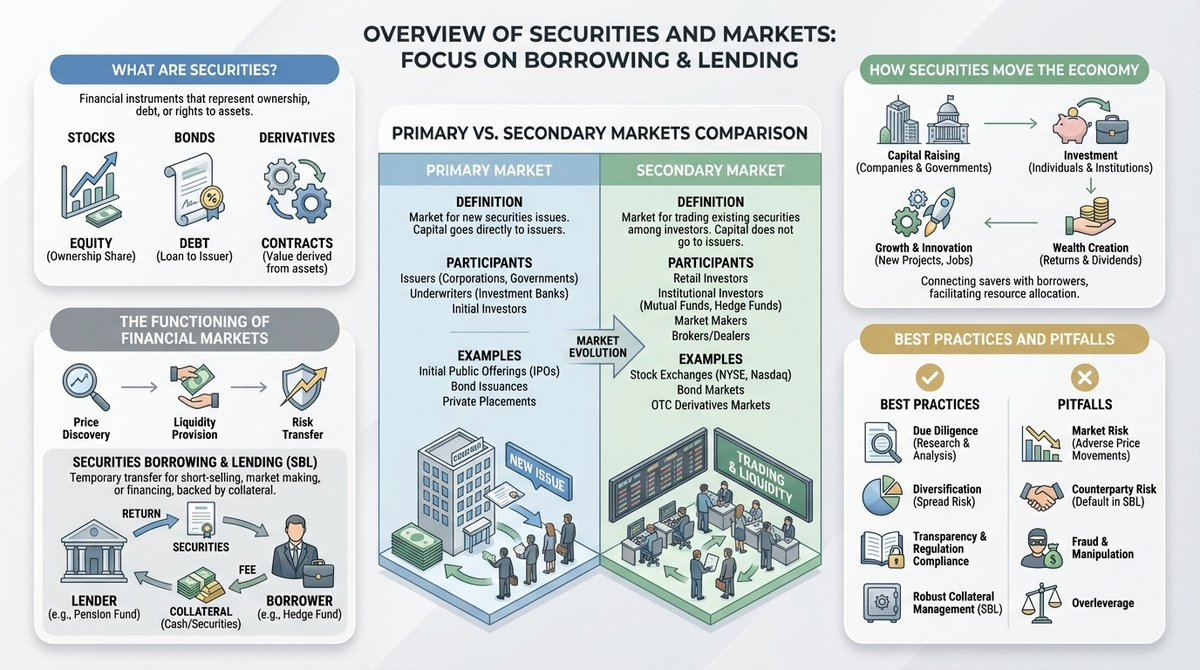
Financial markets bring buyers and sellers together—for instance, the New York Stock Exchange (NYSE) or the bond market. Here’s a simplified breakdown:
-
Primary Markets: Where new securities are sold directly from the issuer to the investor. For instance, during an Initial Public Offering (IPO), a company sells its stocks to the public for the first time.
-
Secondary Markets: After initial issuance, securities are traded between investors. This provides liquidity and an efficient mechanism for price discovery.
| Market Aspect | Primary Market | Secondary Market |
|---|---|---|
| Definition | New securities sold for the first time | Buying and selling of existing securities |
| Participants | Issuer and initial investors | Investors trading among themselves |
| Example | IPO of a company | Buying shares on the NYSE |
Best Practices and Pitfalls in Securities Markets
Best Practices:
-
Due Diligence: Always conduct thorough research before participating in markets, whether for issuing or investing in securities.
-
Diversification: Spread investments across various asset classes to mitigate risks.
Common Pitfalls:
-
Overconfidence: Often leads to ignoring market signals and taking excessive risks.
-
Market Timing: Attempting to time the market is notoriously difficult and can lead to missed opportunities or losses.
Typical Misconceptions
One common misunderstanding is equating securities markets solely with buying and selling stocks. In reality, these markets also handle bonds, derivatives, and more, providing diverse investment opportunities and risk management tools.
Real-World Examples: Securities in Action
Banking Perspective: IPO and Capital Raising
Consider a multinational bank underwriting the IPO of a tech startup. The bank serves as a bridge, guiding the startup through regulatory requirements, valuation, and investor presentation—the goal being to maximize the initial capital raised. Through its expertise, the bank helps facilitate a smooth transition from private to public ownership, often ensuring the company secures significant growth capital.
Broking Scenario: Trading and Advising
A brokerage firm analyzing market trends for a retail investor highlights the importance of bonds in a volatile interest rate environment. They recommend a mix of short- and long-term bonds to stabilize returns. The broker’s market insights help the investor take advantage of varying economic cycles, minimizing risk exposure while targeting steady income streams.
Bringing It All Together
Securities and markets are the backbone of modern finance, enabling wealth creation, economic growth, and risk management. Whether through stocks, bonds, or derivatives, understanding these instruments is crucial for anyone participating in financial services.
This introduction sets the stage for more detailed exploration. Next, we'll build on this by exploring Types of Securities: Bonds, Stocks, and Others. By the end of this section, you'll have a deeper understanding of these essential financial tools and how they shape the world's economies.