

Foundations of Healthcare Robotics
- View
Foundations of Healthcare Robotics [20 minutes]
A new team member in the operating room
Cedar Valley Medical Center is preparing to expand its use of robotics. Leaders are considering a robotically assisted surgical system, rehabilitation devices for patients recovering from strokes, and mobile robots that can transport supplies between hospital units. Each proposal promises greater precision, consistency, or efficiency—but each also changes how clinicians, patients, technicians, and hospital systems interact.
The central question is not simply, “What can the robot do?” The hospital must also ask who controls it, how it senses its surroundings, what happens when conditions change, and whether it fits safely into clinical workflows. A robot that performs perfectly in a demonstration can still fail in practice if staff training, maintenance, cybersecurity, patient consent, or emergency procedures are inadequate.
Healthcare robotics matters because robotic systems increasingly support surgery, diagnosis, rehabilitation, and other care activities. The US Food and Drug Administration describes a robotic medical device as a machine or electrical system that uses robotic technology to improve, assist, or perform healthcare tasks. (fda.gov) Understanding these systems begins with a precise definition of robotics—and with recognizing that a robot is only one part of a larger care system.
What makes a machine a robot?
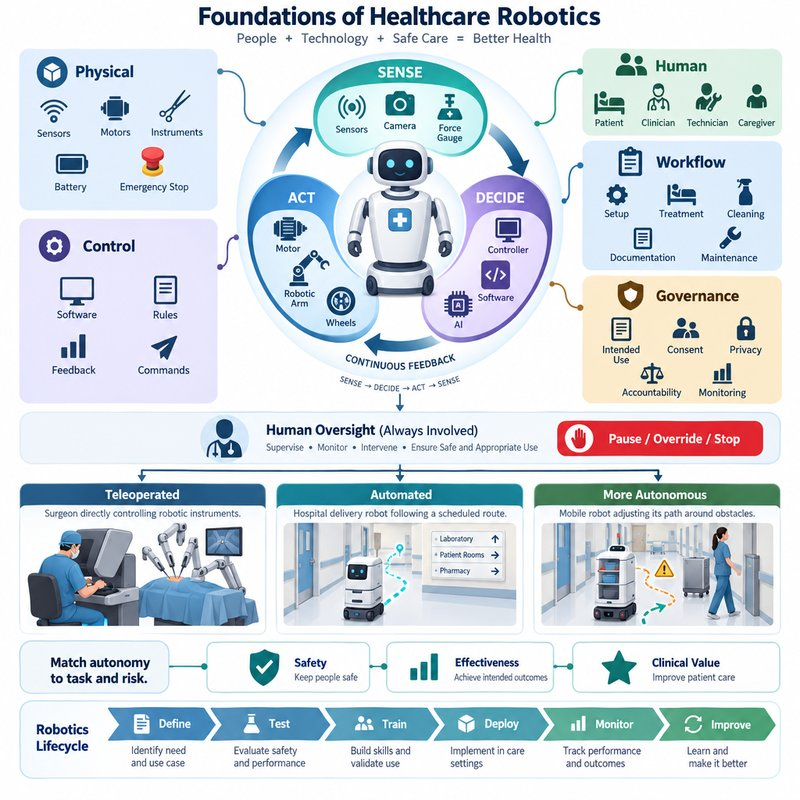
A robot is a physical system that can sense conditions, process information, and act in the world. These three capabilities form a simple loop: sense, decide, act. Sensors collect information, software interprets that information or receives instructions, and actuators produce movement or another physical response.
Consider a rehabilitation robot that assists a patient’s arm movement. Position and force sensors measure how the arm is moving, the controller determines whether assistance is needed, and motors apply an appropriate amount of force. The sensors then measure the result, allowing the cycle to continue. This feedback loop distinguishes a responsive robotic system from a passive mechanical device.
A healthcare robot applies robotic capabilities to a clinical, supportive, or operational task. Depending on its intended use, it may interact directly with a patient, assist a clinician, transport materials, or support rehabilitation. Not every automated healthcare machine is a robot, and not every healthcare robot is a medical device; classification depends on factors such as the intended use, environment, and claims made for the system.
| Category | Ordinary machine | Automated system | Robotic system |
|---|---|---|---|
| Primary behavior | Performs a physical function when operated | Executes predefined actions or rules | Senses conditions and produces physical actions through a controlled process |
| Response to change | Usually depends on direct human adjustment | Responds to limited programmed inputs | May continuously adapt its movement to sensor feedback |
| Example | Manual hospital bed | Timed medication cabinet | Sensor-guided rehabilitation device |
| Key limitation | Requires substantial human operation | Automation may be rigid | Physical action introduces safety, control, and interaction risks |
The boundaries between these categories are not always sharp. A device may contain robotic components without functioning as an independently acting robot, while an advanced robot may still depend heavily on human control. The most useful question is therefore not, “Is this truly a robot?” but, “Which parts sense, decide, and act—and who remains responsible for each part?”
Automation, autonomy, and human control
Automation and autonomy are related but different. Automation means that a system performs a defined action without requiring a person to execute every step. An automated hospital delivery robot, for example, may follow a mapped route, stop when an obstacle is detected, and open a secured compartment at its destination.
Autonomy describes how much freedom the system has to select or modify actions while pursuing a goal. Autonomy is not an all-or-nothing property. A robot may navigate independently while requiring a clinician to choose its destination, or it may regulate movement while a therapist remains responsible for the treatment plan.
Teleoperation sits at another point in the control spectrum. In teleoperation, a human directly controls the robot from a console or remote interface. The robot may filter hand tremor, scale movement, or prevent motion outside configured boundaries, but the person supplies the primary commands. The FDA notes that commonly used robotically assisted surgical systems cannot perform surgery without direct human control. (fda.gov)
| Dimension | Teleoperated system | Automated system | More autonomous system |
|---|---|---|---|
| Who selects the immediate action? | A human operator | Predefined software logic | The system selects among permitted actions |
| Typical example | Surgeon controls robotic instruments | Robot follows a scheduled transport route | Robot modifies its path around changing obstacles |
| Human role | Continuous control | Setup, monitoring, and exception handling | Goal-setting, supervision, and intervention |
| Primary risk | Interface or operator error | Incorrect rules or unexpected conditions | Unpredictable behavior outside validated situations |
| Safeguard emphasis | Training and precise control feedback | Reliable sensing and clear operating limits | Constrained authority, monitoring, and safe fallback behavior |
A common misconception is that “robotic” means “autonomous.” In reality, many clinical robots function as sophisticated tools controlled by trained professionals. Another misconception is that autonomy removes the human role; it actually changes that role from direct operation to supervision, exception management, and accountability.
A sound design assigns control according to the consequences of error. Low-risk, repetitive actions may permit more automated behavior, while high-risk clinical actions usually require tighter constraints and meaningful human authority. The goal is not maximum autonomy—it is the appropriate level of autonomy for the task, user, patient, and environment.
The robot is part of a care system
A healthcare robot is never just hardware. It exists within a sociotechnical system that includes people, clinical procedures, software, data, facilities, policies, and organizational responsibilities. Evaluating only the robot’s mechanical performance overlooks many of the conditions that determine whether it improves care.
At Cedar Valley, a mobile delivery robot may navigate accurately but still create problems if elevators cannot communicate with it, corridors become crowded, or nurses do not know how to retrieve supplies from its compartment. A rehabilitation robot may control movement precisely but disrupt care if it takes too long to fit to each patient. The outcome depends on how well the technology fits the workflow around it.
Five interacting layers help describe the complete system:
-
Physical layer: Sensors, motors, instruments, batteries, mechanical structures, and emergency stops.
-
Control layer: Software that processes inputs, applies rules, and sends commands to physical components.
-
Human layer: Patients, clinicians, technicians, caregivers, and other people who operate or encounter the system.
-
Workflow layer: Scheduling, setup, cleaning, documentation, handoffs, maintenance, and emergency procedures.
-
Governance layer: Intended use, accountability, consent, privacy, regulation, monitoring, and organizational policy.
This system perspective reveals why a technically successful device may not produce a successful clinical service. A robot can improve the precision of one action while adding setup time, new failure modes, or cognitive workload elsewhere. Healthcare organizations must therefore evaluate the complete pathway of care, not just the robot’s headline capability.
[[plantuml-c4-placeholder]]
Matching the robot to the healthcare task
Healthcare robots can be grouped by the type of task they support. Interventional robots assist with physical procedures, such as manipulating surgical instruments. Rehabilitation and assistive robots support movement, mobility, or functional recovery, while service robots transport supplies or perform other operational tasks.
These categories differ in proximity to patients, potential harm, and required oversight. A surgical robot acts within or near the patient’s body, so small errors may have immediate clinical consequences. A supply-delivery robot generally performs a lower-risk task, but it can still block an evacuation route, collide with equipment, or delay critical materials.
| Category | Primary purpose | Typical human relationship | Major considerations |
|---|---|---|---|
| Interventional robot | Supports a diagnostic or therapeutic procedure | Clinician directs or closely supervises activity | Precision, sterility, training, latency, emergency control |
| Rehabilitation robot | Assists repeated therapeutic movement | Patient and therapist interact with the device | Force limits, personalization, comfort, progress monitoring |
| Assistive robot | Supports mobility or daily functioning | User relies on the robot in routine activities | Accessibility, reliability, dignity, changing environments |
| Service robot | Moves materials or supports hospital operations | Staff supervise tasks and handle exceptions | Navigation, security, workflow integration, infection control |
The safest approach begins with a well-defined task, not a desire to purchase impressive technology. The team should identify the problem, current workflow, intended user, operating environment, and measurable outcome. Only then can it determine whether robotics offers a meaningful advantage over simpler alternatives.
This is called task-technology fit. A robotic solution fits when its sensing, control, and physical capabilities match the actual demands of the task. Poor fit often appears when developers optimize for ideal conditions while healthcare teams operate in noisy, crowded, unpredictable environments.
Safety, effectiveness, and clinical value
Safety means reducing the likelihood and severity of harm to an acceptable level. In healthcare robotics, hazards can arise from unintended movement, excessive force, inaccurate sensing, software faults, component failure, incorrect setup, or misuse. Safety must account for normal operation, predictable human mistakes, and reasonably foreseeable abnormal conditions.
Effectiveness asks whether the system produces its intended result under specified conditions. A robot may be mechanically safe but clinically ineffective if it does not improve the relevant patient or workflow outcome. Conversely, evidence of potential benefit does not justify overlooking new risks introduced by the device.
Clinical value takes the analysis further by comparing the overall benefits, burdens, costs, and alternatives. Faster movement is valuable only if it supports the care objective without reducing accuracy or increasing risk. A hospital should examine outcomes such as complications, recovery, staff workload, reliability, throughput, and patient experience rather than relying on a single technical performance measure.
The FDA regulates medical devices in the United States according to their intended uses and applicable classifications, with requirements intended to provide reasonable assurance of safety and effectiveness. (fda.gov) For robotically assisted surgical devices, the FDA also emphasizes appropriate training and continued collection of performance information after deployment. (fda.gov) This reflects a crucial principle: evaluation does not stop when a robot enters service.
Best practice is to treat safety as a lifecycle activity. Teams define intended use, identify hazards, design controls, test foreseeable scenarios, train users, monitor operation, report incidents, and revise procedures when new evidence appears. A common pitfall is to treat the absence of reported accidents as proof of safety, even when the system has seen limited use or near misses are not consistently recorded.
Human oversight is active work
Human oversight is meaningful only when a person can understand the robot’s status, recognize a problem, and intervene in time. Simply placing a clinician “in the loop” does not guarantee safety. The interface must present useful information, responsibilities must be clear, and the operator must have both the authority and practical ability to stop or redirect the system.
Overreliance creates automation bias, the tendency to accept a system’s output even when other evidence suggests it may be wrong. Underreliance causes the opposite problem: users ignore helpful capabilities because they do not understand or trust them. Both patterns can emerge from weak training, poor interface design, inconsistent performance, or unclear expectations.
The World Health Organization’s guidance for AI in health emphasizes protecting human autonomy, promoting well-being and safety, ensuring transparency, assigning accountability, supporting equity, and monitoring systems over time. (who.int) These principles also provide a useful foundation for robotics when software influences physical behavior or clinical decisions.
Strong oversight includes several practices:
-
Define authority: State who may start, pause, override, or stop the robot.
-
Show system status: Make operating mode, warnings, limits, and failures understandable.
-
Prepare for exceptions: Establish procedures for sensor errors, blocked paths, power loss, and communication failure.
-
Maintain competency: Train users for both routine operation and rare emergencies.
-
Preserve accountability: Record decisions, incidents, maintenance, and significant system actions.
A common misconception is that human supervision automatically transfers responsibility away from the developer or organization. In practice, responsibility is distributed across design, procurement, configuration, clinical use, maintenance, and governance. Safe robotics depends on each stakeholder fulfilling a defined role rather than treating the operator as the final defense against every possible failure.
Example: robotically assisted surgery
Cedar Valley first considers a robotically assisted surgical system for selected minimally invasive procedures. The surgeon sits at a console, views the surgical field, and controls instruments mounted on mechanical arms. Such systems can support work in confined areas and facilitate minimally invasive techniques, but the robot does not independently decide where to cut or perform the operation without the surgeon’s control. (fda.gov)
The workflow begins before the procedure. The clinical team confirms that the intended operation falls within the device’s authorized use, selects an appropriate patient, prepares the equipment, and checks instruments and software. Trained staff position the patient and bedside components, while the surgeon verifies visibility, range of motion, and access before beginning.
During the operation, the system translates the surgeon’s control inputs into instrument movements. Staff monitor both the patient and the equipment, remaining prepared to respond to alarms, instrument problems, imaging issues, or a need to change surgical technique. The safety of the procedure therefore depends on the surgeon, bedside team, anesthesia team, device, accessories, and emergency plan functioning together.
The potential benefits include precise instrument control and support for minimally invasive access. The limitations include substantial training requirements, setup demands, dependence on specialized equipment, and the possibility of mechanical, display, or instrument failures. The broader lesson is that “robotic surgery” describes a coordinated human-machine workflow, not an independent machine surgeon.
Example: robotic rehabilitation after stroke
Cedar Valley also evaluates an upper-limb rehabilitation robot for patients recovering from strokes. The device guides or resists arm movement while sensors measure position, speed, and force. A therapist selects the therapeutic objective, configures the device for the patient, and monitors movement quality and patient tolerance.
The process begins with clinical assessment. The therapist considers the patient’s range of motion, strength, pain, cognitive ability, and rehabilitation goals before determining whether the device is appropriate. The robot is then adjusted to the patient’s body dimensions, and conservative force and movement limits are established.
During therapy, the robot can provide consistent, repeatable assistance across many movements. If the patient initiates a movement successfully, the controller may provide less support; if the patient struggles, it may provide more within configured limits. Sensor data can help the therapist observe patterns, but those measurements do not replace professional interpretation of fatigue, discomfort, motivation, or functional progress.
The main benefit is structured repetition with measurable physical interaction. Limitations include the risk of poor fit, discomfort, excessive assistance, and overemphasis on device-generated measurements. The robot becomes clinically valuable only when its capabilities align with an individualized rehabilitation plan and its use is coordinated with the rest of the patient’s care.
Principles that keep robotics grounded in care
Healthcare robotics begins with the interaction of sensing, control, and physical action. The level of automation or autonomy varies, so a robot’s label reveals less than its actual division of responsibilities. Understanding who sets goals, who selects actions, and who handles exceptions is essential.
The strongest implementations also treat robotics as a sociotechnical system. Hardware performance matters, but so do clinical evidence, workflow fit, training, maintenance, patient communication, and organizational accountability. A robot succeeds when the entire care process becomes safer or more effective—not merely when the machine completes its movement.
Keep these foundations in view:
-
Start with the healthcare need, then determine whether robotics is an appropriate solution.
-
Match control and autonomy to risk, rather than pursuing maximum autonomy.
-
Evaluate the complete workflow, including setup, handoffs, cleaning, maintenance, and emergencies.
-
Preserve meaningful human authority, especially when actions can affect diagnosis, treatment, or physical safety.
-
Monitor performance throughout the lifecycle, because real clinical environments reveal issues that initial testing may not capture.
Now that the foundation is in place, we'll move into Machine Learning and AI in Robotic Healthcare Tasks.
Web Sources
-
US Food and Drug Administration, “Robotic Medical Devices.” (fda.gov)
-
US Food and Drug Administration, “Computer-Assisted Surgical Systems.” (fda.gov)
-
US Food and Drug Administration, “Products and Medical Procedures.” (fda.gov)
-
World Health Organization, “Ethics and Governance of Artificial Intelligence for Health.” (who.int)
-
World Health Organization, “Six Guiding Principles for the Design and Use of AI in Health.” (who.int)