

Exploring Future Learning Paths
- View
Exploring Future Learning Paths in Kaizen for Finance [20 minutes]
Why Kaizen Matters in Today's Financial World
Imagine a prominent financial institution grappling with stagnant growth. Despite having robust processes and a skilled workforce, their operations lack innovation. Here’s where the concept of Kaizen becomes pivotal. Originally a Japanese term meaning "continuous improvement," Kaizen encourages small, incremental changes that collectively lead to significant advancements. In the fast-paced and competitive finance sector, applying Kaizen principles can transform mundane operations into dynamic processes, ensuring sustainability and competitiveness.
In this lesson, we'll explore how Kaizen principles can shape future learning paths in the finance sector, driving improvement and creating a culture of perpetual growth.
Understanding Kaizen’s Core Concepts
To apply Kaizen effectively, it's crucial to understand its fundamental principles:
-
Continuous Improvement: This concept emphasizes that minor, ongoing changes are more effective than major overhauls. It's not about one-time projects but fostering a mindset of relentless progression.
-
Employee Involvement: Employees at all levels are encouraged to suggest and implement improvements. This inclusive approach ensures diverse perspectives and collective ownership.
-
Elimination of Waste: Streamlining processes to remove any non-value-adding activities is central to Kaizen. This not only enhances efficiency but also boosts productivity and morale.
These core principles connect back to foundational lessons we've discussed on the importance of efficiency and adaptability in finance, forming the basis for sustained organizational health.
Delving Deeper into Kaizen Methodologies
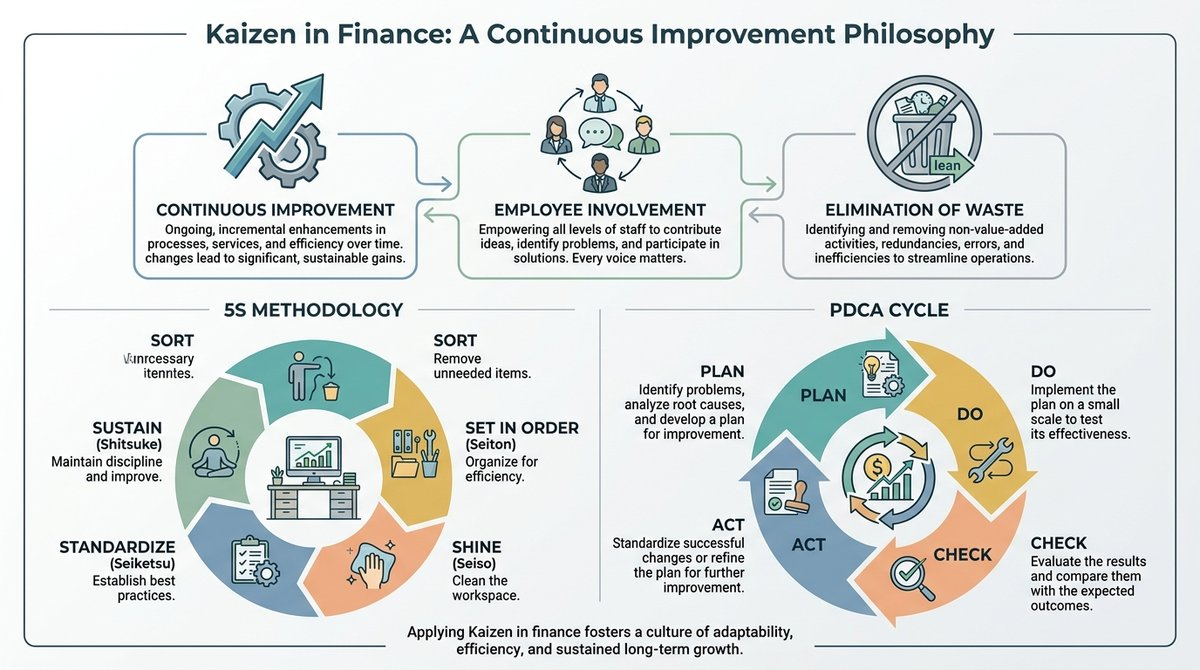
The practical application of Kaizen involves several methodologies, each contributing uniquely to fostering a culture of continuous improvement.
5S Methodology
The 5S methodology stands as a cornerstone of Kaizen, focusing on organizing the workplace to increase efficiency and safety. Each 'S' represents a step in the process:
- Sort: Remove unnecessary items from the work area to declutter and focus on what's essential.
- Set in Order: Arrange items to ensure easy retrieval and return, which saves time and minimizes disorder.
- Shine: Clean the workplace regularly to maintain a tidy environment that fosters productivity.
- Standardize: Establish standards for a neat workplace and implement them consistently.
- Sustain: Ensure that these practices become a cultural norm rather than a one-time task.
Plan-Do-Check-Act (PDCA) Cycle
The PDCA cycle is another integral Kaizen tool, ensuring that changes are systematically tested and refined. Here's how it works:
-
Plan: Identify an area for improvement and develop a plan with measurable objectives.
-
Do: Implement the plan on a small scale to test its effectiveness.
-
Check: Analyze results against the expected outcomes to identify discrepancies.
-
Act: If successful, implement the change on a broader scale. If not, adjust the plan and repeat the cycle.
Both methodologies require a commitment to systematically evaluating and enhancing current practices, thus fostering an environment conducive to ongoing growth and learning.
Applying Kaizen Principles in Finance: Real-World Examples
Example 1: Optimizing Transaction Processing
Consider a mid-sized bank frustrated with delays in transaction processing. By applying the 5S methodology, the bank’s team systematically reviewed each step of the process. Through sorting and streamlining the necessary tools and documents, they reduced bottlenecks significantly. This led to a 20% increase in process efficiency over six months. By standardizing and sustaining their improvements, staff could manage higher volumes while reducing errors.
Example 2: Enhancing Customer Experience
A financial advisory firm facing declining client satisfaction ratings applied the PDCA cycle to evaluate their customer interaction strategies. They planned by gathering data on communication gaps, enacted changes by training staff in active listening, then checked by soliciting client feedback. Subsequent adjustments solidified the new approach, resulting in a customer satisfaction boost from 65% to 85% within a year.
Building a Culture of Continuous Learning with Kaizen
Kaizen goes beyond immediate improvements by instilling a culture of perpetual learning:
-
Empower Employees: By involving employees in improvement initiatives, they become proactive learners who consistently seek knowledge to enhance their work.
-
Flexible Adaptation: Kaizen’s adaptability ensures it can be applied continuously, keeping pace with industry changes and technological advancements.
Comparison of Traditional Practices vs. Kaizen Approach
| Aspect | Traditional Practices | Kaizen Approach |
|---|---|---|
| Change | Driven top-down, often large-scale and episodic | Incremental, driven by all levels, continuous |
| Employee Involvement | Minimal involvement, decisions made by management | High involvement, every employee contributes ideas |
| Focus | Short-term profitability and efficiency | Long-term sustainability and gradual improvement |
| Error Correction | Responsive after significant problems arise | Proactive error prevention through regular reviews and updates |
This comparison highlights Kaizen’s potential to transform finance sector organizations into more agile and resilient entities.
Embracing a Future-Ready Mindset
As we wrap up our exploration of Kaizen in the financial sector, remember that embracing Kaizen is about more than just adopting efficiency tools or practices. It's about fostering a mindset that values improvement and learning as continuous processes. In a rapidly evolving industry, this mindset will serve as your compass, guiding your journey toward innovative growth and sustained success.
Let's sum up with a few key takeaways:
-
Transformative Potential: Seeing change as a gradual, ongoing process allows for deeper and more sustainable improvements.
-
Inclusive Environment: Engaging all employees in the improvement process unlocks diverse perspectives and fosters a sense of ownership and involvement.
With a strong grasp of these concepts, you're well-prepared to implement Kaizen principles in real-world financial environments, ensuring a future of continued success and innovation.