

Overview of Randomized Controlled Trials
- View
Overview of Randomized Controlled Trials [20 minutes]
The Need for Evidence in Education
Imagine a new teaching approach that promises to boost student engagement and improve learning outcomes. How can educators be certain that this method truly works? In a field as nuanced as education, validating such techniques through rigorous methods is crucial for sustainable progress. The gold standard for assessing the effectiveness of educational interventions is the Randomized Controlled Trial (RCT). This lesson dives into why RCTs are integral to educational research, setting the stage for understanding how they function and their significance in driving informed decisions in education.
Defining Randomized Controlled Trials
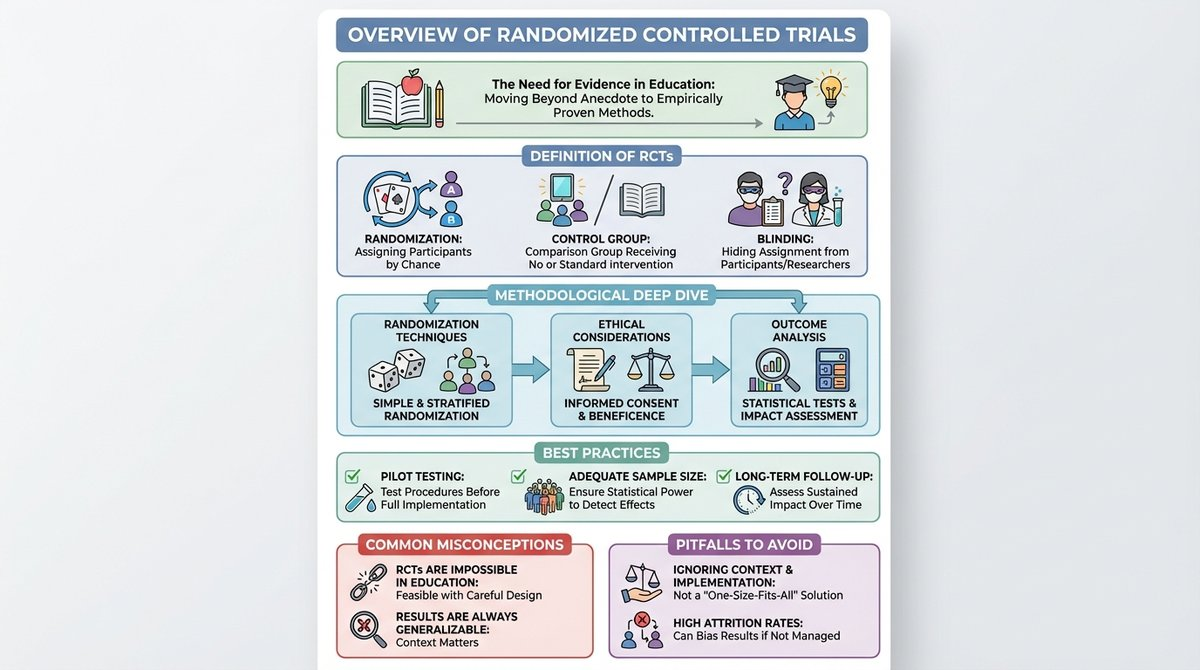
Randomized Controlled Trial (RCT): An RCT is a scientific study designed to determine the effectiveness of an intervention or treatment. Participants are randomly assigned to different groups to eliminate selection bias, allowing for a reliable comparison between groups.
Key Components:
-
Randomization: Participants are randomly assigned to the treatment or control group, ensuring each participant has an equal chance of being placed in either group.
-
Control Group: This group remains unexposed to the intervention, acting as a baseline against which the treatment group's outcomes are measured.
-
Blinding: To avoid bias, ideally neither participants nor researchers know who belongs to which group during the study (double-blinding).
Purpose: RCTs aim to provide robust evidence on the effectiveness of educational interventions by confirming causal relationships beyond correlation.
Analogously, consider an RCT as comparing two competing educational resources by flipping a fair coin to decide where each student starts. This randomness ensures that any observed difference in performance is truly due to the resource, not other factors.
Methodological Deep Dive
Let's delve deeper into the structure and execution of RCTs. While the basic setup seems straightforward, achieving precision in educational RCTs involves attention to detail, particularly considering the diverse educational contexts and learner needs.
1. Randomization Techniques
Randomization can occur at different levels, such as individual students or entire classes, and can be simple or stratified to balance participant characteristics across groups. For instance, stratified randomization might ensure both groups have similar distributions of students with varying proficiency levels.
2. Ethical Considerations
RCTs in education must navigate ethical limitations—like providing fair opportunities to all participants and ensuring no harm—since all educational innovations should ultimately benefit learners. Consent and debriefing are vital to maintaining ethical rigor and participant rights.
3. Analyzing Outcomes
The analysis often involves statistical methods to compare outcomes, like improvement in test scores, between the treatment and control groups. A common pitfall is not accounting for external variables that could influence results, such as differences in facilities or teaching staff between classrooms.
Best Practices in Conducting RCTs:
-
Pilot Testing: Conduct a trial run with a smaller group to refine the study design and materials.
-
Adequate Sample Size: Ensure the study includes enough participants to reliably detect an effect.
-
Long-Term Follow-Up: Assess the intervention's sustainability by following up with participants over time.
Common Misconceptions:
- RCTs are only for drugs and healthcare. Contrary to this belief, RCTs are equally applicable to educational practices, providing insights into what truly works in the classroom setting.
Pitfalls to Avoid:
-
Insufficient Randomization: Failing to properly randomize can introduce bias, compromising the study's integrity.
-
Ignoring Contextual Factors: Educational settings are complex, and failing to account for these dynamics can skew results and reduce external validity.
Illustrative Educational Examples
Example 1: Flipped Classroom Evaluation
Consider a trial where students are assigned to a traditional lecture (control) or a flipped classroom model (treatment). In the flipped setting, students access recorded lectures at home and use class time for interactive activities. Outcomes such as engagement levels, test scores, and retention rates are closely monitored.
Impact & Limitations:
-
Impact: Provides measurable data on engagement and learning improvements.
-
Limitations: Contextual factors like students' self-discipline or access to technology can influence results.
Example 2: Digital Learning Platforms
Another RCT might compare a new digital learning tool against traditional learning methods. Participants are randomly placed in groups using digital platforms or conventional resources in math classes. Success is measured through assessments and student feedback.
Impact & Benefits:
-
Impact: Offers concrete evidence on digital tools' effectiveness compared to traditional methods.
-
Benefit: Helps educators make informed decisions about resource allocation.
Pulling Together Key Insights
RCTs offer a robust framework for determining the educational effectiveness of interventions, helping stakeholders make evidence-based decisions. By understanding their structure and limitations, educators can better appreciate their application in transforming educational practices.
Next, we'll build on this by exploring Importance of RCTs in Educational Research and delve into why these trials hold critical value in determining educational success.