

Connecting Concepts to Future Learning
- View
Why connected knowledge matters in healthcare robotics
A hospital is preparing to introduce a mobile robot that transports medications between the pharmacy and nursing units. The robot must navigate busy corridors, recognize temporary obstacles, interact safely with staff, and deliver the correct container to the correct location. Although each capability can be studied separately, the robot succeeds only when those capabilities work together as one dependable system.
This is especially important in healthcare, where an isolated technical success may still produce an unsafe clinical outcome. A highly accurate vision model cannot compensate for weak access controls, and efficient navigation cannot compensate for delivering medication to the wrong destination. Learning robotics, machine learning, and artificial intelligence therefore requires more than memorizing individual terms. It requires understanding how concepts connect, depend on one another, and support future learning.
The medication-delivery scenario will serve as a recurring reference point throughout this lesson. By tracing how sensing, data, models, actions, evaluation, and human oversight fit together, you will develop a mental framework for approaching more advanced topics without treating them as disconnected technologies.
A working vocabulary for connected systems
A conceptual framework is an organized way to understand how ideas relate. In robotics ML and AI, a framework helps answer questions such as: What information enters the system? How is that information interpreted? Who or what makes a decision? What action follows? How is the result evaluated?
Several foundational terms anchor this framework:
-
Robotics: The design and operation of machines that sense their environment, make or receive decisions, and perform physical actions.
-
Artificial intelligence: A broad field concerned with systems that perform tasks associated with perception, reasoning, planning, language, or decision-making.
-
Machine learning: A branch of AI in which models learn patterns from data instead of relying entirely on manually written rules.
-
Model: A computational representation that transforms input data into a prediction, classification, recommendation, or control signal.
-
Autonomy: The degree to which a system can perform tasks without immediate human direction.
These terms overlap, but they are not interchangeable. A robot may use no machine learning at all, relying instead on fixed rules and traditional control methods. A machine learning model may operate without a robot, such as a model that analyzes medical images, while a healthcare robot may combine learned models with rules, sensors, mechanical components, and human approval.
The distinction becomes clearer when applied to the medication-delivery robot. Its wheels, motors, chassis, and sensors belong to the robotic system. A model that distinguishes a person from an empty cart is an example of machine learning, while the broader process of interpreting the environment and selecting a safe response falls under AI. Autonomy describes how much of the delivery the robot can complete before a person must intervene.
| Category | Robotics | Machine learning | Artificial intelligence |
|---|---|---|---|
| Primary focus | Physical interaction with the environment | Learning patterns from data | Perception, reasoning, planning, and decision-making |
| Typical input | Sensor readings and operator commands | Training data and new observations | Data, rules, model outputs, and contextual information |
| Typical output | Movement or another physical action | A prediction, classification, or score | A decision, plan, response, or recommendation |
| Healthcare example | Transporting supplies through a hospital | Classifying an object detected in a corridor | Selecting whether to stop, reroute, or request help |
| Key limitation | Hardware cannot determine appropriate behavior by itself | A learned pattern may fail in unfamiliar conditions | An intelligent decision still depends on reliable data, objectives, and safeguards |
The most useful perspective is not to ask whether a system is “robotics,” “ML,” or “AI.” Instead, ask what role each area plays within the complete workflow. This systems-oriented view creates a stronger foundation for future technical learning.
The sense–interpret–decide–act loop
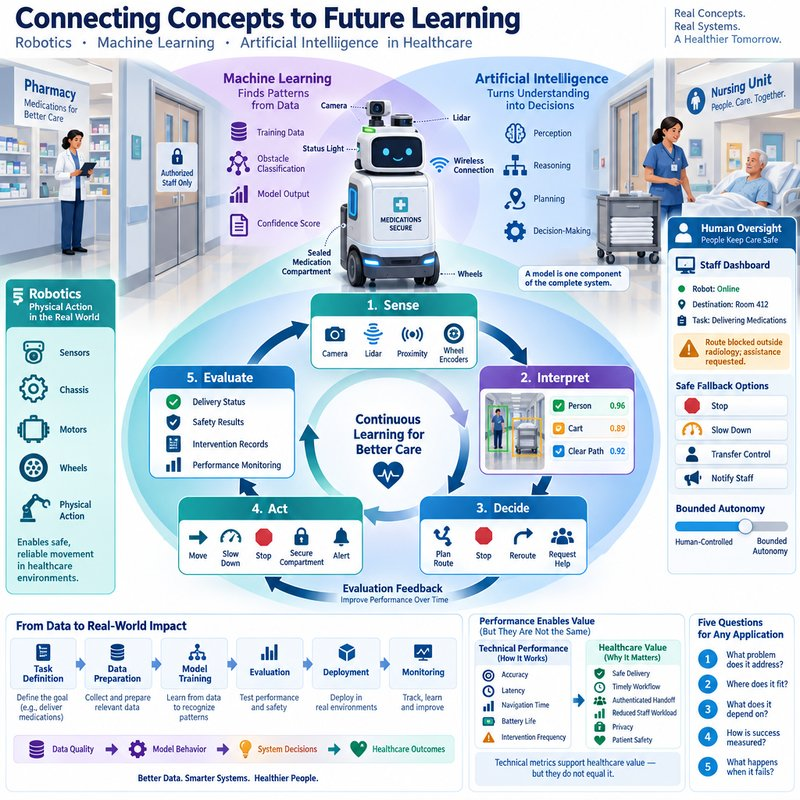
Most intelligent robots can be understood through a recurring loop: sense, interpret, decide, act, and evaluate. The robot senses conditions through devices such as cameras, lidar, microphones, encoders, force sensors, or proximity sensors. It then interprets those signals to estimate what is happening in the environment.
Interpretation transforms raw signals into meaningful representations. A camera produces pixels, not an automatic understanding of “nurse,” “patient,” or “blocked hallway.” Computer vision, sensor processing, and machine learning may convert those pixels into object labels, locations, confidence scores, or movement estimates. If interpretation is inaccurate, every later stage may be affected.
The decision stage selects a response based on the interpreted information, the robot’s goal, and its operating constraints. A delivery robot that detects an obstacle might stop, wait, plan another route, or request assistance. The correct choice depends not only on what the obstacle is, but also on factors such as corridor rules, urgency, available space, and safety requirements.
Action turns the decision into physical behavior. Motors may reduce speed, change direction, open a compartment, or activate an alert. Evaluation then determines whether the action achieved the intended result, allowing the system or its human operators to make corrections and maintain records.
[[flowchart-placeholder]]
This loop is useful because future topics can be placed within it. Sensor fusion improves sensing and interpretation, path planning supports decision-making, control systems manage action, and performance monitoring supports evaluation. Instead of becoming a collection of isolated terms, new knowledge gains a clear position in the overall system.
A major misconception is that the machine learning model is the robot’s complete “brain.” In practice, a model usually performs a limited function within a much larger architecture. Rules, maps, control software, safety interlocks, hardware limits, user interfaces, and human procedures all contribute to the robot’s behavior.
From data to behavior
Machine learning begins with data, but data does not move directly from storage into safe behavior. Developers first define the task and identify what information represents successful performance. They then collect, label, prepare, and divide data before selecting and training a model.
Consider a model that helps the delivery robot identify obstacles. Training examples might contain corridor images labeled with categories such as person, cart, door, equipment, or clear path. The model learns statistical patterns associated with those labels, but it does not develop a human understanding of hospital operations. Its performance remains tied to the quality, relevance, and coverage of the examples it encounters.
After training, developers evaluate the model on data that was not used to fit it. This step estimates whether the model can generalize, meaning that it can apply learned patterns to new but relevant situations. A model that performs well on familiar training images but poorly on new hospital floors may have overfit the training data rather than learned sufficiently transferable patterns.
Deployment introduces another transition: a promising model becomes one component of a real operational system. Camera position, lighting, network delays, processor capacity, cleaning procedures, and changes in the hospital environment can all affect performance. The model’s output must also be translated into a safe robotic response, often through additional software and explicit control rules.
| Stage | Main question | Healthcare robotics example | Common failure |
|---|---|---|---|
| Task definition | What should the system accomplish? | Detect corridor obstacles early enough to stop safely | Defining success only as high model accuracy |
| Data preparation | Does the data represent operating conditions? | Include different floors, lighting conditions, uniforms, carts, and patient mobility aids | Collecting data from one highly controlled corridor |
| Model training | Can the system learn useful patterns? | Learn visual features associated with people and objects | Learning irrelevant background details |
| Evaluation | Does performance transfer to unseen data? | Test on different shifts and hospital areas | Reusing training examples as evidence of success |
| Deployment | Does the complete system work safely? | Connect detections to speed control and stopping behavior | Ignoring delays between detection and physical action |
| Monitoring | Does performance remain acceptable over time? | Review missed detections, unnecessary stops, and interventions | Assuming the model will remain reliable indefinitely |
This progression establishes an important cause-and-effect relationship. Data quality influences model behavior, model behavior influences system decisions, and system decisions influence people and clinical workflows. A weakness early in the chain can therefore produce consequences far beyond a single incorrect prediction.
The best practice is to evaluate the complete chain rather than celebrating one technical metric. Accuracy may be useful, but it does not show whether an error occurred near a patient, delayed a medication delivery, or triggered a safe fallback. Healthcare applications require performance to be interpreted in context.
Technical performance and clinical value
A robotics project can meet an engineering target without creating meaningful healthcare value. For example, a robot may complete 95 percent of assigned deliveries but require frequent staff assistance at elevators. The completion rate appears strong, yet repeated interruptions may increase workload rather than reduce it.
Technical metrics describe system behavior. They may include prediction accuracy, task completion rate, navigation time, localization error, response latency, battery duration, or intervention frequency. These measures help teams diagnose performance and compare system versions, but they do not automatically explain clinical or operational impact.
Healthcare outcomes answer broader questions. Does the system reduce delays? Does it decrease repetitive transport work? Does it preserve patient privacy? Can staff understand when intervention is required? Does it fit infection-control procedures and emergency operations?
The connection between technical and healthcare outcomes is rarely one-to-one. A slightly faster robot may provide little benefit if staff must reorganize their work around its schedule. A slower robot may create greater value if it operates predictably, communicates clearly, and reduces interruptions.
| Dimension | Technical perspective | Healthcare workflow perspective |
|---|---|---|
| Success | The robot completes the programmed task | The task supports safe, timely, and appropriate care |
| Error | A prediction or movement differs from the expected value | The difference creates delay, confusion, risk, or additional work |
| Efficiency | The robot uses less time, energy, or computation | Staff and patients experience a smoother process |
| Reliability | Performance remains consistent under defined conditions | Staff can safely depend on the system during real operations |
| Improvement | A metric increases after a technical change | The change produces a meaningful operational or clinical benefit |
A common pitfall is metric substitution: optimizing a convenient measurement as though it fully represents the real goal. If developers optimize only travel time, the robot may move in ways that feel abrupt or disruptive. If they optimize only obstacle-detection sensitivity, the robot may stop so frequently that staff stop using it.
Best practice requires a combination of measures. Technical metrics reveal how the system behaves, operational metrics reveal how it affects work, and safety measures reveal the consequences of failure. Human feedback adds information that may not appear in system logs, such as whether alerts are understandable or whether the robot blocks access to clinical equipment.
Human oversight as part of the design
Human oversight is not simply a backup added after automation is complete. It is a designed relationship between people and the system, including who supervises the robot, what information they receive, when they intervene, and how responsibility is transferred. The right level of oversight depends on task risk, system capability, environmental complexity, and the consequences of failure.
A low-risk transport robot may operate independently for long periods but request help when it cannot enter a secure area. A robot involved in direct patient contact may require closer supervision, stricter action limits, or approval before specific actions. Autonomy is therefore better understood as a spectrum than as a yes-or-no property.
Effective oversight requires observability. Staff need enough information to understand the robot’s state, destination, task status, and reason for requesting assistance. An error message such as “failure code 47” provides little practical support, while “route blocked outside radiology; assistance requested” makes the situation easier to assess.
Oversight also requires an effective fallback. If a model has low confidence, a sensor fails, or the environment differs from expected conditions, the system needs a safe response. Depending on the task, that response may be to stop, slow down, transfer control, return to a docking station, or notify a designated staff member.
| Autonomy pattern | Robot’s role | Human role | Appropriate use |
|---|---|---|---|
| Human-controlled | Executes direct commands | Continuously directs actions | Unfamiliar, highly variable, or high-risk tasks |
| Human-approved | Recommends or prepares an action | Reviews and authorizes the action | Tasks where professional judgment remains essential |
| Human-supervised | Performs routine actions independently | Monitors and intervenes when needed | Structured workflows with reliable exception handling |
| Bounded autonomy | Acts independently within predefined limits | Defines boundaries and handles exceptions | Repetitive tasks in mapped, controlled environments |
A typical misconception is that more autonomy always indicates a more advanced or valuable system. In healthcare, appropriate autonomy matters more than maximum autonomy. A system that reliably recognizes its limits and requests assistance may be safer and more useful than one that attempts every situation independently.
Another pitfall is assuming that a human can always correct automation instantly. Staff may be busy, distant, or uncertain about what the robot is doing. Good design gives people timely alerts, understandable information, sufficient decision time, and clear authority to stop or redirect the system.
Example: delivering medication across a hospital
The medication-delivery robot receives a request to carry a sealed container from the pharmacy to a secure nursing unit. The order-management system supplies the destination and associates the task with the correct container, while access controls determine who may load and retrieve it. Before moving, the robot confirms that its compartment is secured and that its sensors and battery meet operating requirements.
During travel, the robot combines map information with current sensor readings. Its localization system estimates position, its perception components detect obstacles, and its planning software selects a route. When a linen cart blocks the usual corridor, the robot must connect perception to action: identify that the route is obstructed, determine whether another approved path exists, and move without entering restricted or unsuitable areas.
At the destination, the robot does not simply open its compartment for the nearest person. The workflow must verify the authorized recipient and record the handoff. This final step illustrates how cybersecurity, identity management, physical robotics, and healthcare procedure converge around a single delivery task.
The impact may include fewer repetitive transport trips for pharmacy or nursing staff and more consistent tracking of delivery status. The limitations are equally important: the robot cannot independently resolve every access problem, determine the clinical urgency of a medication, or replace professional verification. Its value comes from handling a defined logistical task while preserving human responsibility for medication decisions.
A robust implementation follows several connected steps:
- Define the workflow goal: Specify the items, locations, users, timing requirements, and conditions under which robotic delivery is appropriate.
- Translate the goal into system functions: Identify navigation, authentication, compartment security, status communication, and exception handling requirements.
- Set operating boundaries: Establish approved routes, speed limits, restricted areas, and situations requiring assistance.
- Evaluate the complete process: Measure delivery completion, delays, interventions, secure handoffs, and effects on staff workload.
- Monitor and improve: Review incidents, environmental changes, user feedback, and repeated failure patterns.
The key connection is that no single AI model guarantees a successful delivery. Safe performance emerges from the coordination of technical components and organizational processes. This systems view prepares learners to examine future methods according to where they fit, what they depend on, and what consequences they create.
Example: assisting with patient rehabilitation
A rehabilitation robot may help a patient repeat a guided arm movement after injury or surgery. Sensors measure position, speed, and force, while control software regulates the robot’s movement. A machine learning component might estimate whether the patient is completing the movement independently or predict when assistance should be adjusted.
The process begins with a clinician-defined therapeutic goal. The system then gathers relevant movement data, estimates the patient’s state, and applies assistance within approved limits. After each movement, performance information can be recorded for clinical review, connecting robotic interaction to the broader rehabilitation workflow.
Suppose the system detects that the patient’s movement has slowed. Several interpretations are possible: the patient may be fatigued, experiencing discomfort, losing attention, or intentionally moving carefully. A model trained only on movement speed cannot determine the full clinical meaning of the change, so the robot should not make unrestricted therapeutic decisions from that signal alone.
The impact may include consistent repetition, detailed movement records, and adaptive physical support. However, benefits depend on appropriate patient selection, clinician oversight, equipment setup, and clear stopping conditions. Limitations include imperfect interpretation of patient intent, differences between individuals, and the inability of sensor data to capture every relevant clinical factor.
This example demonstrates three layers of connection:
-
Technical connection: Sensors, models, controllers, and mechanical components must coordinate in real time.
-
Clinical connection: Robotic actions must remain aligned with a clinician’s rehabilitation plan and safety limits.
-
Human connection: The patient and clinician need understandable information and reliable control over the session.
The best practice is to treat the system’s estimate as one source of information, not as a complete clinical judgment. Designers should define what the robot may adjust automatically, what requires clinician approval, and what conditions require an immediate stop. This division of authority allows automation to support care without assigning it responsibilities beyond its evidence or design.
A durable framework for future topics
As new concepts appear, they can be organized with five questions. First, what problem does the concept address? A navigation method, for example, addresses a different problem from an object-classification model. Defining the problem prevents tools from being treated as solutions merely because they are technically impressive.
Second, where does the concept fit in the system? It may support sensing, interpretation, decision-making, action, evaluation, or human interaction. Some concepts span multiple stages, but identifying their primary role helps clarify their inputs and outputs.
Third, what does the concept depend on? A learned model may depend on representative data, while a control system may depend on reliable state estimates and properly functioning actuators. Dependencies matter because failures often originate outside the component where their effects become visible.
Fourth, how should success be measured? Technical measurements should connect to workflow, safety, and human outcomes. A metric is useful when it provides evidence about a defined goal, not simply because it produces a convenient number.
Fifth, what happens when the concept fails? This question reveals the need for boundaries, monitoring, human oversight, and fallback behavior. In healthcare robotics, understanding failure is part of understanding the technology itself.
| Guiding question | Purpose | Medication-delivery example |
|---|---|---|
| What problem does it address? | Defines the actual need | Reducing repetitive, trackable transport work |
| Where does it fit? | Locates the concept in the system | Object detection supports environmental interpretation |
| What does it depend on? | Reveals prerequisites and failure sources | Reliable sensors, relevant data, and adequate lighting |
| How is success measured? | Connects performance to value | Safe, timely, authenticated delivery with manageable intervention |
| What happens when it fails? | Establishes safeguards | Stop safely, protect the container, and notify staff |
This framework reduces cognitive overload because it gives future information a stable structure. Instead of asking, “How do I memorize another method?” you can ask, “What role does this method play, and how does it affect the complete healthcare system?” That shift supports deeper understanding and more responsible technical reasoning.
A connected foundation
-
Robotics, ML, and AI are related but distinct: Robotics performs physical work, machine learning identifies patterns from data, and AI supports broader perception and decision-making.
-
Intelligent behavior emerges from a system: Sensing, interpretation, decisions, actions, evaluation, and human procedures must work together.
-
Technical performance is not the same as healthcare value: Models and robots must be judged by their effects on safety, workflow, staff, and patients.
-
Appropriate autonomy includes clear boundaries: Human oversight, understandable status information, and safe fallbacks are essential design elements.
You now have a reusable way to organize robotics ML and AI concepts without viewing them as isolated technologies. By tracing each concept’s role, dependencies, measurements, and failure consequences, you can approach increasingly complex healthcare applications with confidence and a strong systems perspective.