

Reviewing Healthcare Robotics and AI
- View
Reviewing Healthcare Robotics and AI [20 minutes]
A technology decision at Riverside Health
Riverside Health System, a fictional regional care network, is considering several new technologies: a robotically assisted surgical platform, an autonomous blood-draw device, an AI system that analyzes retinal images, and a rehabilitation robot for patients recovering from stroke. Each promises greater precision, faster service, or more consistent care. Yet the hospital cannot evaluate them by asking only, “Does it use AI?” or “Is it a robot?” Leaders must understand what the technology does, how independently it acts, and where clinical responsibility remains.
This distinction matters because healthcare robotics and AI are no longer limited to research laboratories. The U.S. Food and Drug Administration, or FDA, describes robotic medical devices as systems that improve, assist, or perform healthcare tasks, including surgery, diagnosis, and rehabilitation. As of September 2026, the FDA reported that it had authorized more than 1,600 AI-enabled medical devices for marketing in the United States. (fda.gov)
These technologies can extend human capabilities, but they also introduce risks involving physical safety, data quality, automation bias, cybersecurity, and unclear accountability. A useful review therefore begins with a simple principle: healthcare robotics provides physical capability, AI provides computational capability, and safe clinical care depends on how both capabilities fit into a human-managed system.
The essential vocabulary
Robotics is the design and use of machines that sense, move, or act in the physical world. A healthcare robot may position an instrument, support a patient’s movement, transport supplies, or perform part of a clinical procedure. It usually combines sensors, control software, mechanical components, and actuators such as motors.
Artificial intelligence, or AI, refers to computational methods that perform tasks commonly associated with human intelligence, such as recognizing patterns, interpreting images, generating predictions, or selecting actions. Machine learning, or ML, is a major branch of AI in which a model learns relationships from data rather than following only manually written rules. Deep learning is a further specialization that uses multilayer neural networks, often for complex data such as images, audio, and physiological signals.
Robotics and AI overlap, but they are not interchangeable. A robot can follow fixed control rules without using ML, while an AI system can analyze medical images without controlling any physical machine. When AI is embedded in a robot, the system may use learned models to interpret sensor data, recognize anatomy, plan motion, or adapt its behavior.
| Category | Healthcare robotics | Healthcare AI and ML | AI-enabled robotics |
|---|---|---|---|
| Primary capability | Produces or supports physical action. | Analyzes information, detects patterns, or generates predictions. | Connects computational decisions to physical action. |
| Typical inputs | Position, force, motion, proximity, or imaging signals. | Images, waveforms, laboratory results, clinical text, or patient records. | Sensor data combined with clinical and environmental data. |
| Typical outputs | Movement, positioning, assistance, or manipulation. | Classification, risk score, alert, recommendation, or generated content. | Adapted movement, automated targeting, or action selection. |
| Example | A surgeon-controlled mechanical arm. | Software that evaluates retinal images for signs of disease. | A blood-draw system that locates a vein and controls needle insertion. |
| Key risk | Collision, excessive force, mechanical failure, or poor positioning. | Bias, false results, data drift, or inappropriate reliance. | A computational error may become a physical safety event. |
A helpful analogy is to think of a healthcare system as a clinical team. AI can act like an analytical specialist, processing information and identifying patterns, while a robot can act like a highly precise pair of hands. Combining the two does not create a human clinician, because the system still lacks the clinician’s complete understanding of the patient, context, values, and ethical responsibilities.
From sensing to clinical action
Most healthcare robotics and AI systems can be understood as a sequence of five functions: sense, interpret, decide, act, and monitor. Sensors first capture information from the patient or environment. Software then converts those signals into an interpretation, such as the location of an instrument, the boundary of an anatomical structure, or the likelihood that an image contains an abnormality.
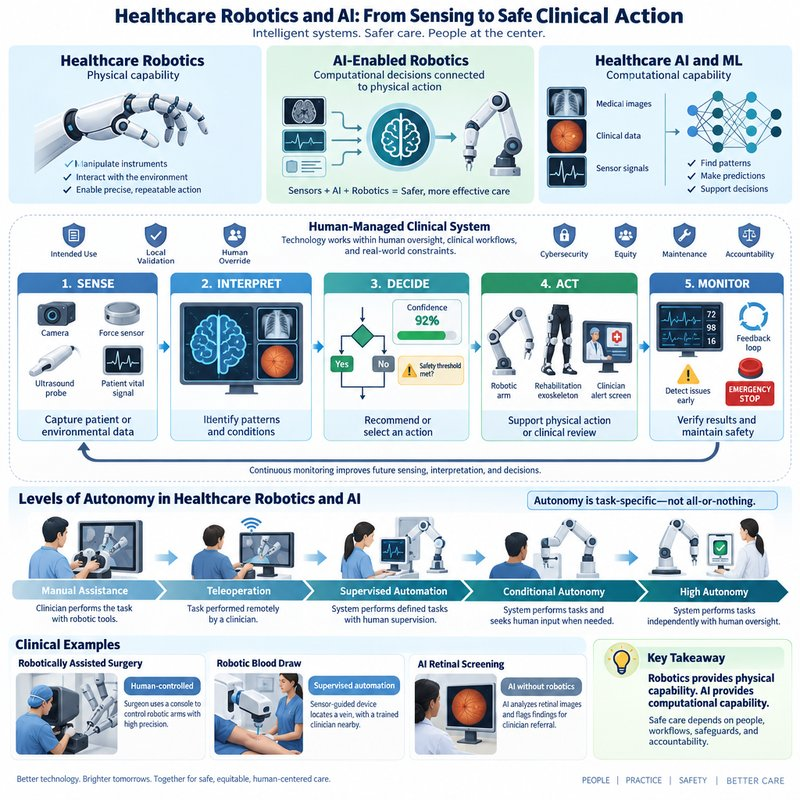
The system next uses that interpretation to support a decision. In a decision-support tool, the output may be an alert shown to a clinician. In a robot, the output may become a movement command, but only within defined limits and under a particular level of human supervision. Monitoring closes the loop by checking whether the action occurred as intended and whether conditions remain safe.
Consider a rehabilitation robot supporting a patient’s leg during walking therapy. Motion sensors estimate the position and timing of the patient’s gait, software compares that movement with a desired pattern, and actuators provide assistance. The therapist still determines the clinical goal, adjusts the session, observes fatigue or discomfort, and decides whether continued use is appropriate.
This sequence reveals an important cause-and-effect relationship: the closer a model’s output is to physical action, the more serious an interpretation error may become. A low-confidence image classification might lead to an unnecessary review, while an incorrect motion estimate could produce unsafe force against a patient. Designers therefore need safety limits, emergency stops, confidence thresholds, and ways for trained users to intervene.
[[flowchart-placeholder]]
A common misconception is that sensing automatically produces understanding. A camera records light, an ultrasound probe records reflected sound, and a force sensor records mechanical pressure; none independently understands the patient. Meaning emerges only after software processes the signal, and that interpretation is valid only under the conditions for which the system was designed and tested.
Human control and levels of autonomy
Autonomy describes how much of a task a system can perform without continuous human control. It is not an all-or-nothing property. A device may autonomously complete one narrow step while requiring a professional to initiate the procedure, supervise the patient, verify the result, or respond to exceptions.
At the lowest level, a robot functions as a controlled tool. Robotically assisted surgical systems, for example, allow a surgeon to control instruments using a console and software, but the device does not independently perform the surgery. The FDA explicitly notes that these systems require direct human control, even though they may improve access to confined anatomy and support minimally invasive procedures. (fda.gov)
At higher levels, systems may automate a defined workflow. An autonomous device could identify a suitable target, perform a limited action, check safety conditions, and stop when those conditions are not met. This still does not mean the device possesses general clinical judgment, because its autonomy remains limited by its intended use, patient population, operating environment, and programmed safeguards.
| Control model | Human role | System role | Main review question |
|---|---|---|---|
| Manual assistance | Directly performs the task. | Stabilizes, measures, or improves precision. | Does the tool reliably enhance human performance? |
| Teleoperation | Continuously controls the device from a console or remote location. | Translates commands into controlled movement. | Can the human maintain awareness and intervene effectively? |
| Supervised automation | Starts the task, monitors operation, and manages exceptions. | Completes defined steps within operating limits. | Are supervision requirements and failure responses clear? |
| Conditional autonomy | Sets the goal and remains available when requested. | Selects and performs actions under specified conditions. | Can the system recognize when conditions exceed its capability? |
| High autonomy | Provides broader oversight rather than continuous control. | Performs most of a defined task independently. | How are rare events, accountability, and safe shutdown handled? |
The best practice is to describe autonomy task by task, rather than calling an entire product “autonomous.” Reviewers should identify who selects the patient, who initiates operation, what the device controls, when it stops, and who verifies the outcome. This approach prevents capability inflation and makes accountability visible.
Trustworthy performance across the care lifecycle
A model can perform well in a laboratory and still create problems in a hospital. Clinical data may come from different scanners, patient populations, documentation practices, or care settings. Workflows also change over time, so a system that once received familiar inputs may later encounter new equipment, protocols, or patterns of disease.
The NIST AI Risk Management Framework organizes trustworthy AI around characteristics such as validity and reliability, safety, security and resilience, accountability and transparency, explainability and interpretability, privacy, and fairness with harmful bias managed. NIST emphasizes that these characteristics should be considered throughout design, development, deployment, use, testing, and evaluation—not merely at the moment a product is released. (nist.gov)
In healthcare, this lifecycle view requires local validation and continuing monitoring. A hospital should confirm that a system works with its patients, devices, staffing patterns, and escalation procedures. Teams should also watch for false positives, false negatives, performance differences among patient groups, user workarounds, unexpected downtime, and changes in input data.
World Health Organization guidance adds a human-centered perspective. Its principles call for protecting autonomy, promoting safety and the public interest, ensuring transparency, fostering accountability, supporting inclusion and equity, and maintaining responsive and sustainable systems. The guidance places responsibility on stakeholders to ensure that AI is used under appropriate conditions by properly trained people. (who.int)
Strong implementation practices include:
-
Define the intended use: Specify the clinical task, users, patient population, environment, and limits.
-
Validate in context: Confirm performance with representative local data and realistic workflows.
-
Preserve human authority: Give trained users clear options to question, override, pause, or stop the system.
-
Monitor after deployment: Track safety events, model errors, workflow effects, and performance changes.
-
Assign accountability: Establish who reviews outputs, handles exceptions, maintains the device, and reports incidents.
The most common pitfall is evaluating only technical accuracy. A system with impressive test results can still fail if alerts reach the wrong person, staff do not understand the output, the robot interrupts infection-control procedures, or maintenance responsibilities are unclear. Clinical effectiveness is produced by the entire sociotechnical system, not by the algorithm or machine in isolation.
Misconceptions that distort technology decisions
One misconception is that robots replace clinicians. Most current healthcare robots perform narrow tasks or extend a professional’s physical capabilities. Even highly automated systems operate within defined boundaries and require human roles such as patient selection, supervision, outcome verification, maintenance, and exception management.
A second misconception is that AI “knows” the correct answer. An ML model estimates an output from patterns in training data, and that estimate may be wrong when data are noisy, incomplete, unfamiliar, or unrepresentative. A confidence score does not eliminate uncertainty; it expresses uncertainty according to the model’s design and calibration.
A third misconception is that regulatory authorization proves superiority over existing care. In the United States, the FDA uses pathways such as 510(k) clearance, De Novo classification, and premarket approval depending on a device’s characteristics and risk. Authorization indicates that the device met the applicable regulatory requirements for its intended use, but organizations must still determine whether it offers meaningful value in their own setting. (fda.gov)
A final misconception is that human oversight guarantees safety. Oversight works only when users have enough time, training, information, and authority to intervene. If a clinician must review hundreds of low-value alerts or cannot understand what triggered a recommendation, the human may become a ceremonial checkpoint rather than an effective safeguard.
Example one: robotically assisted surgery
Riverside’s surgical committee first reviews a computer-assisted surgical system. The platform includes a surgeon console, a bedside cart with mechanical arms and instruments, and supporting hardware and software. During a procedure, the surgeon views the surgical field and controls the instruments; the system translates those commands into precise movements inside the patient.
The review begins by mapping the workflow. The team identifies eligible procedures, surgeon credentialing requirements, operating-room setup, instrument sterilization, emergency conversion procedures, and responsibilities during technical failure. The FDA notes that robotically assisted systems can facilitate minimally invasive surgery and complex work in confined areas, but safe use depends on appropriate procedures and proper training. (fda.gov)
The potential benefits include improved instrument articulation, stable visualization, and access through small incisions. Those capabilities may support clinical goals, but they do not guarantee shorter procedures or better outcomes for every patient. Results depend on the procedure, surgeon experience, patient characteristics, team coordination, and comparison with available alternatives.
The limitations extend beyond the robot itself. Riverside must consider setup time, maintenance, compatible instruments, staff availability, cybersecurity, and the possibility of component, mechanical, image, or display problems. The committee therefore treats the system as a human-controlled clinical platform, not an independent surgeon, and evaluates whether the entire service can use it safely and consistently.
Example two: autonomous robotic blood collection
Riverside then evaluates Aletta, which the FDA authorized through the De Novo pathway on August 19, 2026. The FDA described it as the first standalone robotic device authorized to draw blood from an adult patient’s arm without hands-on operator intervention. It is intended for outpatient settings and operates under the oversight of a supervisor trained in phlebotomy. (fda.gov)
The workflow illustrates how robotics and computational perception combine. The device guides arm positioning, uses near-infrared light and Doppler ultrasound to locate a suitable vein and distinguish it from arteries, and declines to attempt the procedure if it cannot find an appropriate vein. It can then apply a tourniquet, prepare the skin, insert and dispose of the needle, change collection tubes, and place a bandage. (fda.gov)
Human responsibility remains visible throughout the process. A trained phlebotomist initiates the session, remains available to respond to problems, verifies that tubes are collected in the correct order, and checks that they are adequately filled. The device also includes safety responses, such as stopping the procedure if excessive patient movement causes the needle to detach.
The benefit is not simply “automation.” The more precise value proposition is that one trained professional may supervise up to three devices while retaining responsibility for oversight and verification. The limitations include patient eligibility, the need for trained supervision, exception handling, cleaning, maintenance, patient comfort, and integration with labeling and laboratory workflows. (fda.gov)
Example three: AI-supported retinal screening
Riverside’s primary care clinics also consider an AI system for diabetic retinopathy screening. The system analyzes retinal images and automatically detects signs associated with more-than-mild diabetic retinopathy in adults with diabetes who have not previously received a diabetic retinopathy diagnosis. This is AI functioning as a medical device without controlling a physical robot. (accessdata.fda.gov)
The process begins with image acquisition rather than direct diagnosis by the model alone. Staff must capture images of sufficient quality, the system must determine whether the inputs are usable, and the software then applies a deep-learning model to generate an output. The result must connect to a defined referral process so that patients with concerning findings receive appropriate follow-up.
The potential benefit is expanded access to screening in settings where an eye-care specialist is not immediately available. However, the system addresses a specific condition in a specific population; it does not perform a complete eye examination or detect every possible disease. Poor image quality, use outside the intended population, or failure to complete referrals can reduce the real clinical value of technically accurate analysis.
This example clarifies the difference between model performance and care delivery. A correct output helps only if the right patient is screened, the image is usable, the result reaches the responsible professional, and the patient receives follow-up. AI becomes clinically meaningful when it strengthens the complete workflow rather than merely producing a prediction.
A practical framework for reviewing any system
When Riverside compares these technologies, it uses the same set of questions regardless of whether the product is primarily robotic, AI-based, or both. This creates a consistent review process and prevents attention-grabbing features from replacing clinical reasoning.
- What clinical problem is being addressed? Define the patient need and current workflow before examining the technology.
- What does the system sense, predict, or control? Separate data collection, interpretation, decision support, and physical action.
- How autonomous is each task? Identify initiation, supervision, intervention, stopping, and verification responsibilities.
- What evidence supports the intended use? Examine safety, effectiveness, representative data, and relevant operating conditions.
- How will performance be governed over time? Plan training, monitoring, maintenance, incident response, privacy protection, and accountability.
The central question is not whether a technology appears intelligent. The better question is whether it performs a well-defined task safely, reliably, equitably, and usefully within a real care system. That perspective keeps patient outcomes and professional responsibility at the center of innovation.
The foundation for sound evaluation
-
Robotics and AI provide different capabilities: Robotics acts in the physical world, while AI interprets data or generates predictions.
-
Autonomy exists on a spectrum: A system may automate selected steps while humans retain responsibility for initiation, supervision, exceptions, and outcomes.
-
Safe performance depends on the whole workflow: Data, people, equipment, policies, and escalation pathways all shape clinical results.
-
Trust requires lifecycle management: Validation, transparency, equity checks, monitoring, maintenance, and accountability must continue after deployment.
-
Intended use defines the boundary: A system should be evaluated for the patients, tasks, users, and environments it was designed to serve.
Healthcare robotics and AI are most valuable when they extend human capability without obscuring human responsibility. A clear understanding of sensing, decision-making, physical action, autonomy, and governance makes it possible to distinguish meaningful clinical innovation from impressive but poorly integrated technology.
Next, we'll build on this by exploring Connecting Concepts to Future Learning.